
All eight planets orbit the Sun in the same direction because they formed within one rotating disk of gas and dust.
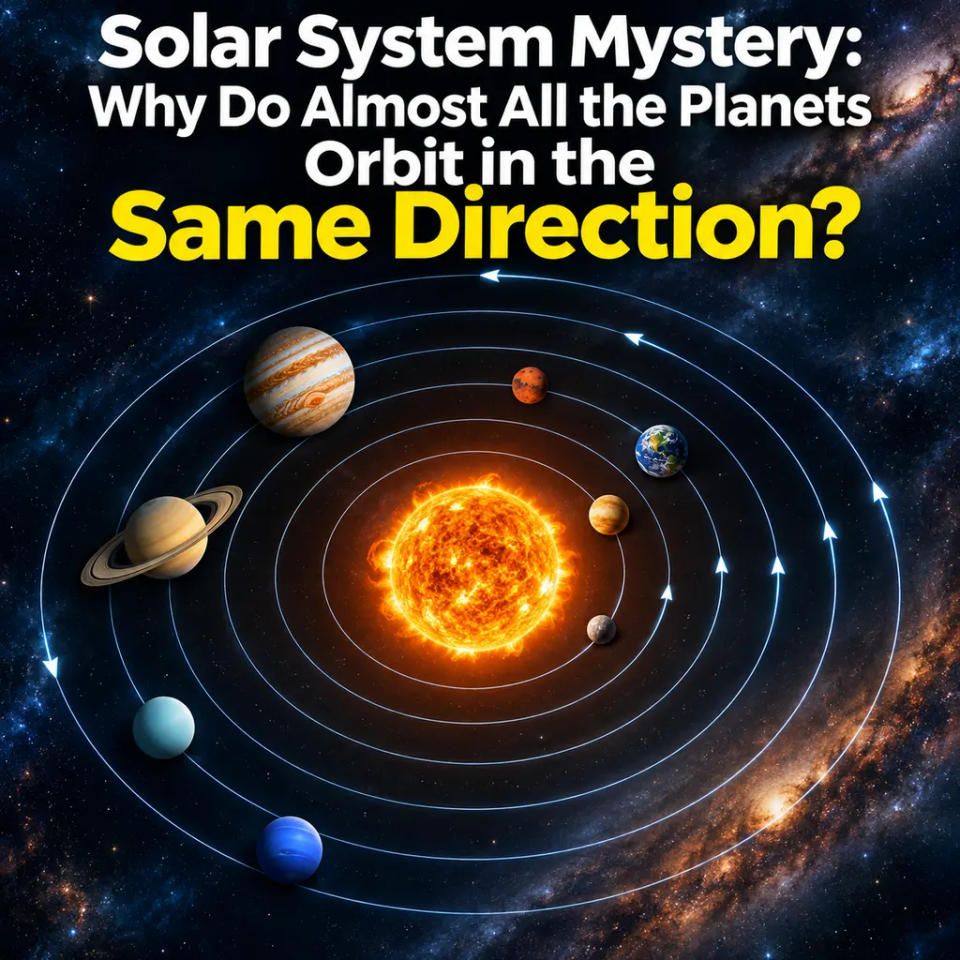
Imagine watching the Solar System from a position high above the Sun’s north pole. Mercury speeds around the Sun, distant Neptune follows its much longer path, and every other planet joins the same cosmic traffic pattern. None of the eight goes around the Sun in the opposite direction. This remarkable agreement is a clue to how our planetary neighborhood was born.
The short answer is that the planets inherited their orbital motion from a single spinning cloud. Gravity, collisions, and the conservation of angular momentum shaped that cloud into a rotating disk roughly 4.6 billion years ago. The planets grew inside it, so their shared direction is a surviving fingerprint of the Solar System’s origin.
Why Do All Eight Planets Move Counterclockwise?
First, direction depends on where you stand. NASA describes the planets’ motion as counterclockwise when viewed from above the Sun’s north pole. Move to the opposite side of the Solar System and the very same motion appears clockwise. Nothing has reversed; only the viewing direction has changed.
All eight recognized planets—Mercury, Venus, Earth, Mars, Jupiter, Saturn, Uranus, and Neptune—travel around the Sun in that shared direction. Astronomers call this broad pattern prograde orbital motion. The planets also occupy orbits that lie close to a common flat surface, known as the ecliptic plane. Their paths are ellipses rather than perfect circles, and the orbital planes are not exactly identical.
There is another important distinction: the planets do not move at the same speed. Mercury completes a circuit in about 88 Earth days. Earth takes about a year, and Neptune takes roughly 165 Earth years. Gravity governs their present-day trajectories, while the shared direction reflects the motion inherited at birth. The agreement is about which way they go, not how quickly they complete a lap.
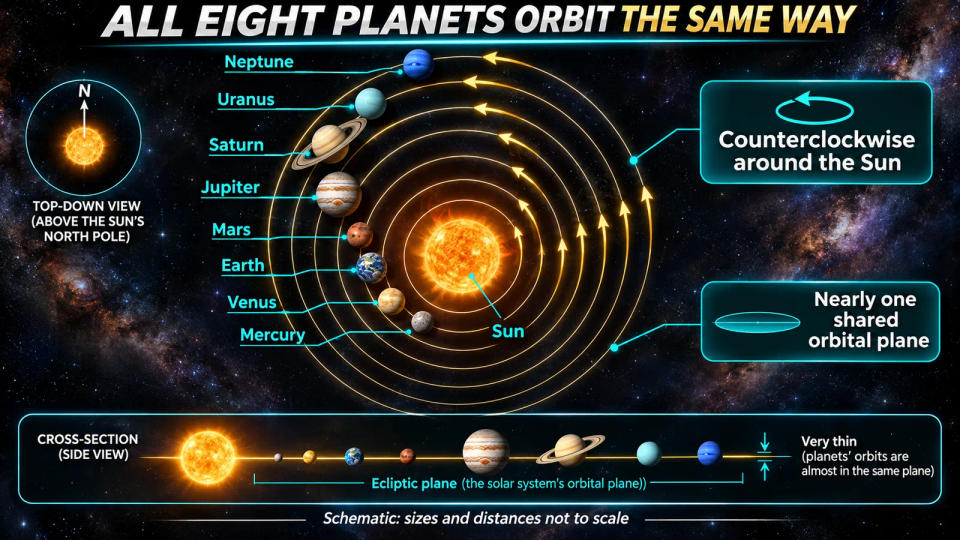
This pattern was historically one of the strongest clues that the Sun and planets formed together. If every planet had arrived independently from a random direction, such a neatly aligned family of orbits would be difficult to explain. A common rotating birthplace makes the arrangement understandable.
How Did One Spinning Cloud Set Every Planet’s Direction?
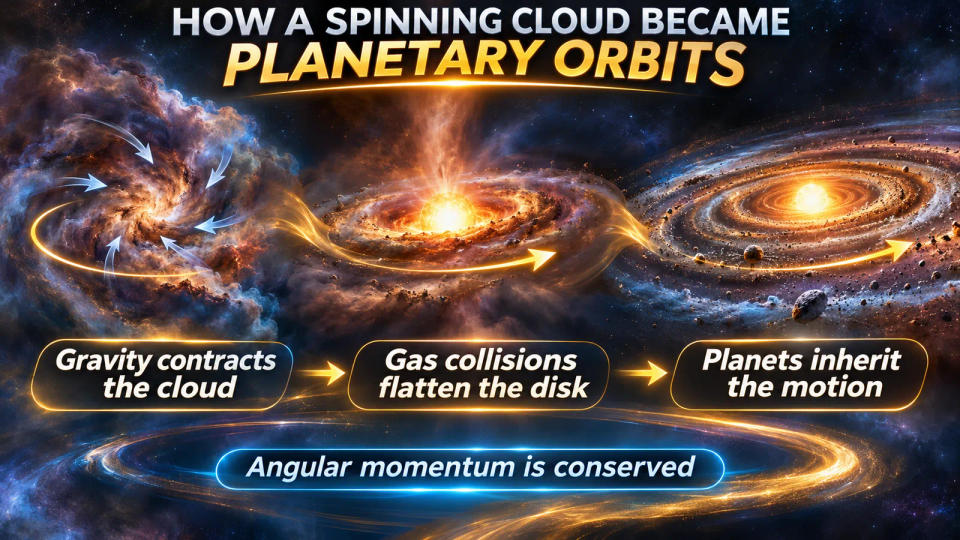
Travel back about 4.6 billion years. Before the Sun shone, the material that became our Solar System existed as part of a vast cloud of gas and dust. A region of that cloud collapsed under gravity. The cloud was not completely motionless: its material had some net rotation, even if that rotation was initially slow.
As the cloud contracted, its rotation became increasingly important. This involves conservation of angular momentum, a basic rule of physics. Think of a figure skater drawing their arms closer to their body and spinning faster. A collapsing cloud is vastly more complex, but the central idea is similar: material moving inward does not simply lose its angular momentum.
Why did the cloud become a disk instead of remaining a spherical swarm? Gas parcels and dust grains interacted and collided. Such interactions could dissipate some of their disordered motion while retaining the system’s overall rotation. Matter therefore concentrated into a flattened, rotating protoplanetary disk around the growing young Sun.
Within that disk, dust particles collided and accumulated into larger bodies. Over time, planet-building objects grew, interacted gravitationally, and helped assemble the planets we know today. Although individual collisions and later orbital shifts could alter details, the overall direction of the disk survived in the planets’ orbits.
Scientists have not photographed the birth of our own Solar System. Instead, they combine meteorite evidence, physical models, and observations of young stars to test this account. NASA documents disks around nearby young stars, while ALMA has measured complex gas movements within the disk surrounding HD 163296. Those observations do not reveal our ancient cloud directly, but they show that the planet-forming environments predicted by the model really exist.
The mechanism explains two features at once: why the planets generally circle in the same direction and why their paths lie near the same plane. It is a stronger explanation than simply saying the Sun’s gravity forces them to orbit counterclockwise. Gravity can support an orbit in either direction; the Solar System’s formation history largely selected the direction we see.
What About Venus, Uranus, and Objects That Go Backward?
Here is the twist hidden inside the headline: all eight planets orbit the Sun in the same direction, not merely “almost all.” The apparent exceptions usually arise from mixing up two different motions. Revolution means traveling around the Sun. Rotation means spinning about a planet’s own axis.
Venus rotates slowly in a retrograde direction, opposite to the usual spin of most planets. Uranus has an extreme axial tilt and effectively spins on its side. Yet both Venus and Uranus still revolve around the Sun in the same direction as Earth. An unusual day-night cycle does not imply a backward orbit around the Sun.
Why are planetary spins less uniform? Planet formation was not a perfectly gentle process. Impacts, gravitational interactions, and—in some cases—tidal effects can modify a planet’s orientation and rotation. The details of Venus’s history remain an active scientific question, so no single impact story should be presented as settled fact.
Some smaller Solar System bodies can follow steeply inclined or retrograde orbits, especially among comets and irregular moons. They are reminders that the young Solar System changed after the original disk formed. But those exceptions are not one of the eight major planets, and they do not erase the shared pattern in planetary revolution.
Conclusion
The planets do not circle in the same direction because the Sun commands clockwise or counterclockwise traffic. Their motion records a shared origin. A collapsing, rotating cloud became a disk; planets assembled from its material; and the disk’s overall orbital direction endured for billions of years.
Next time you picture Jupiter following Earth around the Sun, remember that their journeys are not a coincidence. The planets have very different sizes, temperatures, and orbital periods, but they still move in a common direction inherited from the Solar System’s earliest chapter.
Sources & Further Reading
- NASA Science — Chapter 1: The Solar System
- NASA Science — Planetary Systems
- NASA Astrobiology — How Did Our Solar System Form?
- NASA Science — Orbits and Kepler’s Laws
- NASA Goddard — Imagine the Universe! Solar System Questions
- ALMA Observatory — ALMA Witness Planet Formation in Action
Post a Comment