
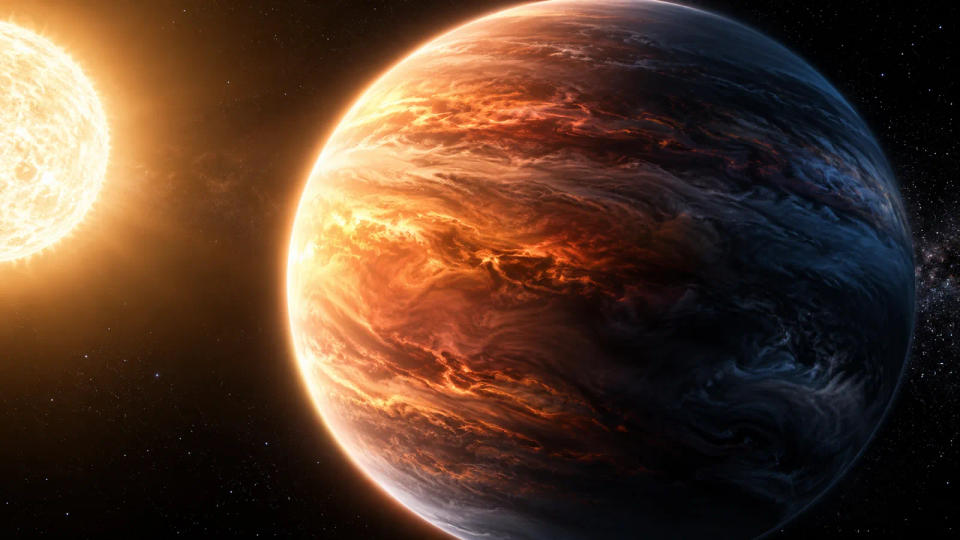
Imagine rain that is not water but liquid metal. On the exoplanet WASP-76b, about 640 light-years from Earth, powerful heating may evaporate iron on the permanent dayside, while winds carry that vapor into cooler darkness where it can condense. That is why astronomers suspect the planet can experience molten-iron rain—but no telescope has photographed individual iron raindrops.
The idea comes from a measurable difference between the two edges of the planet’s atmosphere. Iron vapor was detected near the edge entering night, yet an equivalent signal was missing near the edge emerging from night. This extraordinary clue tells us about conditions on a world so distant that even our best telescopes cannot see its weather directly.
Why WASP-76b Has a Scorching Day Side and a Cooler Night Side
WASP-76b is an ultra-hot Jupiter: a giant planet made mainly of gas, rather than a rocky world with familiar ground under its clouds. NASA lists an orbital period of about 1.8 Earth days, an orbital distance of about 0.033 astronomical units, and a radius roughly 1.85 times Jupiter’s. Its tight orbit puts the planet extraordinarily close to its host star.
The planet is thought to be tidally locked, so essentially the same hemisphere faces its star while the opposite hemisphere faces away. This does not mean its atmosphere stands still. Powerful circulation can shift heat and chemical species around the planet, even though sunlight keeps heating the same general side.
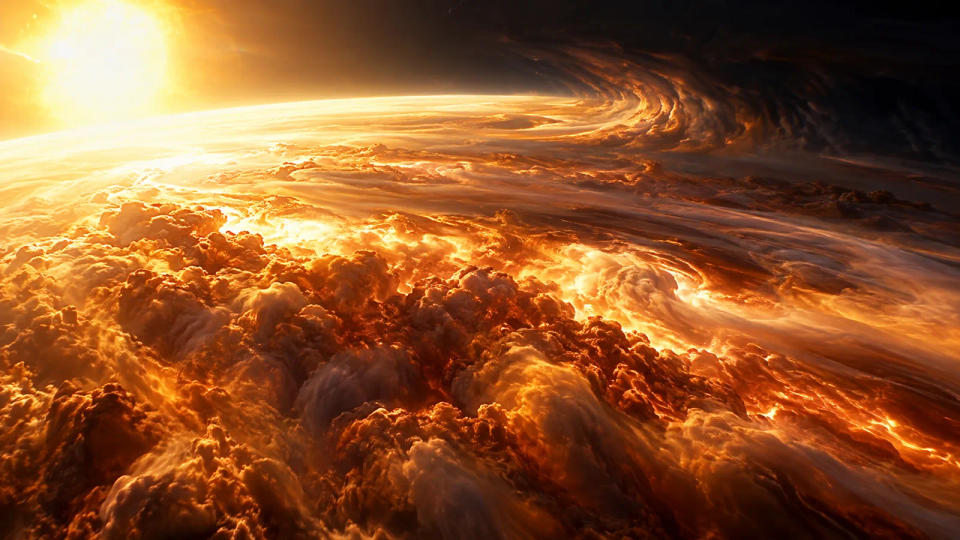
According to the European Southern Observatory, dayside temperatures can exceed 2,400°C, while the cooler nightside can be near 1,500°C. Both are unimaginably hot by human standards. The important factor is the difference: material able to remain gaseous in the hotter region can become unstable and condense when carried into cooler air.
For comparison, the iron in an ordinary metal object remains solid in a typical room because the temperature is much lower. In WASP-76b’s upper atmosphere, conditions are so extreme that neutral iron can exist as a vapor. The dramatic orange clouds in the accompanying scientific reconstruction are illustrative, not a real photograph or a measured map of iron abundance.
How Vaporized Iron Could Become Metal Rain
Think of Earth’s water cycle, but replace water with an element usually found in solid metal. Water evaporates, travels through air, cools, and forms droplets. On WASP-76b, intense stellar radiation supplies the heat needed for iron-bearing material to exist as gas, and atmospheric motion can transport iron atoms toward a darker, cooler region.
As air moves from the day side to the night side, a change in temperature and pressure may let the vapor condense into tiny particles or droplets. Under suitable conditions those droplets could merge, grow, and fall through the atmosphere. The proposal is scientifically motivated, but the exact droplets, their chemical composition, their size, and how much rain falls remain uncertain.

This is not a scenario in which hot iron lands on roads, mountains, or oceans. WASP-76b is a gas giant without a clearly defined solid surface where pools of metal would collect. Material descending into deeper, hotter atmospheric layers may heat up and evaporate again, allowing an ongoing atmospheric cycle without any Earth-like landscape.
Nor should the phrase “molten iron” be confused with a direct measurement of liquid metal. Spectroscopy identifies light absorbed by atoms or molecules; it does not reveal the shape of a falling droplet. The atmospheric image here is an artistically generated reconstruction of a proposed process, not an observation of rain.
What Telescopes Found—and What Remains Unproved
The original clue came from ESPRESSO, a high-resolution spectrograph on the European Southern Observatory’s Very Large Telescope in Chile. During a transit, WASP-76b passes in front of its star, and a small fraction of the starlight filters through the planet’s outer atmosphere. Different atoms absorb particular wavelengths, leaving patterns that astronomers can identify.
In a 2020 Nature paper, David Ehrenreich and colleagues reported a strong signal attributed to neutral iron near the planet’s evening terminator—the border where illuminated air moves toward night. Near the morning terminator, where nighttime air returns toward daylight, they did not observe a corresponding iron absorption signal. Their interpretation was that iron becomes depleted from the observable gas during its nightside passage.
One possible explanation is condensation: iron vapor cools enough to form particles that no longer produce the same atomic absorption signature. That makes the idea of iron rain more than a science-fiction invention. Still, the observations establish an atmospheric asymmetry, not a direct movie of cloud droplets falling.
Subsequent investigations have complicated the simplest picture. A 2024 Astronomy & Astrophysics study by Demangeon and colleagues emphasized that the asymmetry has been reproduced in multiple studies but that its physical origin remains debated. Winds, temperature structure, clouds, and the condensation of other materials may all contribute to what the spectra show.
The European Space Agency also reported in April 2024 a possible “glory” signal: a faint, rainbow-like scattering pattern that might arise from near-spherical cloud droplets. The effect has not been confirmed, and the droplets’ composition is not established. It is therefore not independent proof that iron rain was seen. Instead, it shows how scientists are testing the presence and properties of clouds on WASP-76b with different instruments.
The planet is an excellent reminder that astronomers often reconstruct alien climates from remarkably subtle evidence. The telescope measures changes in starlight. Researchers then compare those changes with physical models and ask which combination of chemistry, winds, and clouds could produce them. Strong models earn confidence when they explain several observations together, not simply because they create a memorable headline.
Conclusion
WASP-76b may rain molten iron because intense permanent daylight can keep iron in vapor form, while atmospheric flow moves it into a cooler nightside where condensation becomes possible. The 2020 iron-absorption measurements support that interpretation, but iron droplets have not been directly observed and newer studies show that the full atmospheric explanation is still being refined.
What we can say with confidence is just as fascinating: the atmosphere of a giant planet hundreds of light-years away changes measurably from one edge to the other. By reading those tiny differences in starlight, astronomers can investigate weather that would be impossible to experience—and learn how planetary atmospheres behave under extreme conditions.
Sources & Further Reading
- European Southern Observatory — ESO Telescope Observes Exoplanet Where It Rains Iron
- Ehrenreich et al. (2020), Nature — Nightside Condensation of Iron in an Ultrahot Giant Exoplanet
- NASA — WASP-76 b Exoplanet Catalog
- Demangeon et al. (2024), Astronomy & Astrophysics — Asymmetry in the Atmosphere of WASP-76 b
- European Space Agency — First “Glory” on Hellish Distant World?
Post a Comment