
A quasar is an extraordinarily bright galactic core powered by hot gas spiraling toward a supermassive black hole.
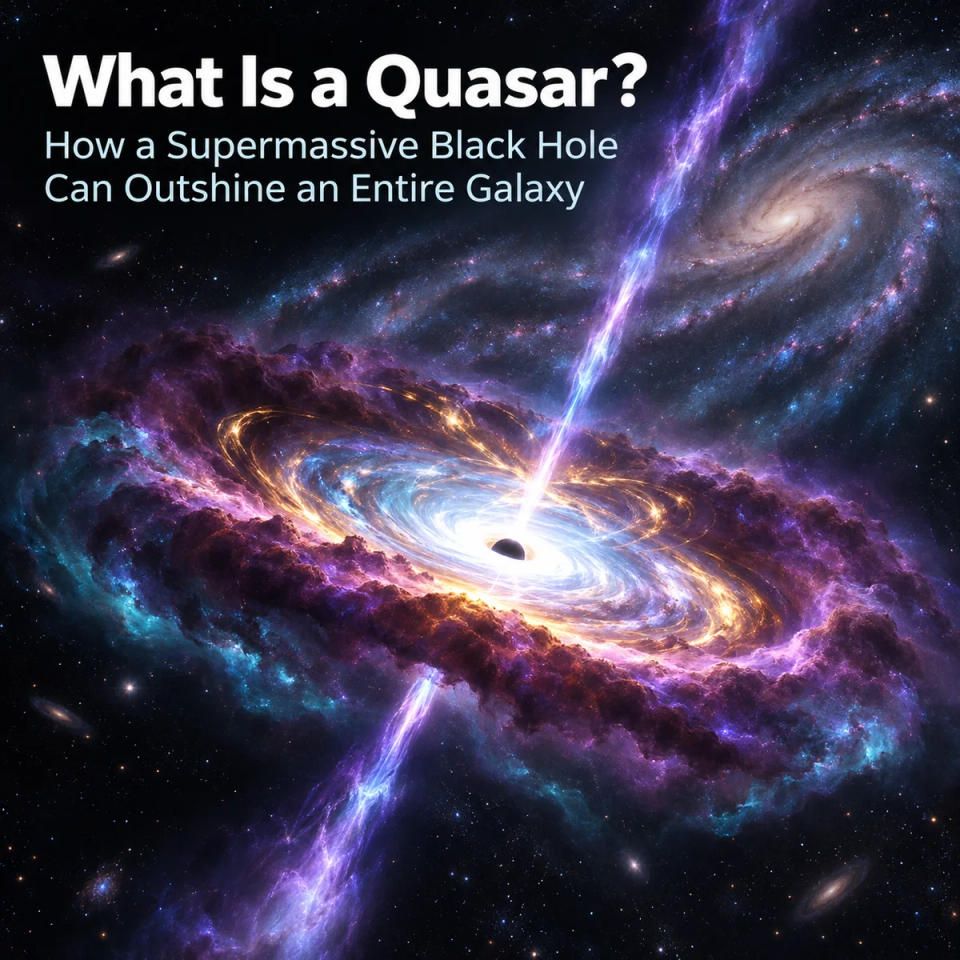
Imagine a light so intense that it drowns out the combined glow of billions of stars. That is what astronomers see in some galaxies with active supermassive black holes: a quasar. The black hole itself is dark, but gas falling toward it can produce a dazzling beacon visible across enormous cosmic distances.
Quasars are not stars, and they are not entire galaxies made unusually bright by ordinary starlight. They are exceptionally luminous galactic centers called active galactic nuclei, or AGN. Understanding the difference reveals how one compact region can dominate the light from a far larger galaxy.
How Does a Black Hole Power a Quasar?
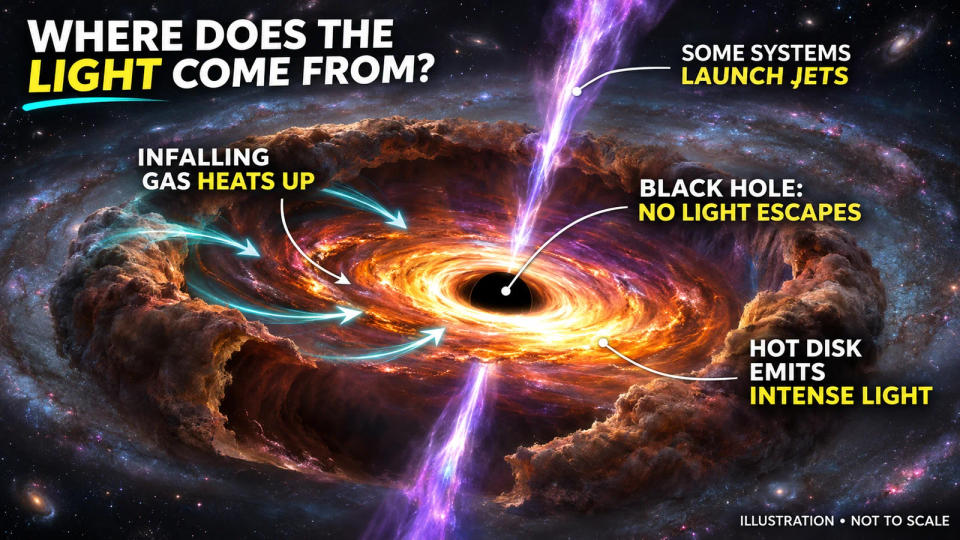
Most large galaxies contain supermassive black holes near their centers. A black hole becomes an active galactic nucleus when enough surrounding material is supplied to its neighborhood. Rather than plunging straight inward, much of that gas settles into a rotating accretion disk, where it orbits the black hole at tremendous speeds.
As gas spirals inward, gravitational energy is converted into heat and radiation. Collisions and processes within the hot, turbulent disk release energy across a wide range of wavelengths, including visible, ultraviolet and X-ray light. In the most powerful systems, the radiation from this relatively compact region can exceed the light produced by the host galaxy's stars.
The distinction matters: the black hole is not shining from inside its event horizon. Light that crosses that boundary cannot escape. The luminous material is still outside the horizon, where it is being accelerated and heated as it moves inward. The great brightness comes from matter on its way toward the black hole, not from light emerging from the black hole itself.
Some active galactic nuclei also launch enormous jets of fast-moving particles along their polar directions. Strong magnetic fields help channel the outflows. Jets can stretch far beyond their parent galaxies, but a visible pair of jets is not a required feature of every quasar. The disk and its surrounding energetic environment are central to the explanation.
The term quasar dates to the discovery of objects that looked almost like stars through early telescopes but emitted unexpectedly strong radio signals. Astronomers called them quasi-stellar radio sources. We now know that the apparent points of light were distant, extraordinarily bright galactic nuclei. The historical name survived even after the physical picture became clearer.
How Can a Quasar Outshine Its Entire Galaxy?
Here is the strange comparison: a galaxy may contain hundreds of billions of stars spread over tens of thousands of light-years, while much of a quasar's visible energy can be produced in a region only light-days to light-years across. An extreme concentration of energy, rather than an enormous glowing size, makes the quasar stand out.
NASA's Hubble quasar overview describes examples that radiate hundreds or even thousands of times the light of their host galaxies. These are extreme cases, not a fixed brightness ratio that applies to every active galactic nucleus. How bright a quasar becomes depends on the black hole's environment and the supply of gas, among other factors.
Its glare can be so intense that the much larger host galaxy becomes hard to distinguish. Astronomers sometimes compare the task to trying to examine something faint beside a car headlight. The surrounding stars have not vanished; the brilliant central source is simply overwhelming their signal in the telescope's image.
A concrete example is 3C 273, a famous quasar about 2.5 billion light-years away. To study structures near this source, NASA's Hubble Space Telescope has used a coronagraph, an optical technique that blocks the bright central light. With some of the glare suppressed, observers can detect fainter material and structures nearby, including features associated with the quasar's environment and jet.
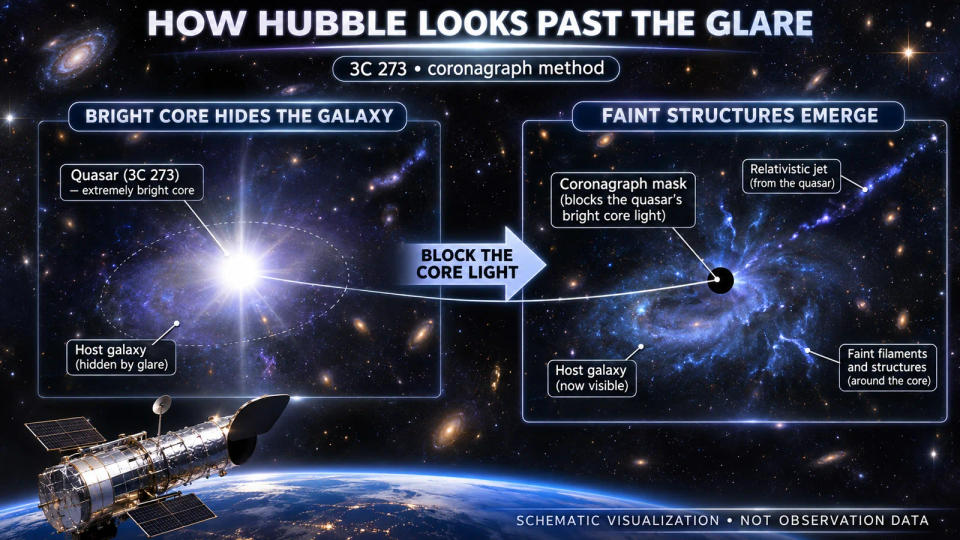
A coronagraph does not turn off the quasar or change the galaxy. It changes what the instrument can measure, much as shielding your eyes from a headlight helps you see the surroundings. The resulting data, combined with spectroscopy and infrared observations, let astronomers separate intense nuclear activity from the light of gas and stars elsewhere in a galaxy.
Why Are Quasars Important for Studying the Early Universe?
Because their light can travel enormous distances, quasars allow scientists to examine galaxies as they existed long ago. Looking farther away also means looking further back in time: light from a distant quasar may have been traveling toward Earth for billions of years. Astronomers use these bright objects to investigate early black-hole growth and the gas between galaxies.
In 2026, the European Space Agency reported that its Euclid mission had identified 31 very early quasars, including two observed from a time when the universe was only about 670 million years old. The result is an observational achievement, but it raises a difficult question: how did some black holes become so massive and energetic so early? Researchers continue to test competing explanations for their rapid growth.
Quasars also affect their surroundings. Radiation, winds and jets from active nuclei can heat or remove gas that would otherwise be available for star formation. This kind of interaction is one reason scientists study the connection between growing black holes and the evolution of galaxies. It does not mean every quasar shuts down all star formation: the outcome depends on the system and the way energy couples to the galactic gas.
The observations remain challenging. Distant objects are faint despite their enormous intrinsic power, and the expansion of the universe stretches their light to longer wavelengths. Instruments such as the James Webb Space Telescope help astronomers examine that redshifted light and separate a brilliant nucleus from its host.
Conclusion
A quasar is one of the most dramatic examples of gravity releasing energy. A supermassive black hole stays dark, while infalling material just outside it becomes so hot and luminous that its small galactic core can overpower the combined starlight around it.
That brightness makes quasars both difficult targets and valuable scientific tools. By blocking the glare, measuring spectra and looking deep into cosmic history, astronomers can study the galaxies that harbor them and test how the universe's largest black holes grew.
Sources & Further Reading
- NASA Hubble — Hubble Quasars
- NASA Webb — What Are Active Galactic Nuclei?
- NASA Webb — How Do We Know There Are Black Holes?
- NASA — Hubble Takes the Closest-Ever Look at a Quasar
- ESA — Euclid Discovers the Most Ancient Quasar in the Universe
Post a Comment