
A magnetar is a city-sized dead star whose magnetic field can be up to 1,000 times stronger than that of a typical neutron star.

Some of the universe's most extreme objects are surprisingly small. A magnetar is a rare kind of neutron star: the collapsed core of a massive star, packed into a sphere about the size of a city. What makes it extraordinary is its magnetic field, which can store enormous energy and power sudden eruptions of X-rays and gamma rays.
A magnetar is not a new star burning fuel like the Sun. It is a stellar remnant, and its behavior offers researchers a natural laboratory for investigating magnetic fields, matter under extreme pressure, and even the physics of empty space.
What Makes a Magnetar Different From an Ordinary Neutron Star?
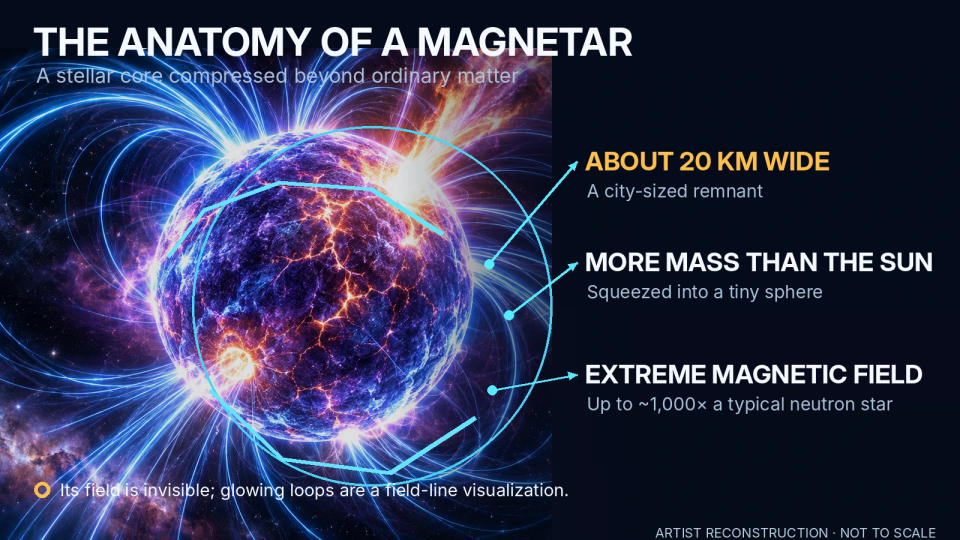
When a sufficiently massive star exhausts the fuel in its core, gravity can overwhelm the pressure that supports it. The core collapses during a supernova, leaving behind a neutron star if a black hole does not form instead. NASA describes these remnants as containing more mass than the Sun within a sphere comparable in size to a major city. A typical diameter is around 20 kilometers (12 miles).
All neutron stars are strongly magnetized, but magnetars occupy an extreme end of the range. NASA explains that a magnetar's field may be up to about 1,000 times stronger than the field of a typical neutron star. In field-strength units, some magnetars reach roughly 1014 to 1015 gauss. The values are not identical for every object, and particular regions can be stronger than a simple global estimate suggests.
The intense field is invisible. Illustrations often show graceful blue loops surrounding the star, but these curves are visual guides to magnetic geometry, not glowing cables hanging in space. Charged particles and radiation can follow or respond to this magnetic structure, allowing astronomers to infer aspects of the field from observations.
Despite their small size, neutron stars are so dense that ordinary comparisons become almost meaningless. Their surfaces and interiors behave very differently from Earth's rocks and metals. Their magnetic fields also interact with their crusts and surrounding particles in ways that cannot be reproduced directly in terrestrial laboratories.
Not every neutron star is a magnetar. And a magnetar is not simply another name for a rapidly flashing pulsar. Some magnetars do emit regular radio pulses, but many are better known for irregular bursts and sustained high-energy activity, rather than the steady, rotation-powered lighthouse pattern associated with ordinary pulsars.
Why Can a Magnetar Unleash X-rays and Gamma Rays?
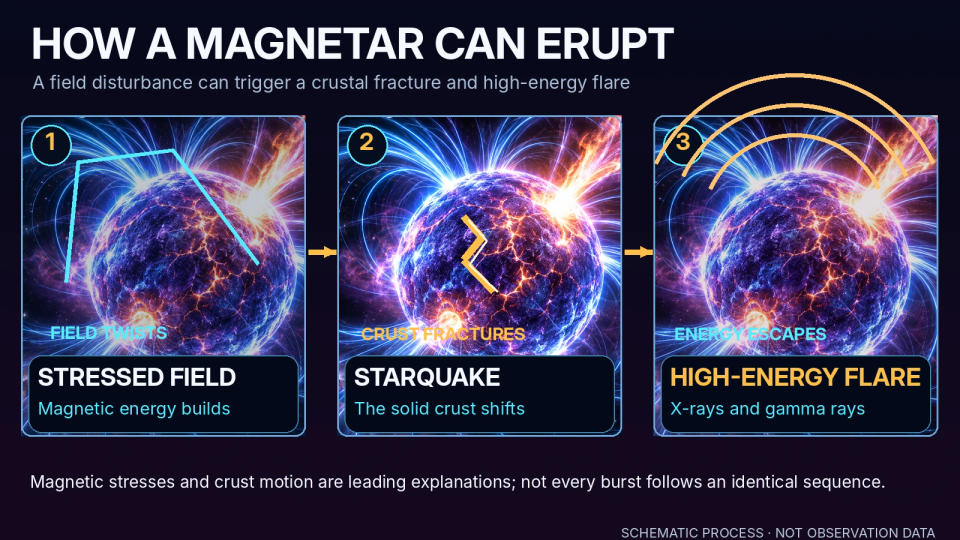
A magnetar's magnetic field can become distorted or twisted, accumulating stress in and around the star. One leading explanation for its violent activity is that magnetic stresses deform or fracture the solid outer crust. These events are often called starquakes. Sudden changes in the magnetic configuration can release energy as powerful X-ray and gamma-ray outbursts.
The details of individual eruptions are still under investigation, and not every flare is proven to follow precisely the same sequence. But the fundamental distinction is clear: many ordinary pulsars are powered mainly by the loss of their rotational energy, while magnetic energy is central to magnetar activity.
Some bursts last only a short time. Other episodes leave the magnetar unusually bright in X-rays for weeks. Giant flares are much rarer still. NASA notes that these high-energy flashes have traveled across our galaxy and caused measurable changes in Earth's upper atmosphere. That is evidence of their extraordinary radiation output, not a prediction of a catastrophe on Earth from every observed burst.
A real observation helps illustrate the process. On August 21, 2024, NASA telescopes detected an outburst from magnetar 1E 1841-045, located within the supernova remnant Kes 73. NASA's Imaging X-ray Polarimetry Explorer, or IXPE, then studied the unusually bright source. The mission measured the polarization of its X-rays, information that helps researchers investigate the radiation-producing regions and magnetic geometry.
How Do Astronomers Measure Such an Extreme Magnetic Field?
Because field lines cannot simply be photographed, astronomers combine several kinds of evidence. A neutron star's slowing rotation can provide an estimate of its large-scale magnetic field. The shape and changing features of its X-ray spectrum can reveal more localized structures. In 2013, ESA reported that observations of magnetar SGR 0418+5729 exposed highly intense fields in small surface regions even though earlier spin-based estimates suggested a comparatively weak overall field.
Researchers also measure polarization, which describes how the oscillations of light are oriented. On August 5, 2026, NASA reported coordinated IXPE, NICER, and radio observations of magnetar 1E 1547.0-5408. The unusually strong X-ray polarization supported an explanation involving vacuum birefringence: a predicted quantum effect in which an extreme magnetic field changes how light propagates through otherwise empty space.
This was compelling evidence for an idea proposed decades ago, not a final declaration that every alternative is eliminated. The team used modeling to interpret the measurements, and additional observations are needed to test the interpretation. Such caution matters when a distant object becomes a test of fundamental physics.
Even the origins of all magnetars are not settled. In 2025, Hubble measurements of SGR 0501+4516 showed that its motion does not point back to the nearby supernova remnant once assumed to be its birthplace. A collapse or merger scenario involving another stellar remnant remains a possibility, not a confirmed history of that magnetar.
These discoveries make magnetars valuable for more than their dramatic explosions. Their radiation can reveal the composition of material around them, the behavior of intensely magnetized plasma, and physical effects that cannot yet be produced in human-made experiments.
Conclusion
A magnetar is an extraordinarily compact neutron star whose magnetic field can be hundreds or even thousands of times stronger than that of many ordinary neutron stars. Its astonishing energy does not come from ongoing normal stellar fusion. It comes largely from the magnetic forces governing its crust and surrounding environment.
Starquakes, bursts, and polarized X-rays have turned these dead stars into some of astronomy's most exciting test sites. The closer scientists study them, the more they learn about both the lives of massive stars and the behavior of matter and light under extreme conditions.
Sources & Further Reading
- NASA Science — Types of Stars
- NASA Science — Neutron Stars Are Weird!
- NASA — IXPE Obtains First X-ray Polarization Measurement of Magnetar Outburst
- NASA — IXPE May Have Proven 90-Year-Old Theory (2026)
- NASA — Hubble Tracks a Roaming Magnetar of Unknown Origin
- ESA — Mysterious Magnetar Boasts One of Strongest Magnetic Fields in Universe
Post a Comment