
A newly discovered neutron star spins 261 times per second, yet its signal hid in 15 years of NASA Fermi data.

Imagine an entire star's collapsed core completing a rotation before you can blink—then doing it another 260 times in the same second. That is the extraordinary behavior of PSR J1622−7204, a newly identified gamma-ray pulsar found by searching archival observations from NASA's Fermi Gamma-ray Space Telescope. The surprising part is not only how fast this dead star spins, but how researchers finally heard its faint cosmic rhythm in data that had been available for years.
The discovery, announced in November 2026, paired an old astronomical question with an unexpected tool from mathematics and computer science. Here is what 261 rotations per second really means, how the signal escaped earlier searches, and why this method could reveal more hidden pulsars.
How Can a Dead Star Spin 261 Times Every Second?
A pulsar is a neutron star: an incredibly dense remnant left when the core of a massive star collapses. Its outer layers may explode in a supernova, while the surviving core becomes a compact object only about the size of a city. Matter is squeezed to extraordinary density, and the remnant can retain a powerful magnetic field and rapid rotation. It is called a “dead star,” but that nickname does not mean it has stopped moving or producing detectable radiation.
One part of the explanation is conservation of angular momentum. Think of an ice skater pulling their arms inward: as the spinning mass becomes more compact, it can rotate faster. A collapsing stellar core undergoes a vastly more extreme change in size. However, this is not a complete explanation for every exceptionally fast pulsar. Many millisecond pulsars are thought to have been spun up further by receiving matter from a companion star in the past.
For PSR J1622−7204, the measured rotation is approximately 261 turns per second, which means each full turn takes about 3.83 milliseconds. The object is reported as isolated today, but the exact sequence of events that brought it to this spin rate has not been established. Its present isolation does not, by itself, prove it never had a companion.
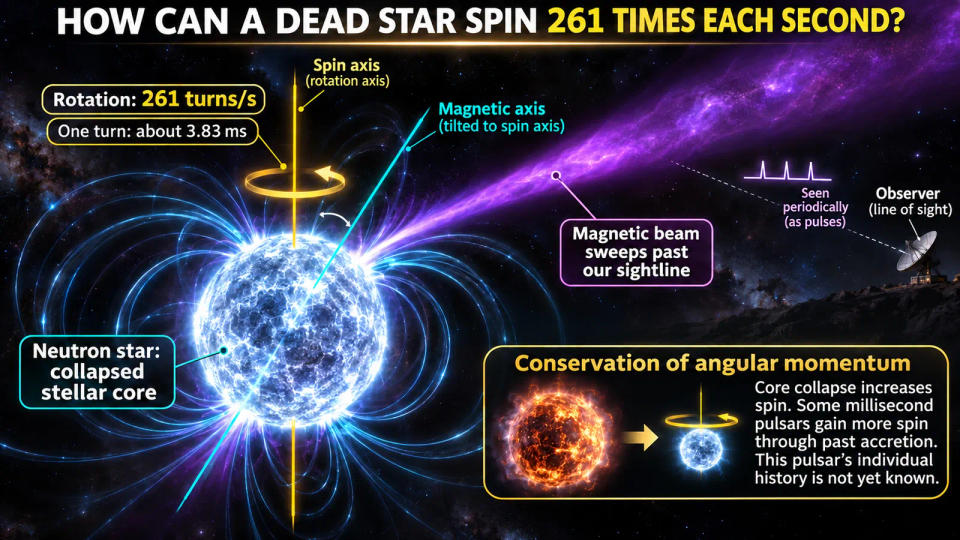
Why call it a pulsar? Its magnetic axis can point in a different direction from its rotation axis. Radiation associated with the magnetic regions forms beams that sweep around as the star spins. If a beam crosses our line of sight, the emission appears to pulse like the flash of a lighthouse. The star does not switch on and off 261 times each second; our viewing geometry creates that repeated signal.
It is also important not to confuse the new discovery with a speed record. Astronomers already know faster-spinning neutron stars. The news here is the previously hidden gamma-ray pulsation and the way it was identified.
How Did NASA's Fermi Data Reveal a Hidden Pulsar?
NASA's Fermi Gamma-ray Space Telescope, launched in 2008, surveys the high-energy sky with its Large Area Telescope. Gamma rays are the most energetic form of light, but an individual pulsar can be extremely faint at these wavelengths. Researchers do not get a neat video of each rotation. Instead, they record the arrival times and directions of widely separated high-energy photons against a busy background of other gamma-ray events.
In this case, the team examined approximately 15 years of publicly available Fermi observations. According to the Max Planck research announcement, the search involved roughly 16,000 gamma-ray photons associated with the target over that long interval. For perspective, the scientific paper explains that a typical relevant signal can yield only about one detectable photon for roughly every 100 million stellar rotations. That makes the repeating pattern easy to bury in noise.
Finding the rhythm requires more than looking for evenly spaced flashes. The search must account for where the source lies in the sky, how rapidly it spins, how that spin changes over time, and how the detector's motion affects photon arrival times. A small mismatch in any of these parameters can smear the signal across years of observations.
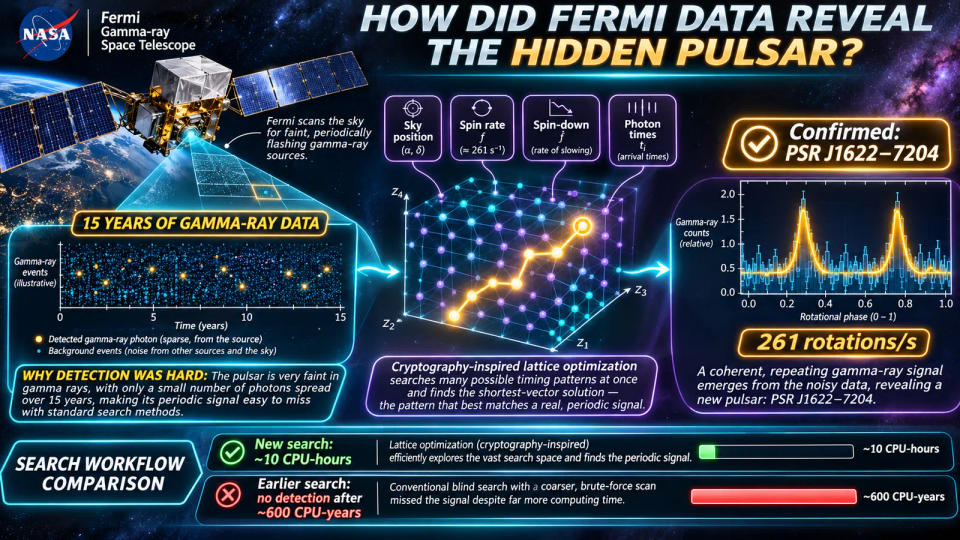
The breakthrough came from a lattice-based search method inspired by techniques used in cryptography. Rather than exhaustively checking a huge number of candidate timing solutions in the usual way, the algorithm transforms the problem into finding a short vector in a high-dimensional mathematical lattice. A promising solution corresponds to photon times that line up with one underlying periodic signal.
The team first worked with a carefully selected subset of photon events to locate candidates efficiently, then checked the promising pulsar signal against the larger dataset. The resulting timing pattern identified PSR J1622−7204 as a gamma-ray millisecond pulsar. The illustrated signal plots in our infographic explain the method; they are not reproductions of a published measurement chart.
Why Does This New Pulsar Search Method Matter?
The computational difference is striking. The new search required about 10 CPU-hours on an ordinary processor for this target, according to the discovery team. An earlier search strategy had failed to detect the same source despite roughly 600 CPU-years of computing effort. Those figures compare computational workloads, not the number of calendar years a person spent waiting. They also describe the tested search problem, rather than promising the same speed-up for every pulsar in the universe.
NASA's account describes the approach as being on the order of a million times faster than the previous technique in this context. That improvement matters because the Fermi archive contains years of sky observations in which very faint periodic sources may still be concealed. A new algorithm can sometimes make an old dataset scientifically new without a new telescope launch.
There are limits. Pulsars in binary systems can be even harder to find because orbital motion constantly shifts the timing pattern. Researchers see adapting the lattice technique to binary searches as an opportunity for future work, not as an already demonstrated discovery. Likewise, one newly discovered object does not prove how many more are waiting in the archive.
The larger lesson reaches beyond astronomy. Space telescopes collect more information than scientists can immediately extract. Better mathematics, computing methods and open access to observations can turn previously overlooked signals into evidence. PSR J1622−7204 was not hiding because it had suddenly begun spinning; its faint pulse pattern simply required a better way of listening.
Conclusion
How can a dead star rotate 261 times per second? A neutron star is the ultra-compact remnant of stellar collapse, and shrinking a spinning core can greatly increase its rotation rate. Some millisecond pulsars gain additional spin through interactions with companion stars, although the specific history of PSR J1622−7204 remains uncertain. Its 3.83-millisecond lighthouse-like gamma-ray signal was found in 15 years of NASA Fermi data through an unusually efficient lattice-based search. Sometimes the next astronomical discovery is already in the archive—we just need a smarter way to recognize it.
Sources & Further Reading
- NASA Science — Fermi Data Pulsar Discovery (November 2026)
- Max Planck Society — Finding Gamma-Ray Pulsars a Million Times Faster
- Physical Review Letters — Gamma-Ray Pulsar Discovery Using a Lattice-Based Method
- NASA Hubble — Pulsars
- NASA Fermi Science Support Center — Fermi Data Access
- NASA Science — Fermi Mission Nets 300 Gamma-Ray Pulsars and Counting
Post a Comment