
Asteroid Psyche may contain 30–60% metal by volume, but NASA must reach this unusual world to test what it is really made of.

Yes, a giant metal-rich asteroid exists in the main belt between Mars and Jupiter. Its name is 16 Psyche, and NASA has sent a spacecraft to investigate what makes it so unusual. However, the popular image of a giant solid iron ball is misleading: scientists currently expect a mixture of rock and metal, not an asteroid made entirely of metal.
That uncertainty is exactly why the Psyche mission matters. Earth-based telescopes can estimate its shape, reflectivity, heat behavior, and density, but they cannot directly reveal its detailed composition. As of November 2026, the spacecraft is still traveling toward the asteroid, where it is scheduled to begin close-up investigations in 2029.
Is Psyche Really a Giant Metal Asteroid?
Asteroid Psyche was discovered in 1852 by Italian astronomer Annibale de Gasparis. The number 16 simply records that it was the sixteenth asteroid discovered. It travels around the Sun in the outer main asteroid belt, approximately three times as far from the Sun as Earth, and its irregular shape is often compared to a potato.
The asteroid measures about 280 kilometers (173 miles) across at its widest point. That is large for a small Solar System body, although its modest gravity and battered appearance would make it very different from a round planet. Its distance from Earth constantly changes as both worlds orbit the Sun.
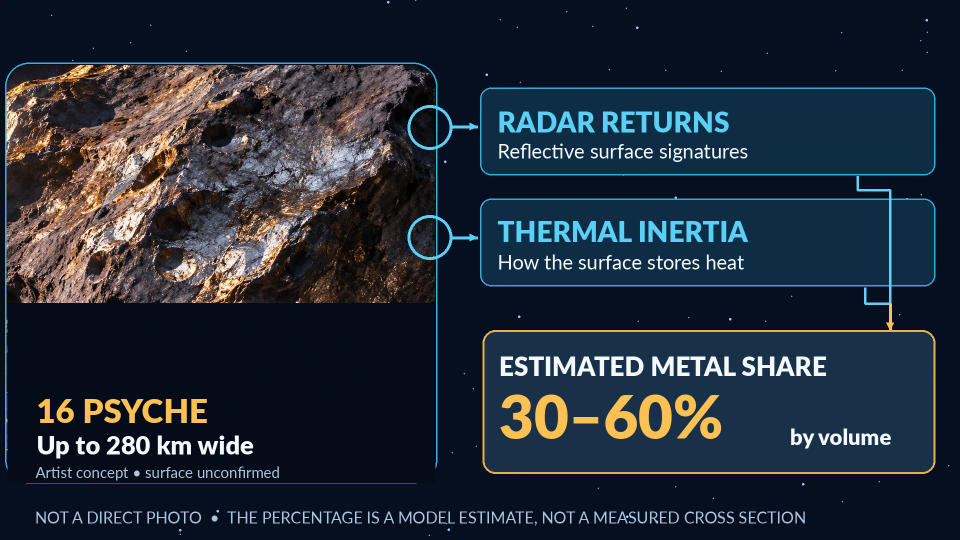
Scientists suspect substantial metal because radar signals reflected from Psyche and measurements of how quickly it absorbs and emits heat differ from what is expected for many ordinary rocky asteroids. Models using those observations suggest that metal may account for roughly 30% to 60% of Psyche's volume. The estimate is a range, not a direct sample measurement or a verified map of the interior.
One intriguing possibility is that Psyche contains the exposed metallic core of an ancient planetesimal—a small building block from which rocky planets once grew. Violent collisions could have removed much of that object's outer rocky material. Another possibility is that Psyche formed from unusually metal-rich material without becoming a conventional planetary core. These scenarios remain hypotheses, not discoveries established by close-up inspection.
Even realistic-looking pictures of Psyche must be interpreted carefully. Before the spacecraft arrives, published views of the asteroid's detailed surface are artist impressions or modeled reconstructions, not spacecraft photographs of its craters and metallic patches.
How Will NASA Find Out What Psyche Is Made Of?
NASA's mission is an orbiter, not a lander or a mining operation. Its spacecraft will spend many months traveling through a series of orbits, collecting several kinds of measurements that test different explanations for Psyche's composition and origin. No single instrument can answer the whole question.
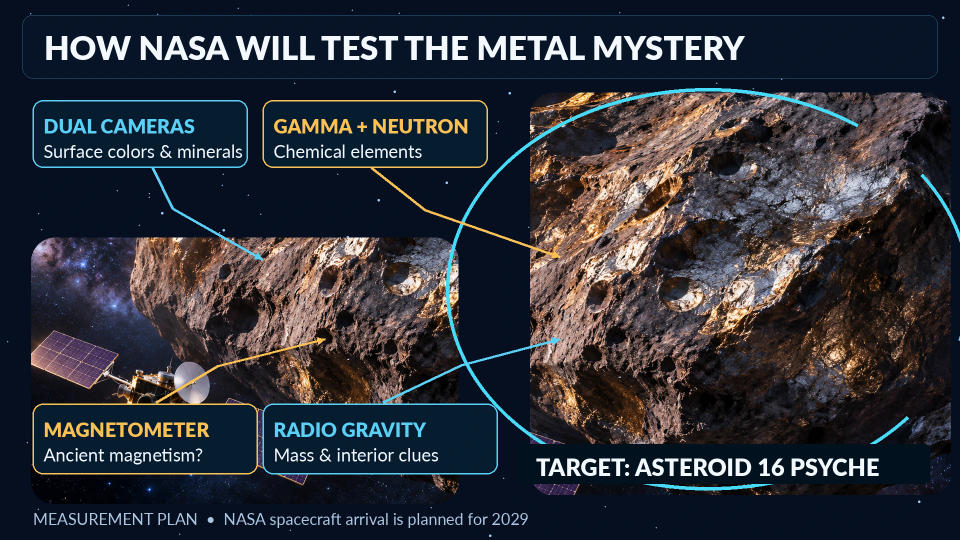
The multispectral imager uses two cameras with filters to examine the asteroid in visible and near-infrared light. Those views will map terrain, investigate surface-color variations, and provide clues about minerals. Images can reveal landforms and crater patterns, but a photograph alone cannot prove what lies deep underground.
A gamma-ray and neutron spectrometer will detect emissions produced when energetic particles interact with material near Psyche's surface. The signals can identify chemical elements and help investigators assess how metal-rich that material truly is. A magnetometer will search for signs of remanent magnetism: a persistent magnetic imprint that could support the idea that the asteroid was once part of a body with an active metallic core.
There is also a less obvious experiment. As Psyche orbits the asteroid, scientists will monitor changes in the spacecraft's radio signals. Tiny variations in its motion can reveal the asteroid's gravitational field, helping constrain its mass and the distribution of material inside. Combining all four approaches is far more informative than guessing from a shiny-looking surface.
A separate technology passenger, Deep Space Optical Communications, was designed to demonstrate laser communications during cruise. It should not be confused with the scientific instruments intended to study the asteroid itself. Nor does the Psyche mission plan to return samples to Earth.
Where Is NASA's Psyche Spacecraft in 2026?
Psyche launched on October 13, 2023, aboard a SpaceX Falcon Heavy rocket. Its long route includes both the gentle, sustained push of solar-electric propulsion and a carefully planned encounter with Mars. The spacecraft's Hall-effect thrusters use electromagnetic fields to expel xenon ions; the thrust is small but can operate over long periods in deep space.
On May 15, 2026, the spacecraft passed about 4,609 kilometers (2,864 miles) above the Martian surface. That gravity assist changed its trajectory and added roughly 1,000 miles per hour to its speed, according to NASA's mission team. It was more than a navigational maneuver: the team used the opportunity to test cameras and scientific instruments, producing images of Mars and measurements of its surrounding environment.
NASA's October 22, 2026 mission update reported that Psyche's electric thrusters had been activated again after the Mars flyby, accelerating it toward its destination. The spacecraft is therefore on its way, not already orbiting the asteroid. Its planned arrival is in the summer of 2029, followed by an orbital science campaign lasting at least 26 months.
That distinction matters when reading dramatic headlines about the mission. NASA has not announced a close-range picture of the asteroid's surface, confirmed that it is a naked metal core, or discovered a gigantic treasure chest of accessible precious metals. The scientific payoff is evidence about what the asteroid actually is—not a speculative price tag attached to the metal it might contain.
Conclusion
Psyche is a real, unusually metal-rich asteroid, but its exact composition and origin remain open questions. Current models suggest a mixture of metal and rock, while NASA's mission is designed to test whether the body preserves part of an ancient planetary core or represents an altogether different kind of Solar System building block.
The most revealing images and chemical measurements are still ahead. Until the spacecraft reaches Psyche in 2029, the smartest answer to the question “Is there a giant metal asteroid in space?” is yes—but we do not yet know how metallic this mysterious world really is.
Sources & Further Reading
- NASA — Psyche Mission Overview
- NASA — Psyche Science
- NASA — Psyche Spacecraft
- NASA/JPL — Psyche Mission Aces Mars Flyby, Targets Metal-Rich Asteroid (May 19, 2026)
- NASA/JPL — Psyche Mission Delivers Mars Flyby Data, Time-lapse Video
- NASA — Pedal to the Metal: Psyche Heads Toward Asteroid Belt (October 22, 2026)
Post a Comment