
The Sun began in a collapsing cloud of gas and dust about 4.6 billion years ago, and ancient meteorites still hold clues to its birth.
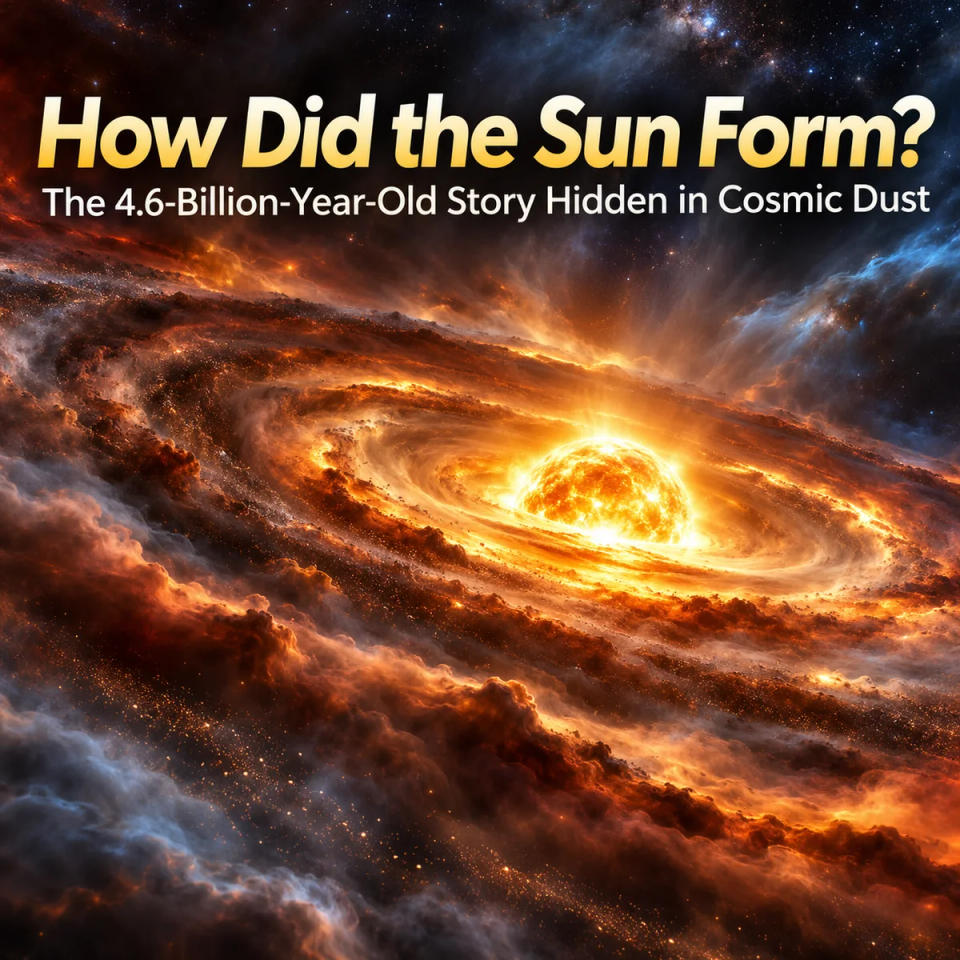
Long before Earth had oceans, mountains, or even a solid surface, our Sun was taking shape inside a cold cloud of interstellar gas and dust. Gravity gradually gathered material toward the center, a spinning disk formed around the growing protostar, and nuclear fusion eventually made the Sun a true star. We cannot watch our own Sun being born, but meteorites and observations of young stars elsewhere reveal how the process works.
That is the remarkable part of this story: the enormous star that now dominates our sky began in material so thin and cold that most of it would have been invisible to human eyes. The evidence is scattered across ordinary-looking space rocks and distant stellar nurseries.
How Did a Cloud of Cosmic Dust Become the Sun?
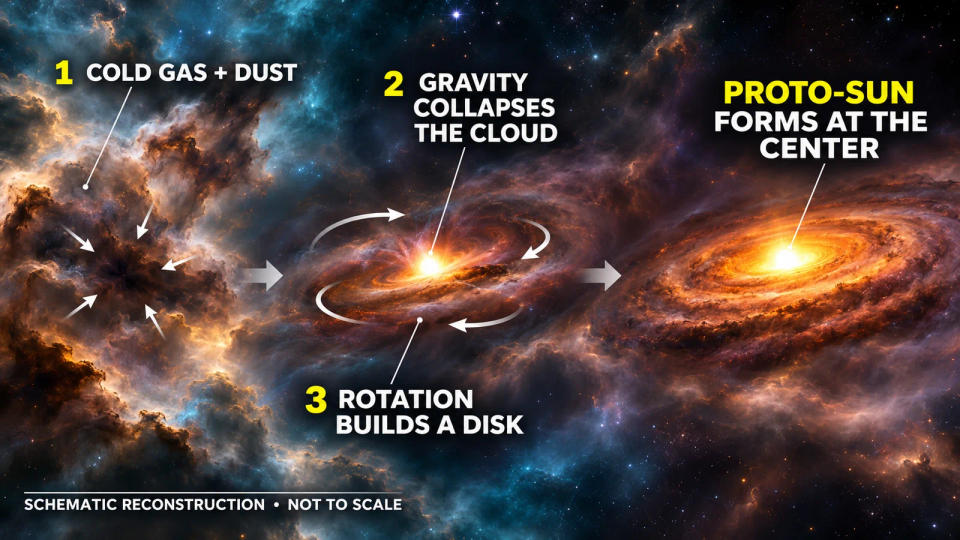
About 4.6 billion years ago, the material that would become our solar system occupied part of a vast molecular cloud. Such clouds consist mostly of gas, especially hydrogen, mixed with tiny solid grains. They are not static. Dense regions can begin to collapse when gravity overcomes the pressure supporting them.
Some explanations suggest that a passing shock wave, perhaps from a nearby stellar explosion, helped compress the cloud. That is a possible trigger, not an established eyewitness account of our Sun's birth. The central process is much better understood: once a sufficiently dense region started falling inward, gravity drew more material toward its center.
As the cloud contracted, its rotation became more noticeable. The same conservation of angular momentum that makes a spinning skater turn faster when pulling in their arms helped the collapsing material spin faster. Gas and dust settled into a broad, rotating disk, while much of the mass concentrated at the center. Astronomers call this central growing object a protostar and its surrounding material a protoplanetary disk.
The protostar was not immediately the stable hydrogen-fusing Sun we know. Gas falling inward released gravitational energy and raised the temperature of the central object. Eventually, conditions in its core allowed hydrogen nuclei to fuse into helium, producing the sustained energy that powers a star. That change happened within the evolving central object, not because the surrounding dust suddenly caught fire.
NASA estimates that the Sun contains about 99.8% of the solar system's total mass. The relatively small amount left in the disk supplied material for planets, moons, asteroids, and comets. Some of the remaining gas and dust was later dispersed by radiation and the young Sun's activity. The formation of the Sun and the formation of the planets were connected processes, but they were not one instantaneous event.
How Do Meteorites Reveal a 4.6-Billion-Year-Old Beginning?
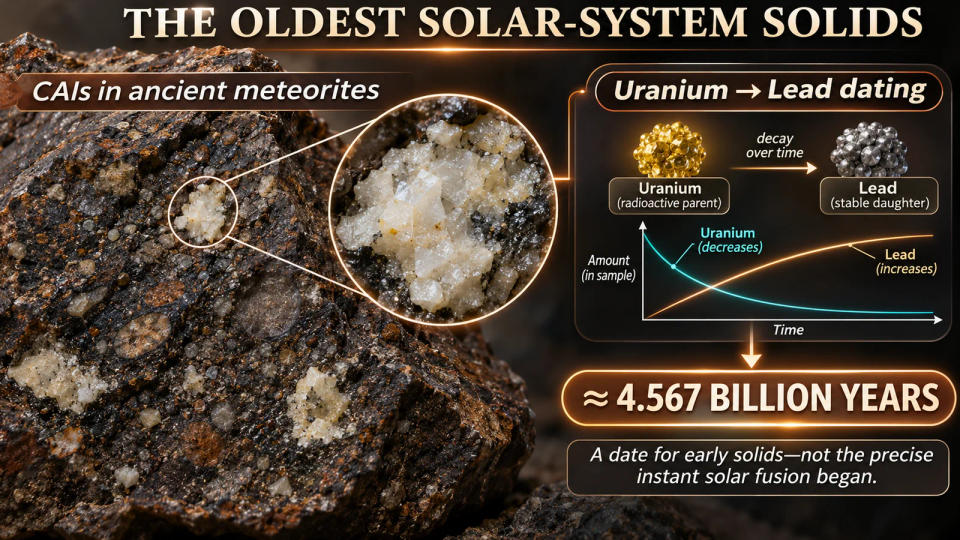
There is no photograph of the original solar nebula. Yet certain meteorites contain tiny mineral inclusions that formed when the solar system was extremely young. Among the most important are calcium-aluminum-rich inclusions, usually shortened to CAIs. These heat-resistant solids preserve chemical and isotopic clues from the disk that surrounded the early Sun.
Scientists can estimate when some of these minerals formed by measuring radioactive isotopes and the products of their decay. In particular, uranium-lead dating of very old inclusions places the earliest solar-system solids at approximately 4.567 billion years old. That is one reason astronomers commonly round the age of our solar system, and the Sun's birth era, to about 4.6 billion years.
It is important to read that number correctly. A mineral date tells us when that ancient solid formed or recorded its isotopic history. It does not directly measure the exact second when hydrogen fusion first became sustained inside the Sun. The earliest rocks provide a time marker for a much larger process that scientists reconstruct using meteorite measurements, stellar observations, and physical models.
The minerals also reveal that the young solar nebula was far from a calm, uniform place. NASA-supported studies have examined different isotopes inside individual inclusions, finding evidence of changing conditions and movement of material within the early disk. Some grains may have experienced repeated heating and cooling. Those histories help scientists test how material traveled around the young Sun before it became incorporated into larger worlds.
In a sense, meteorites are surviving scraps from the construction site. They do not tell us everything, but unlike most material that became part of planets and was later transformed, some preserve extraordinarily old records.
Can We See Other Stars Being Born the Same Way?
Yes, although what astronomers observe are other young systems, not the Sun's own distant past. Across the Milky Way, telescopes detect dusty disks and protostars at different stages of growth. Each system offers a piece of the larger picture, showing how gas falls inward and how disks surround young stars.
One striking example is IRAS 04302+2247, a young star-forming system about 525 light-years away in Taurus. A combined view involving the James Webb Space Telescope, Hubble, and the Atacama Large Millimeter/submillimeter Array reveals an edge-on disk around a protostar. Dust blocks the direct central light, while glowing material above and below helps show the system's three-dimensional structure.
The observations are valuable because different instruments reveal different components. Webb traces fine dust and scattered light, Hubble provides clues to surrounding material and outflows, and ALMA detects emission from larger dust grains. The disk measured in Webb observations extends roughly 65 billion kilometers across. This is a real example of the kind of environment where stars and planetary systems grow, not a picture of our Sun 4.6 billion years ago.
Combining such observations with meteorite chemistry is especially powerful. Remote telescopes show what stellar birthplaces look like now; ancient solids let researchers examine what conditions were like when our solar system formed. The two lines of evidence do not answer every question, including the exact cause that set our particular cloud collapsing, but they make the broad formation story scientifically testable.
Conclusion
The Sun formed when a dense part of an interstellar cloud collapsed under gravity about 4.6 billion years ago. Rotation shaped a disk, material built a protostar at its center, and sustained hydrogen fusion eventually turned that object into the star we see today. The remaining disk became the starting material for the rest of the solar system.
The most surprising evidence is still close enough to study in a laboratory: ancient meteorite minerals that preserve ages and chemical clues from the Sun's earliest neighborhood. Together with images of distant newborn stars, those tiny grains make a 4.6-billion-year-old story much more than a guess.
Sources & Further Reading
- NASA Science — Sun: Facts
- NASA Science — Planetary Systems
- NASA Astrobiology — Using Isotopes to Probe the Earliest History of the Solar Nebula
- NASA Astrobiology — Looking Back at the Formation of the Sun
- ESA — Webb Zooms In on a Dusty Disc
Post a Comment