
A planet could reveal itself by adding a periodic wobble to gravitational waves from a close pair of stellar remnants.
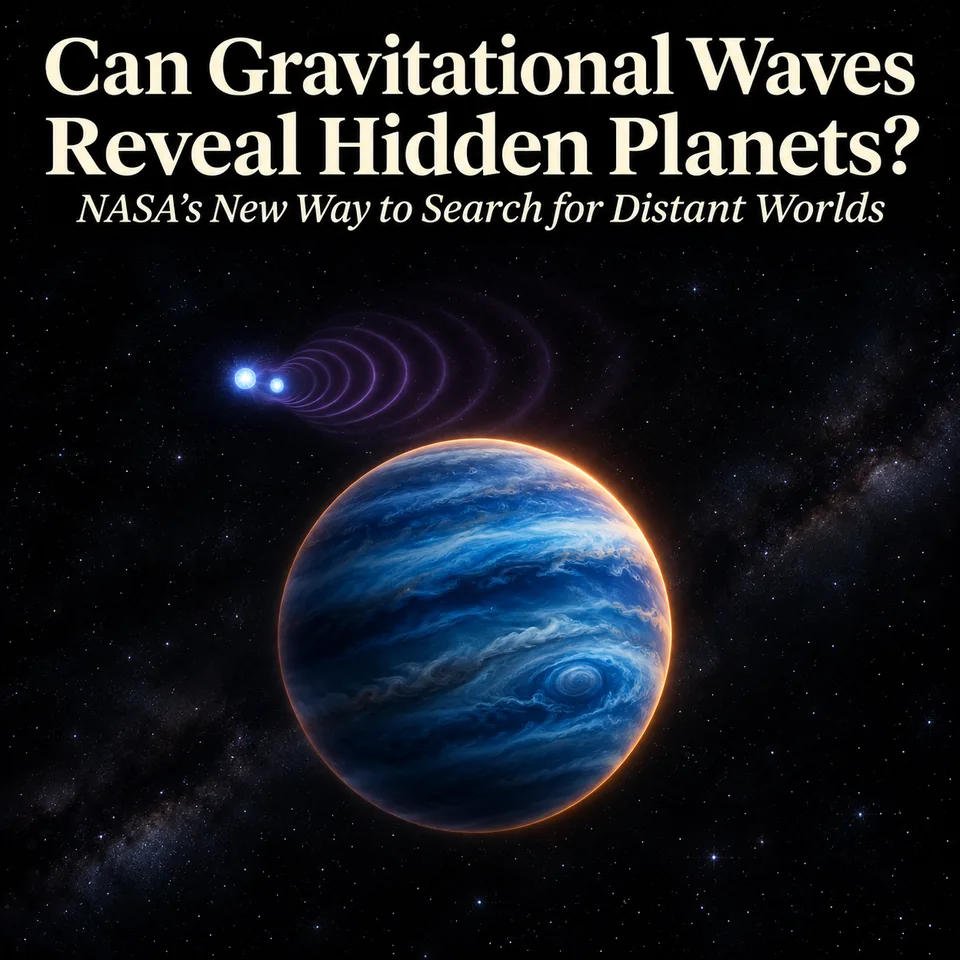
Gravitational waves could help astronomers find planets by tracking how their gravity moves a pair of stellar remnants. In November 2026, NASA highlighted two studies exploring that possibility and ways to check future candidates. The work looks ahead to LISA, an ESA-led observatory being developed with NASA, which is scheduled to launch in the mid-2030s.
For a planet that is hard to pick out in starlight, its pull on something astronomers can measure offers another route to discovery. Here, the measurable source would be a tightly orbiting pair of white dwarfs. The proposed search follows changes in the signal that reaches the observatory as the pair moves toward and away from it.
How Does a Planet Leave a Mark on Gravitational Waves?
White dwarfs are compact remnants left behind by stars such as the Sun. When two orbit close together, their motion can produce a persistent gravitational-wave signal. Those ripples in space-time travel outward from the binary. NASA's visualization uses a steady tone to represent the signal, bringing an otherwise invisible pattern into a form people can follow.
A planet orbiting both stars also exerts gravity on them. The binary therefore makes a small motion of its own around the wider system's center of mass. As that motion carries the pair toward and away from the observer, the arriving wave pattern shifts. This is a gravitational-wave version of the Doppler effect.
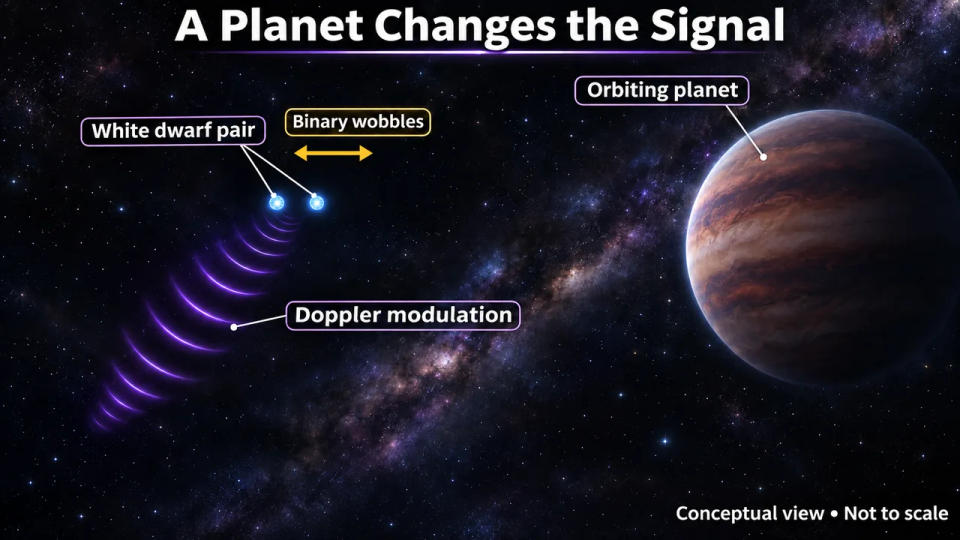
Think of an ambulance siren changing pitch as the vehicle passes. For the proposed planet search, the repeating change comes from the source's orbital motion. A steady gravitational-wave frequency acts as a carrier. A planet's influence puts additional structure, called sidebands, on either side of that main frequency when researchers analyze the signal.
Casey McGrath's study develops this method mathematically and examines which companions could produce a measurable effect. Larger planetary masses and longer orbital periods can increase the strength of the phase modulation. Detection also depends on how clearly the observatory measures the source, how long it watches, and the system's orientation. The observatory's own movement must be included in the analysis because it introduces another Doppler effect.
How Could Webb Help Check a Candidate?
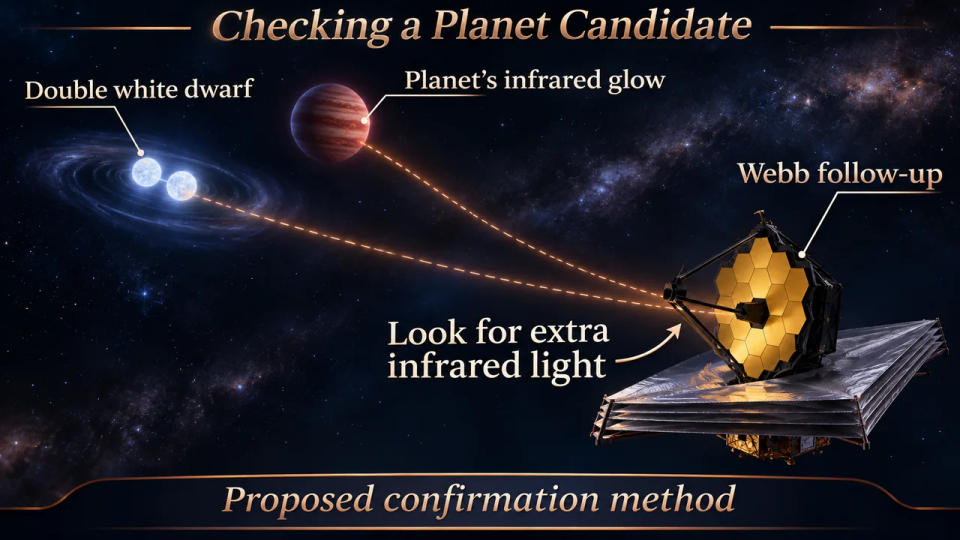
A repeating modulation would give scientists a candidate to investigate. A second observation could then test whether the proposed companion has the properties expected of a planet. McGrath and colleagues studied how that check might work for a planet around a double white dwarf, using a representative binary placed at a modeled distance of 150 parsecs, roughly 490 light-years.
The team examined an approach called infrared excess. Researchers estimate how much infrared light the two stars should supply. A cool companion can add its own thermal emission, raising the measured infrared brightness above that prediction. Webb's sensitivity at infrared wavelengths makes it a possible tool for searching for this additional light in suitable nearby systems.
The study also considered astrometry, which measures tiny changes in an object's apparent position on the sky. The attraction of combining these observations is that each probes a different consequence of the companion. Gravitational waves trace motion in the source signal, infrared observations test its extra light, and astrometry follows positional motion.
The overlap matters. A planet that affects the gravitational-wave signal strongly enough for LISA may still be difficult to verify in infrared. The researchers mapped regions where the methods could work together. Their example establishes a way to plan follow-up observations, with the usefulness of each method depending on the individual system.
What Would LISA Measure?
LISA stands for Laser Interferometer Space Antenna. Three spacecraft will orbit the Sun in a triangular formation, with each side spanning about 2.5 million kilometers, or 1.6 million miles. Laser beams exchanged between the spacecraft will allow the observatory to measure extraordinarily small changes in their relative separations as gravitational waves pass.
The long distances between the spacecraft make LISA sensitive to low-frequency gravitational waves. Close white dwarf pairs in the Milky Way are among its expected sources. Their persistent signals could give researchers time to search for the slower modulation associated with an orbiting companion.
ESA leads the mission, while NASA contributes hardware and scientific expertise. NASA's contributions include telescopes, laser technology, and systems that help manage electric charge on the freely falling reference masses. Together, the spacecraft and their instruments form an observatory for measuring changing distances across space.
The new planet studies ask what researchers could extract from those future measurements. They extend an idea explored in earlier work, including a proposal by Naoki Seto in 2008. The next challenge is to make the signal models detailed enough to recognize possible companions while accounting for other effects in the data. A successful search would add a way to study planets around compact stellar remnants, whose histories differ greatly from systems like our own.
Conclusion
A distant planet could announce its presence through the motion it gives a gravitational-wave source. The 2026 studies explain how that signature could be extracted and how independent observations could help test it. LISA's future measurements would supply the search data, with infrared and positional observations offering additional evidence for suitable candidates.
Sources & Further Reading
- NASA — NASA Scientists Show How Gravitational Waves Can Reveal New Worlds
- McGrath — Receiving Exoplanet Messages with Gravitational-wave Carriers: The Gravitational-wave Radial Velocity Method
- McGrath et al. — Multimessenger Exoplanets: Combining Infrared Excess and Astrometry with Gravitational-wave Detections of Double White Dwarf Exoplanets
- NASA — LISA
- NASA Scientific Visualization Studio — How Gravitational Waves Can Reveal New Worlds
Post a Comment