
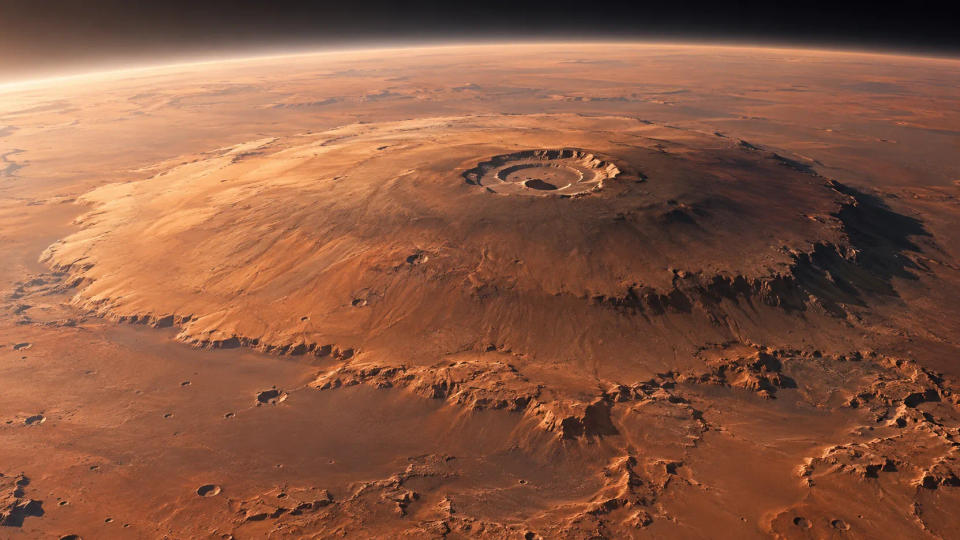
Mars is only about half Earth’s diameter, yet it carries a volcano so enormous that nothing else in the Solar System comes close. Olympus Mons spreads roughly 600 kilometers across and rises about 22–27 kilometers above its surroundings, depending on the reference level used. Its footprint is comparable to the size of a large U.S. state.
The surprising answer is not that Mars somehow makes stronger volcanoes. Olympus Mons became gigantic because several conditions worked together for an extremely long time: the Martian crust did not move over its magma source the way Earth’s tectonic plates do, Mars has weaker gravity, and fluid basaltic lava could repeatedly spread out and pile up in the same region.
In other words, Olympus Mons is what can happen when a volcano is allowed to keep building in one place for geological ages.
A Stationary Crust Let One Volcano Keep Growing
The most important difference between Mars and Earth is plate tectonics. On Earth, the outer shell is broken into moving plates. A hotspot can remain in roughly the same place in the mantle while the plate above it slowly travels past. Hawaii is a classic example: as the Pacific Plate moves, volcanoes are carried away from the hotspot and new ones form farther along, producing a chain of islands and seamounts.
Mars does not have an Earth-like system of active, moving tectonic plates today. Its outer shell has behaved much more like a mostly stationary lid. That means a long-lived source of rising hot material could feed the same general location again and again instead of being dragged away from it.
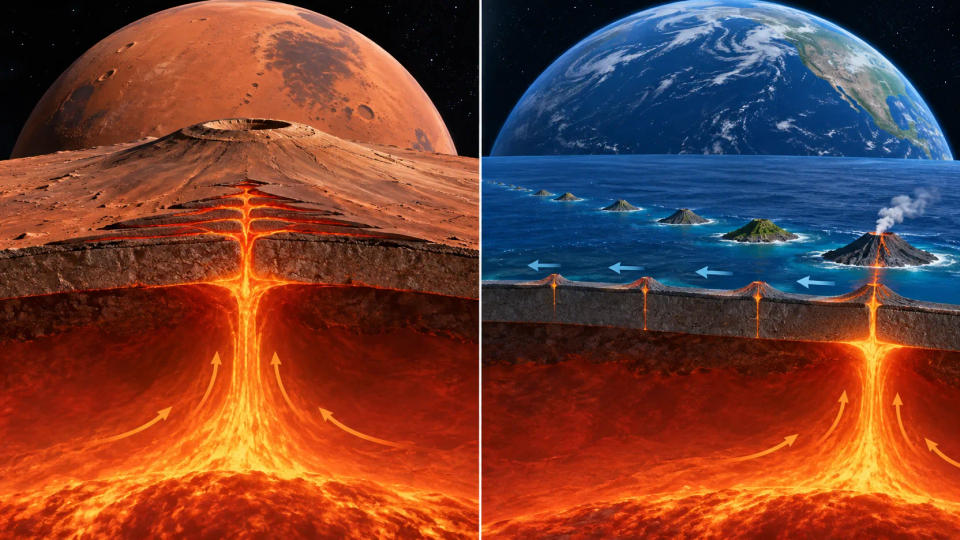
Scientists therefore interpret Olympus Mons as the product of prolonged hotspot-style volcanism beneath a relatively stationary lithosphere. Rather than creating a neat chain of separate volcanoes, repeated eruptions kept adding new lava to one immense shield. This is one of the main reasons Martian volcanoes can reach dimensions that are difficult to reproduce on Earth.
Mars’s smaller size also matters indirectly. A smaller rocky planet loses internal heat differently from Earth, and it never developed—or did not preserve—the same global plate-recycling system. The exact history of Martian tectonics is still studied, but the broad contrast is clear: Earth continually rearranges its surface plates, while Mars has allowed huge volcanic provinces such as Tharsis to remain fixed for very long periods.
Lower Gravity Raised the Size Limit
Mars has another advantage for building oversized mountains: surface gravity is only about 38 percent of Earth’s. Weaker gravity reduces the stress created by a volcano’s own weight, so a volcanic edifice can grow taller before its rocks are forced to support the same kind of load they would experience on Earth.
That does not mean low gravity alone created Olympus Mons. The stationary crust is crucial because it kept volcanism concentrated in one place. But weaker gravity helped raise the structural ceiling, allowing the growing shield to reach extraordinary height and width.
There is also an important visual trick. Olympus Mons is not shaped like a steep cone. It is a shield volcano, built mainly by relatively fluid basaltic lava that spread outward in broad sheets. Most of its slopes are only a few degrees. If you stood on one of those flanks, the surface might feel more like an immense rising plain than the side of a towering mountain.
Its great height becomes easier to appreciate from orbit, where the full scale is visible at once. Around the volcano’s base is a dramatic cliff-like boundary, or basal scarp, that reaches several kilometers high in places. Near the summit, nested calderas record episodes in which magma drained away and the ground above collapsed.
Olympus Mons Was Built by Patient, Repeated Lava Flows
Olympus Mons did not appear in one spectacular eruption. It was assembled layer by layer. Lava repeatedly flowed across older lava, spreading far down the shallow slopes and gradually thickening the entire structure.
Research that combines surface geology, crater counting, and models of how the Martian crust bends under the volcano’s weight suggests that most of the giant shield formed over a remarkably long interval. One study estimated that the main construction phase may have lasted on the order of a billion years, with much lower levels of volcanic resurfacing continuing afterward.
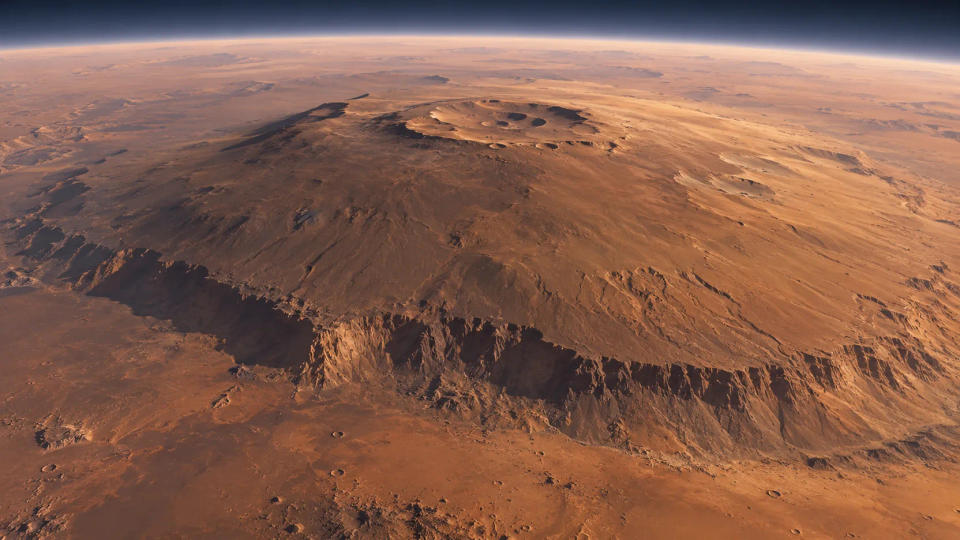
Some lava surfaces mapped on Olympus Mons are much younger than the oldest parts of the volcano, showing that its history stretched deep into comparatively recent Martian time. Studies have identified volcanic and tectonic features tens of millions of years old. That is young in planetary geology, but it is not evidence that Olympus Mons is erupting now. No active eruption has ever been directly observed.
The huge span of ages is part of what makes the volcano so impressive. On Earth, plate motion usually carries a volcano away from its main magma source before it can spend such an extraordinary length of time growing in the same location. Mars effectively gave Olympus Mons a much longer construction schedule.
Why Olympus Mons Is More Than a Record Holder
It is tempting to treat Olympus Mons as a simple trivia answer: the biggest volcano in the Solar System. But its real scientific value is that it records how a rocky planet behaves when its interior cools, its crust does not recycle like Earth’s, and volcanism can remain focused for immense spans of time.
The volcano also helps scientists compare planetary interiors. Earth, Mars, Venus, the Moon, and rocky exoplanets may all begin with heat left from formation and radioactive decay, yet they can lose that heat in very different ways. Those differences control whether a world develops plate tectonics, widespread volcanism, giant stationary hotspots, or a mostly quiet crust.
Olympus Mons is therefore a geological clue as much as a mountain. Its broad slopes, enormous base, stacked lava flows, summit calderas, and surrounding deformation preserve pieces of Mars’s thermal history. By studying them, planetary scientists can test ideas about how long Martian volcanism persisted and how the planet’s rigid outer shell responded to the weight of a truly gigantic volcano.
Conclusion: Mars has the Solar System’s largest volcano because it offered an unusual combination: a long-lived magma source beneath a relatively stationary crust, lower gravity, and repeated outpourings of fluid lava over immense stretches of time. Olympus Mons is not the result of one violent event. It is the result of persistence on a planetary scale.
Sources & Further Reading
- NASA Science — Mars in a Minute: How Did Mars Get Such Enormous Mountains?
- NASA Science Photojournal — Olympus Mons
- U.S. Geological Survey — Volcano Watch: Volcanism on Other Planets
- ESA — Landslides at the Foot of Olympus Mons
- Earth and Planetary Science Letters — The Volcanic History of Olympus Mons from Paleo-topography and Flexural Modeling
Post a Comment