
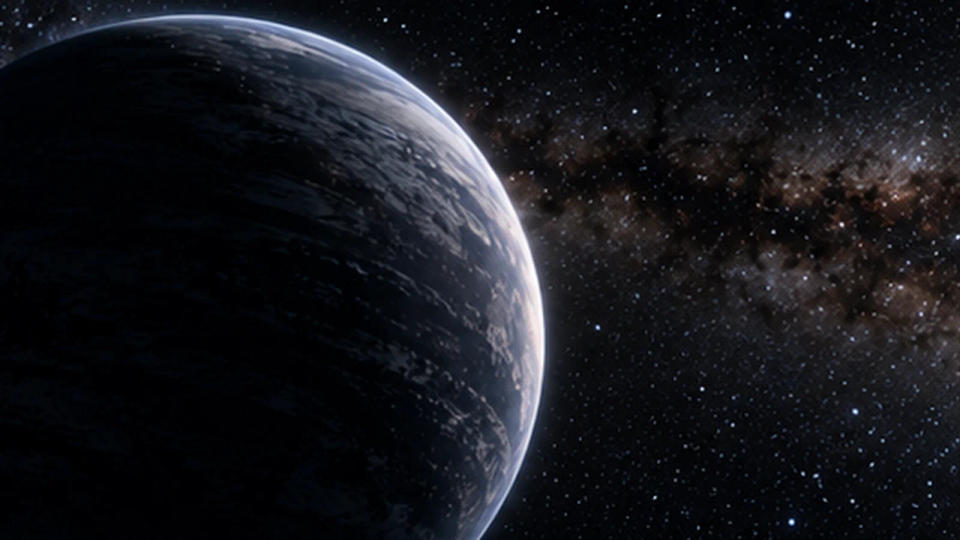
Could an unbound planet wander into our solar system and destroy Earth? Yes, a sufficiently close and massive visitor could disturb Earth's orbit, but a passage through the distant outskirts would not automatically spell disaster. The outcome depends primarily on the rogue planet's mass, trajectory, speed, and closest approach to the planets.
A rogue planet is a world that travels without being gravitationally bound to a star. It might have formed around a star and been ejected by gravitational encounters, or followed another formation path. Such objects are difficult to see because they receive little starlight. The question is not whether wandering planets exist—we have observational evidence for candidates—but what an imaginary encounter with our particular solar system would actually do.
How Could a Rogue Planet Reach the Solar System?
Our solar system moves through a galaxy full of stars, gas, dust, and planets. A rogue planet need not aim for the Sun; its path could simply intersect a distant part of the Sun's gravitational domain. Astronomers detect some free-floating planet candidates through gravitational microlensing: when a foreground object's gravity briefly magnifies light from a background star. The brightening provides evidence of an otherwise difficult-to-see object, although some candidates may instead be planets on extremely wide orbits.
NASA reported in 2023 that a survey-based analysis suggested free-floating worlds may be abundant and could be more numerous at lower masses. These estimates concern the galaxy as a whole. They do not show that a rogue planet is currently approaching Earth, nor do they give a reliable probability of a near-term collision with our planet. Abundance across the Milky Way and the chance of entering a tiny region near Earth's orbit are very different questions.
Imagine a dark planet arriving from interstellar space. If it is moving too quickly to become bound to the Sun, it may follow a bent, hyperbolic path and depart again. The Sun changes its trajectory through gravity. A more complicated exchange of energy with existing planets could, in some cases, lead to capture or ejection, but capture is not the default outcome of a simple two-body flyby.
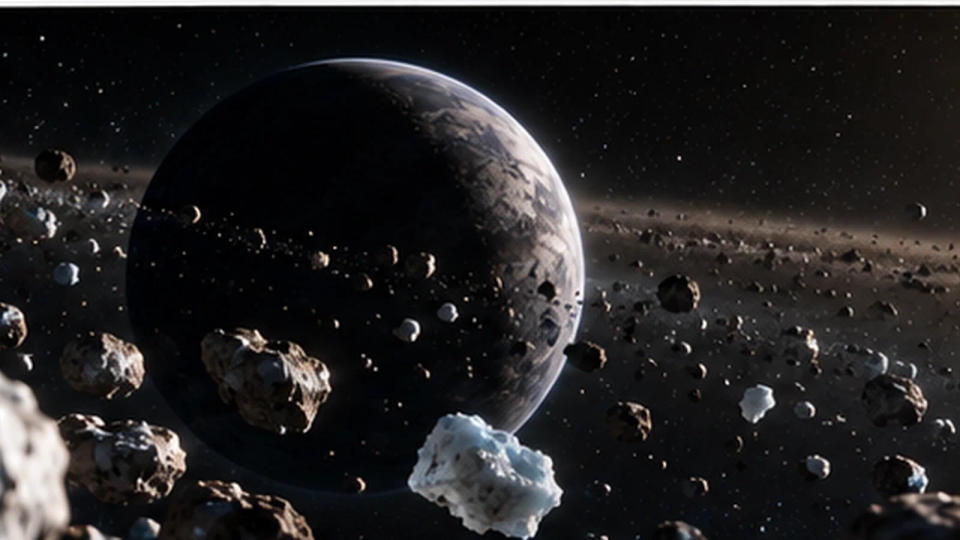
Space is enormous. Neptune orbits the Sun at about 30 astronomical units, while the hypothesized Oort Cloud extends thousands to tens of thousands of astronomical units from the Sun. One astronomical unit, or AU, is approximately the average Earth–Sun distance, about 150 million kilometers. A visitor can therefore 'enter the solar system' in a broad sense while remaining extraordinarily far from Earth's neighborhood.
Three Encounters, Three Very Different Outcomes
Scenario one: a distant passage. If a rogue planet crosses the outer Oort Cloud, its gravitational influence might change the trajectories of some icy bodies. That is a potential long-term cometary concern, not an automatic immediate apocalypse. NASA describes the Oort Cloud as a distant, roughly spherical reservoir of icy objects, whose orbits can be affected by external gravity. A distant intruder might eject some objects or send some toward the inner solar system, where their travel could take very long periods.
Scenario two: an encounter with the giant-planet region. A sufficiently massive visitor moving near Neptune, Uranus, Saturn, or Jupiter could alter orbital energies and eccentricities. The giant planets themselves might scatter the incoming world into a different path. Depending on the geometry, the interaction could also indirectly change the long-term stability of smaller planets. These outcomes require computer simulations with specified initial conditions; it is misleading to declare that Jupiter would either certainly shield Earth or inevitably throw the rogue planet toward it.
Scenario three: a passage near Earth. This is the most dangerous case. Even without striking Earth, a massive planet could exert a differential gravitational pull across Earth and the Moon, alter their relative orbits, and disturb Earth's path around the Sun. A closer and slower encounter generally permits a stronger gravitational deflection than a comparable distant, rapid flyby. Extreme approaches could provoke serious tides, orbital changes, or collisions, but the size of each effect cannot be specified without the visitor's mass and exact path.
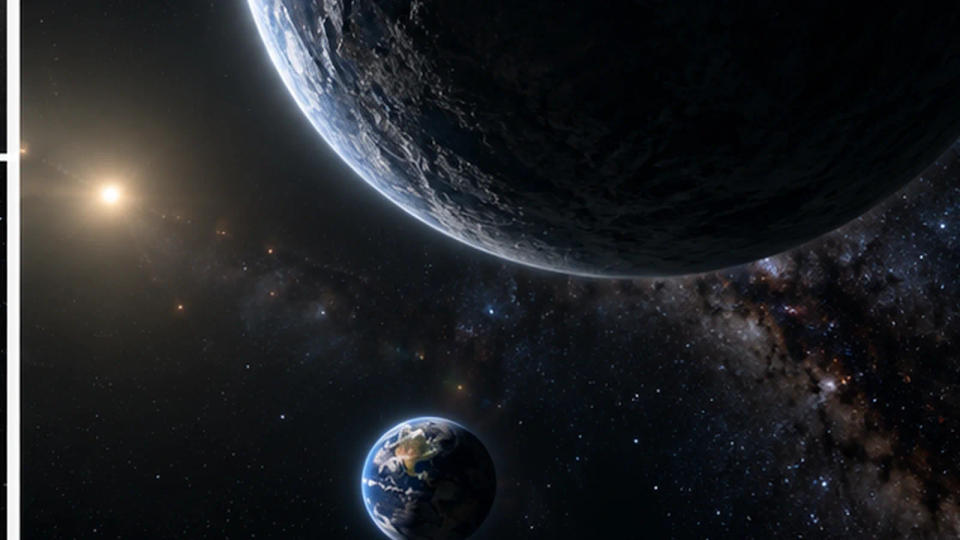
There is no universal 'safe distance' for every rogue planet. An Earth-mass body passing at a given distance is not equivalent to a Jupiter-mass one passing there. Likewise, the encounter geometry matters: a gravitational tug can partly add to, subtract from, or redirect a planet's orbital velocity. In short, a close flyby is a dynamical problem rather than a movie scene with a single inevitable ending.
What Would Happen to Earth's Climate and Habitability?
Earth's survival has several meanings. The planet could remain physically intact while its environment becomes difficult for civilization or life. A changed orbit might increase or decrease the amount of sunlight Earth receives. A substantially more eccentric orbit could expose the planet to stronger seasonal or long-term variations in solar heating. Those changes would affect oceans, ice, weather patterns, and ecosystems, but the magnitude would depend on the new orbital parameters and the climate response.
If Earth were somehow ejected from the solar system, it would no longer receive the Sun's familiar light and warmth. That is a scientifically conceivable dynamical outcome under unusually strong interactions, not a prediction of what most rogue-planet passages would do. Surface conditions would become profoundly hostile without a comparable energy source. Whether particular subsurface or geothermal environments could persist is a different, narrower question from whether human civilization could survive outdoors.
A direct collision between planets would be catastrophic, yet it is crucial not to confuse gravitational disruption with impact. A planet can change another planet's orbit from a distance, and most conceivable passages do not require the two bodies to touch. Nor should every comet displaced from the Oort Cloud be counted as an eventual Earth impact. A chain of gravitational encounters and a favorable trajectory would be needed before a collision became possible.
Real stellar flybys provide useful context for how distant gravitational disturbances can occur. NASA reports that Scholz's star likely grazed the outer Oort Cloud roughly 70,000 years ago. That event involved a star and companion rather than a rogue planet; it demonstrates that our wider solar-system environment is not perfectly isolated, not that Earth was nearly destroyed. Research using numerical experiments also shows that planetary systems can be disrupted in some encounter conditions, but model outcomes should not be mistaken for a documented event involving Earth.
Observational astronomy is improving our census of free-floating planets. Microlensing surveys are valuable because a rogue planet may be virtually invisible in ordinary reflected light. Better statistics will tell us more about how common these travelers are, while precise orbital calculations would still be needed to assess any individual object suspected of approaching our solar system.
Conclusion
Earth could survive a rogue planet entering the distant solar system, and many such flybys would have little direct effect on our world. A massive visitor passing close to the major planets or Earth could instead rearrange orbits and threaten habitability. The responsible scientific answer is conditional: without the intruder's mass, speed, and closest approach, neither safety nor catastrophe can be predicted.
Sources & Further Reading
- NASA: New Study Reveals Roman Could Find 400 Earth-Mass Rogue Planets
- NASA: Oort Cloud Facts
- NASA: A Passing Star—Our Sun’s Near Miss
- NASA: Unveiling Rogue Planets With Roman
- NASA NTRS: The Evolution and Disruption of Planetary Systems
Post a Comment