
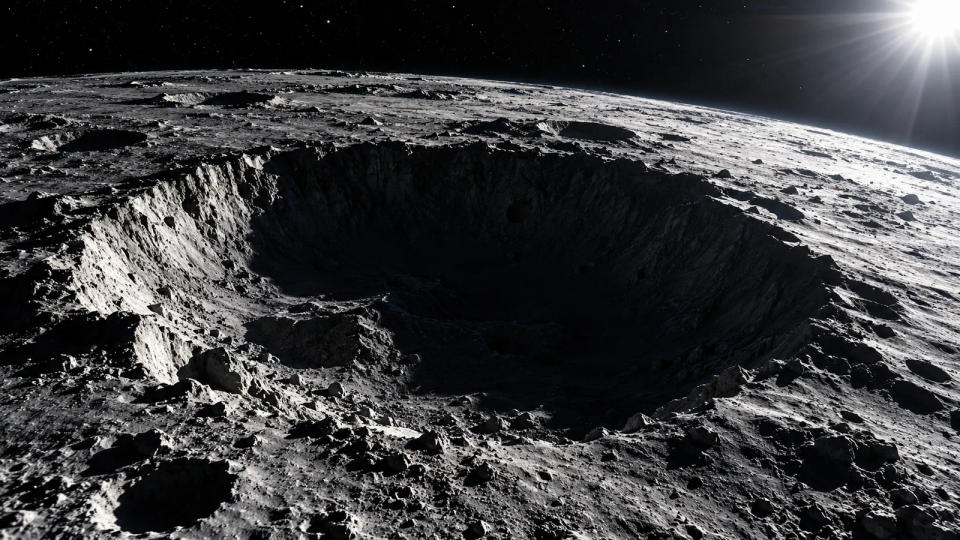
Deep inside some lunar polar craters, the Sun never reaches the ground. Those dark floors contain ordinary rock and dust, but spacecraft have also detected water ice and evidence of other frozen or easily vaporized substances. They are not proven underground glaciers or lakes: the deposits appear uneven, and their depth and abundance remain uncertain.
These permanently shadowed regions, or PSRs, are some of the Moon’s most intriguing natural archives. Their cold can preserve molecules that would be lost from warmer ground, offering both clues to the Moon’s past and possible supplies for future explorers.
Why Can a Lunar Crater Stay Dark Forever?
Near the Moon’s poles, the Sun travels low around the horizon. The Moon’s rotation axis has only a small tilt relative to its orbit around the Sun, so seasonal sunlight does not rise high enough to illuminate the floors of some deep craters. Their rims act like permanent walls against direct sunshine. This is a question of geometry, not of the Moon having an ordinary night that lasts unusually long.
A nearby ridge may be illuminated while the crater floor only a short distance away remains in darkness. Those different lighting conditions create striking differences in surface temperature. The Lunar Reconnaissance Orbiter’s Diviner instrument has measured temperatures in polar cold traps as low as about 25 kelvin, around minus 248 degrees Celsius. At such temperatures, water molecules that arrive and settle may remain trapped for immense spans of time.
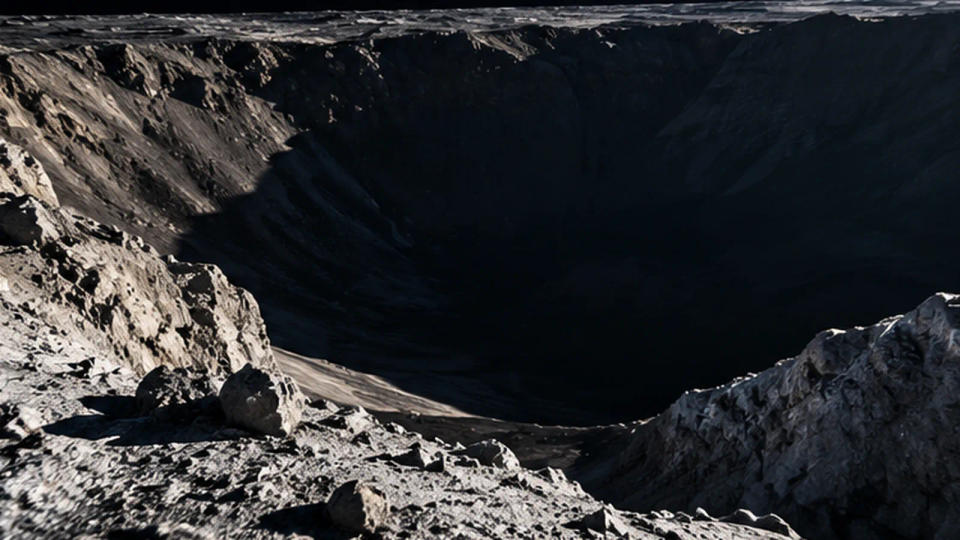
Conceptual reconstruction, not a photograph of a specific named crater or a map of measured ice.
Dark does not mean invisible to every scientific instrument. NASA’s ShadowCam uses very high sensitivity to record reflected light entering shadowed terrain from nearby features. Orbiters also measure thermal radiation, ultraviolet behavior, neutron signals and infrared spectral signatures. Each technique reveals something different, but no single shadow photograph establishes how much ice lies below the soil.
The permanent shadows occur near both lunar poles, rather than across every crater. At lower latitudes, the Sun rises much higher and ordinarily illuminates crater interiors during the lunar month. The exceptionally cold polar geography is what makes these locations special.
What Has Actually Been Found Inside the Darkness?
The simplest answer is a mixture of regolith—broken rock, tiny impact fragments and fine dust—with water ice detected in certain locations. The ice is not known to form continuous, gleaming sheets. In many places it may occur as scattered grains, frost-like patches or material mixed into soil, and some deposits may sit below a dry surface layer.
There are several independent strands of evidence. In October 2009, NASA’s LCROSS mission deliberately sent a spent Centaur rocket stage into Cabeus crater near the south pole. A following spacecraft examined the debris thrown above the rim, where sunlight made its contents measurable. That plume provided direct evidence for water and revealed other volatile components, including compounds relevant to the chemical history of the Moon.
In 2018, researchers analyzing NASA’s Moon Mineralogy Mapper aboard India’s Chandrayaan-1 mission identified the distinctive infrared absorption signatures of solid water ice at polar locations. These confirmed surface-ice detections were patchy. They did not imply that every permanently shadowed crater contains accessible, concentrated ice.
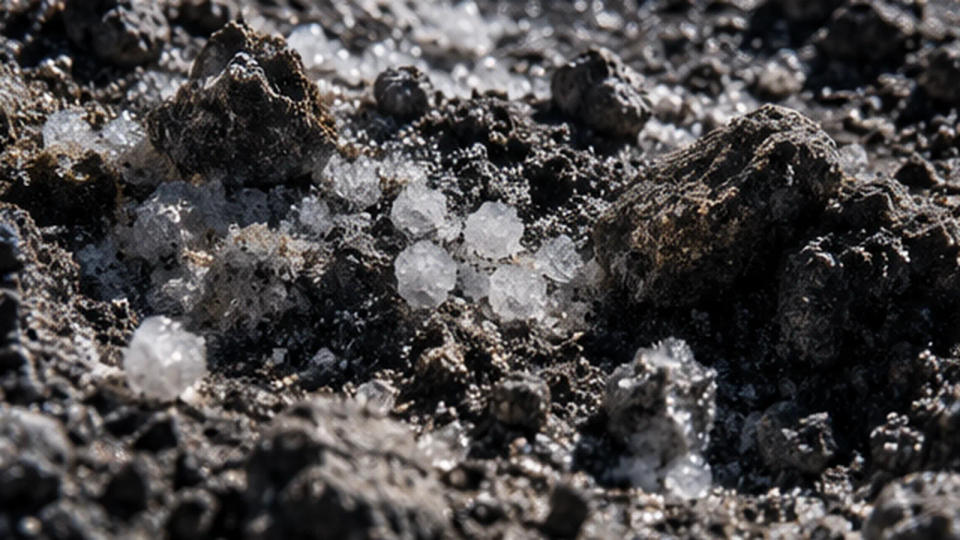
Illustrative reconstruction. The visible pale material is not a documented sample, and no concentration is implied.
Other molecules matter too. Analyses associated with LCROSS and cold-trap studies point to substances such as carbon dioxide, ammonia and other volatile materials as possible or detected components of the polar inventory. But a measured spectral signature, a modeled stable temperature and an actual mineable deposit are three different kinds of evidence. The results vary by place and technique.
Scientists are also still testing where these volatiles came from. Comets and asteroids may have delivered some; solar-wind hydrogen interacting with oxygen-bearing minerals may contribute to lunar water chemistry; and some vapor may have originated inside the Moon. Cold traps preserve material, but they do not, by themselves, identify its source.
How Much Ice Is There—and Could Astronauts Use It?
Newer mapping has expanded the list of promising places. A NASA-led 2024 analysis of Lunar Reconnaissance Orbiter measurements found evidence consistent with water ice across permanently shadowed regions extending to at least about 77 degrees south latitude, beyond only the biggest craters closest to the pole. The researchers expected the highest concentrations in colder spots, especially those below roughly 75 kelvin and near certain pole-facing slopes.
That analysis did not measure a dependable total inventory or establish that its inferred deposits are easy to extract. Orbital instruments combine information from areas that can be larger than a small rover’s worksite, while loose soil can conceal deeper material. An apparently promising crater could contain useful ice in one patch and very little a short distance away. Drilling, sampling and experiments on the surface are needed to test the map.
Why make the effort? Water would help visiting crews drink and conduct operations. If processed, it could yield oxygen for breathing and hydrogen and oxygen for propulsion. Yet mining it means surviving deep cold, uneven terrain, abrasive dust, communications constraints and long periods without direct solar power. Any practical operation would need power, reliable transport and machinery suited to frozen, granular soil.
There is another reason to study the cold traps before disturbing them. Each layer could preserve some record of incoming objects, impact gardening and chemical processes over very long periods. That potential history is not yet dated or decoded in detail. Protecting scientific context while investigating resources will be part of the challenge.
Darkness itself is not proof of life or hidden caverns. The evidence concerns extremely cold geological material and volatile molecules. The compelling mystery is how the ice is arranged, how old its components are and whether local deposits could support missions without erasing a valuable archive.
Conclusion
The Moon’s sunless polar craters hold rocky soil and, in confirmed locations, water ice along with a more complex inventory of volatile substances. Orbital data and the LCROSS impact have transformed them from blank spots on a map into scientifically important cold traps. What remains unknown is the precise quantity, distribution, depth and accessibility of the ice in any future worksite.
Sources & Further Reading
- NASA – LCROSS mission
- NASA JPL – Ice Confirmed at the Moon’s Poles
- NASA Science – LRO Lunar Ice Deposits Are Widespread (2024)
- NASA – ShadowCam Images Permanently Shadowed Regions
- UCLA Diviner – Science and Permanently Shadowed Regions
Post a Comment