
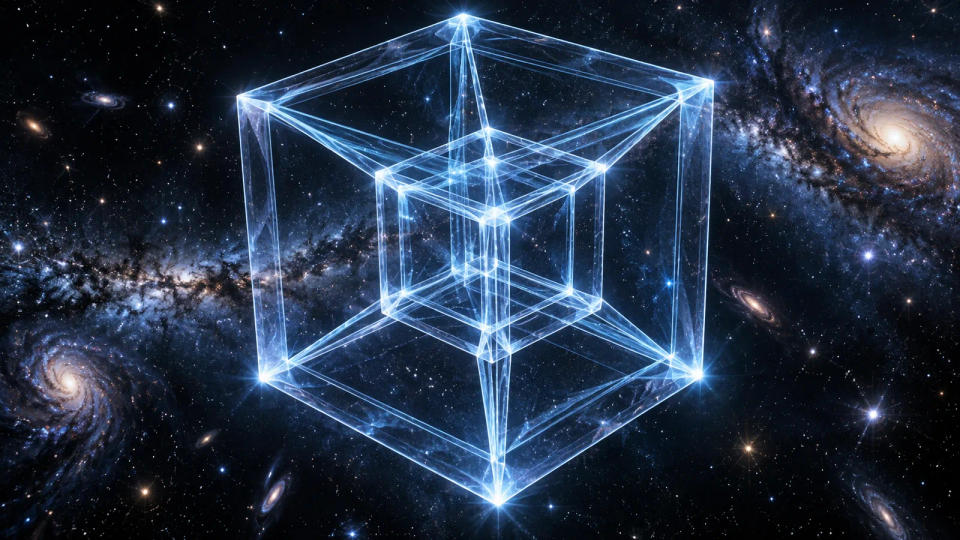
Near the end of Interstellar, Cooper floats through a strange place filled with endless versions of his daughter’s bedroom. He can look at moments from her life as though they were rooms on a shelf. Could anything like that actually exist?
Higher dimensions are a serious idea in mathematics and physics, but the movie’s time-traveling tesseract is science fiction. We can describe four-dimensional shapes with equations. Some theories even suggest that space could have extra directions we cannot see. What we do not have is evidence of a hidden room where people can browse the past.
To make sense of that difference, forget black holes for a moment. Start with a pencil and a sheet of paper.
What Is a Dimension? Start With a Sheet of Paper
A dimension is simply an independent direction you can use to say where something is. On a flat sheet of paper, imagine a tiny cartoon character who can move only left and right, or up and down the page. That character lives in a two-dimensional world.
We live in three spatial dimensions. Besides moving left and right or forward and backward, we can move up and down. A bird can fly above a wall that a character trapped on a flat page could never get over.
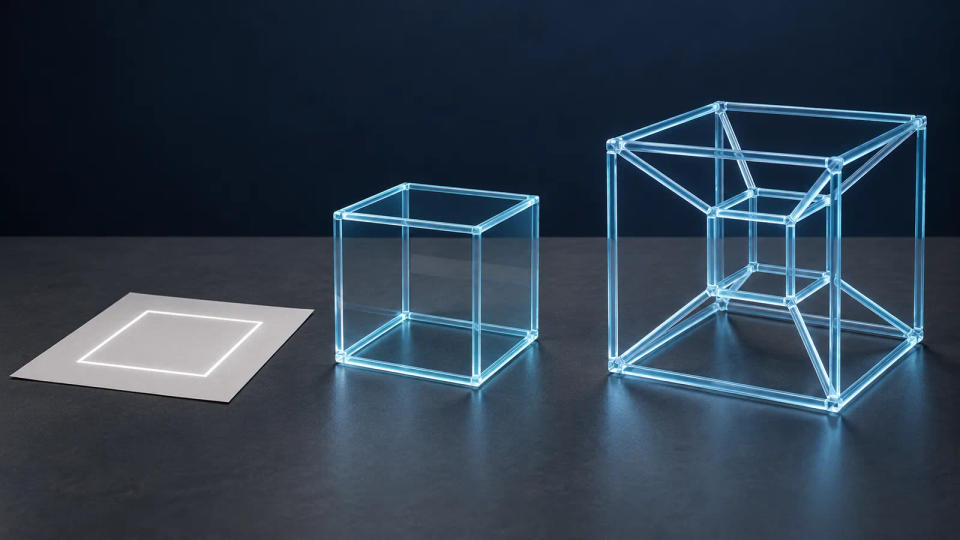
Now imagine reaching into the paper world and lifting the cartoon character off the page. To the character, you might appear to perform a miracle: you have escaped a wall without walking through it. But you are only using a direction the character cannot access.
That is the basic idea behind an extra spatial dimension: one more independent direction, beyond the three familiar ones. It is hard to picture because our brains grew up in a three-dimensional world. The math, however, does not have the same problem.
What Exactly Is a Tesseract?
Here is a shape-building game. Draw a line, then move it in a new direction to make a square. Move that square in another new direction and you get a cube. If you could move the cube in a fourth spatial direction, you would get a tesseract, also called a four-dimensional hypercube.
A cube has six square faces. A tesseract has eight cube-shaped cells forming its three-dimensional boundary. You do not need to memorize those numbers; the important point is that a tesseract is to a cube what a cube is to a square.
Why do tesseract drawings often look like a little cube inside a bigger one, joined by lines? Think about drawing an ordinary cube on flat paper. Your sketch is not a real solid cube. It is a two-dimensional picture of one, made to suggest depth.
Likewise, the familiar nested-cube picture is a lower-dimensional projection of a tesseract. It helps us think about a four-dimensional object without actually showing us four-dimensional space. An architect can draw a house that has never been built; mathematicians can define a tesseract without proving that the universe contains an accessible fourth direction of space.
Is Time the Fourth Dimension in Interstellar?
Yes—but there is a catch. In Einstein’s relativity, we describe an event using three coordinates for where it happens and one for when it happens. Together they form four-dimensional spacetime.
Imagine arranging to meet a friend at a café. Giving the street address is not enough. You also need the time: Tuesday at 3 p.m. Both pieces of information are needed to identify the meeting. That is why physicists treat time as part of the same larger picture as space.
But time is not simply another hallway you can walk down. You can choose to step left or right. You cannot decide to step backward into yesterday in the same ordinary way. In relativity, time and space are deeply connected, yet they do not behave identically.
In the film, the tesseract turns different moments in Murph’s bedroom into something Cooper can inspect almost like locations. It is a brilliant way to visualize a difficult concept. But it is not a demonstration that real people can move freely through their own past—or communicate with it through a watch. Those abilities belong to the story.
Could Extra Dimensions Be Hidden Around Us?
Possibly. One idea is that an extra direction could be curled up so tightly that we do not notice it. For an easy comparison, picture a long rope seen from far away. It looks almost like a thin line with just one useful direction: along its length.

Now put an ant on the rope. The ant can walk along it, but it can also crawl around its curved surface. From the ant’s point of view, the rope offers a direction that was easy to overlook from a distance.
This does not mean the rope literally contains a new dimension. The rope is still an ordinary three-dimensional object. It is only an analogy for how a tiny, tightly curled direction might escape our everyday notice.
Some proposed models of nature use extra spatial dimensions to explore why gravity seems so weak compared with other forces. In certain versions, gravity may spread into directions ordinary matter does not freely enter. Other models imagine extra dimensions too small for us to detect directly. These are possibilities physicists can calculate, not established descriptions of our universe.
What Have Scientists Actually Found?
Scientists have strong evidence for the three spatial dimensions we experience and for relativity’s four-dimensional description of spacetime. They have not confirmed an additional spatial dimension. That is the dividing line between the film’s fascinating idea and the present state of physics.
Still, the search is real. At CERN’s Large Hadron Collider, scientists smash particles together and study the results. Certain extra-dimension theories predict unusual signatures, such as very heavy versions of known particles or effects associated with hypothetical tiny quantum black holes. Finding a convincing signal would be exciting. Finding none helps researchers rule out parts of those theories.
In a result reported on September 24, 2026, the ATLAS experiment described a search using collisions recorded from 2022 to 2024. Researchers looked for the pattern expected from one proposed type of quantum black hole. They found no significant excess over the ordinary physics prediction, and they placed tighter limits on the models tested. That is not proof that all extra dimensions are impossible; it means this particular search did not reveal them.
There is also an important distinction between finding an extra spatial dimension and building Cooper’s extraordinary room. Even if physicists detected evidence of another spatial direction tomorrow, that would not prove that humans could survive inside a black hole, visit earlier moments, or send messages to the past. Each of those claims would require its own evidence.
Conclusion: The tesseract is real as a mathematical idea. Extra spatial dimensions remain scientifically possible in some theories, but unconfirmed. Interstellar takes that genuine mystery and turns it into a moving story about time and family. The interesting question is not whether we can visit Murph’s bedroom tomorrow. It is whether the universe has hidden directions we have not yet learned how to see.
Sources & Further Reading
- NASA — General Relativity and the Nature of Spacetime
- Wolfram MathWorld — Tesseract
- CERN — Extra Dimensions, Gravitons, and Tiny Black Holes
- ATLAS Collaboration — The Hunt for Quantum Black Holes Ventures Into the Energy Frontier (September 24, 2026)
- CMS Collaboration — Are There Quantum Black Holes That Evaporate Instantly? (December 4, 2025)
- WIRED — Interstellar Almost Had 6 Wormholes and 5 Black Holes (2014)
Post a Comment