
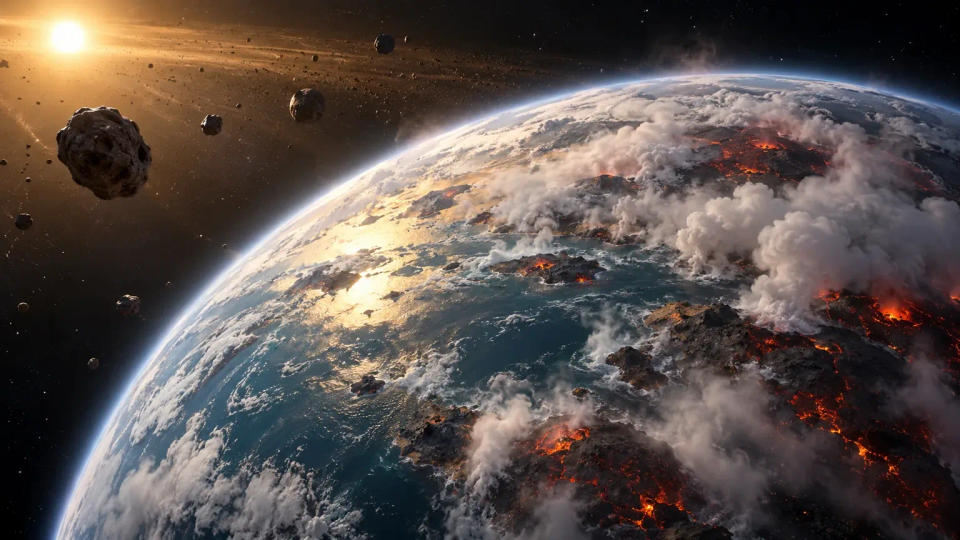
Look at Earth from space and the question seems almost unavoidable: how did a rocky planet that formed close to the hot young Sun end up covered by oceans? The best answer is no longer a simple story about icy comets arriving late. Evidence from meteorites, isotopes, planetary-formation models, and even Apollo Moon dust points to a mixed history in which Earth acquired water ingredients during its growth, received more from water-bearing asteroids, and may also have gained a smaller contribution from comets.
In other words, Earth’s oceans probably do not have a single birthplace. Their story is tied to how the planet itself was assembled.
Some of Earth’s water may have been built in from the start
Water is made from hydrogen and oxygen, and oxygen was never the difficult ingredient for a rocky planet. Earth’s silicate rocks are rich in oxygen. The harder question is how the young planet obtained and retained enough hydrogen.
For years, one influential picture treated the inner Solar System as too hot and dry for Earth’s main building blocks to carry much hydrogen. In that view, water-rich material from farther out had to be delivered later. But laboratory work has complicated that picture.
A 2025 study led by University of Oxford researchers examined an enstatite chondrite, a rare meteorite type whose chemistry resembles important parts of Earth’s original building material. Using X-ray spectroscopy, the team found hydrogen associated with sulfur-bearing material in the meteorite’s fine matrix. Their results suggest that enstatite-chondrite-like material may contain far more hydrogen than its apparently dry minerals imply.
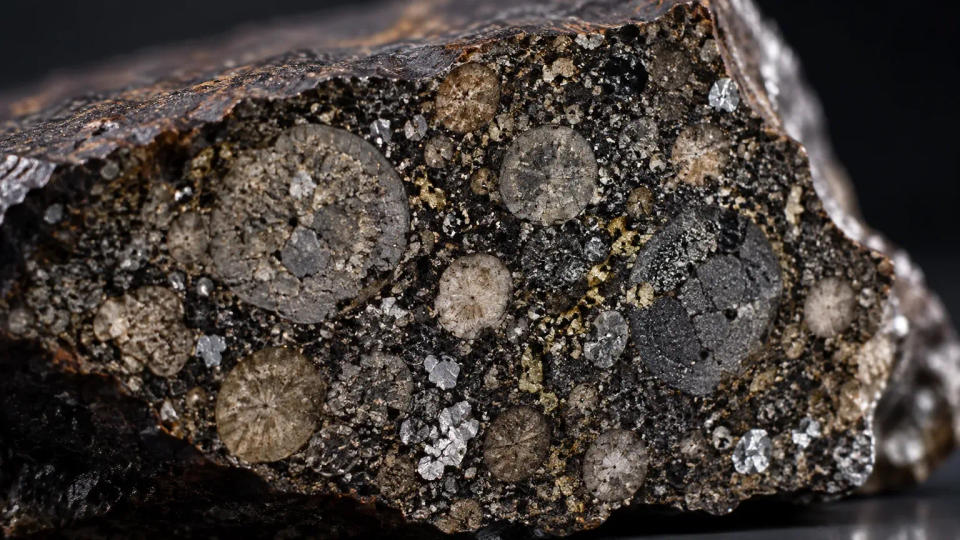
That does not prove that all of Earth’s water was present from day one. It does show that a young Earth assembled from seemingly dry inner-Solar-System material could have started with a meaningful hydrogen supply. Other models also explore how hydrogen from the solar nebula could have interacted with molten planetary embryos and helped produce water. Once Earth cooled enough, water stored in its interior and atmosphere could cycle through volcanic outgassing, steam, condensation, and eventually long-lived surface oceans.
Water-rich asteroids were still an important part of the story
Native hydrogen does not eliminate asteroid delivery. Primitive meteorites called carbonaceous chondrites contain water-bearing minerals and volatile elements, and their isotopic chemistry has long made them strong candidates for supplying part of Earth’s water inventory.
The important distinction is timing. “Asteroids delivered water” can mean two very different things. Water-rich bodies may have been mixed into Earth while the planet was still growing, becoming part of its bulk material. That is different from imagining a mostly finished, dry Earth being filled mainly by a late rain of meteorites.
Modern planet-formation models often blur the old boundary between those ideas. Young planets grow by repeatedly colliding with smaller bodies and planetary embryos, so a water-bearing impactor can be both a delivery vehicle and one of the planet’s building blocks. Earth’s final water budget may therefore record many stages of accretion rather than one dramatic bombardment.
Hydrogen isotopes act like fingerprints
Scientists cannot replay Earth’s formation, so they compare chemical fingerprints. One of the most useful is the ratio of deuterium, a heavy isotope of hydrogen, to ordinary hydrogen. Different regions of the early Solar System developed different deuterium-to-hydrogen ratios, allowing researchers to compare ocean water with meteorites and comets.
This is why comets have moved in and out of the spotlight. Some comet measurements look compatible with Earth’s oceans, while others do not. The famous case of Comet 67P/Churyumov–Gerasimenko once appeared to have roughly three times the oceanic deuterium level, weakening the case for Jupiter-family comets.
In 2024, however, a NASA-led analysis argued that dust in 67P’s coma had affected how earlier spacecraft measurements were interpreted. The revised analysis found that the comet’s water signature could be more Earth-like than previously thought. That reopens the possibility that comets contributed some water, but it does not demonstrate that comets supplied most of Earth’s oceans.
Moon dust puts a limit on late water delivery
The Moon offers something Earth cannot: a surface that preserves an ancient impact record. Weather, oceans, plate tectonics, and erosion continually recycle Earth’s crust, but the lunar regolith keeps fragments and chemical traces of the objects that struck the Earth-Moon system over immense spans of time.
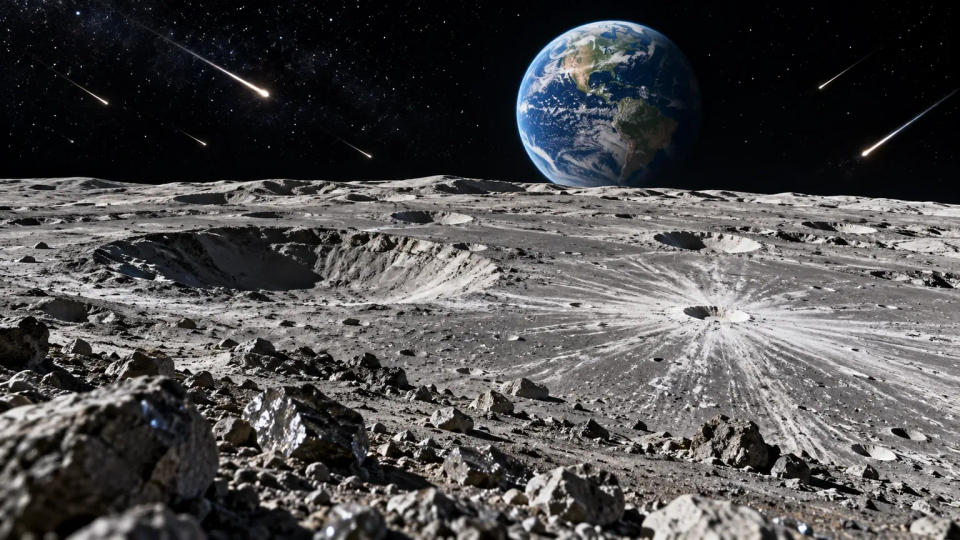
In January 2026, a NASA-led study used triple oxygen isotopes in Apollo lunar soil to estimate the contribution of carbon-rich meteorites to the Moon’s regolith. The researchers then scaled that record to Earth’s much higher impact rate. Even using generous assumptions, they found that meteorites arriving since about four billion years ago could account for only a small percentage of the water in today’s oceans.
This result does not rule out asteroids as a major source of Earth’s water. Instead, it makes the timing clearer. If water-rich asteroidal material contributed substantially, much of that contribution likely happened earlier, during Earth’s main growth phase, rather than as a late delivery to an already formed planet.
So where did Earth’s water come from?
The emerging picture is a blend of sources and processes. Earth’s own building material may have carried more hydrogen than scientists once assumed. Water-rich asteroids and planetary embryos were incorporated during accretion. The hot young planet stored and released water through its mantle and atmosphere. Comets may have added a smaller amount, and ongoing impacts continued to modify the inventory after the oceans existed.
What makes the question fascinating is that scientists are still changing the answer as new evidence arrives. A microscopic sulfur-bearing grain in a meteorite, a revised isotope measurement from a comet, or dust collected by Apollo astronauts can all change how we reconstruct events from more than four billion years ago.
The oceans outside your window, then, are not simply melted comet ice. They are a surviving record of planet formation itself: hydrogen captured in early rocks, volatile-rich bodies mixed into a growing Earth, water cycled through a molten interior, and perhaps a final contribution from distant icy visitors.
Sources & Further Reading
- NASA Science — Lunar regolith limits meteorites as a late source of Earth’s water (2026)
- University of Oxford — Evidence for hydrogen in Earth-like building material (2025)
- Icarus — The source of hydrogen in Earth’s building blocks (2025)
- NASA Science — Revised Comet 67P water isotope analysis (2024)
- Nature — Earth shaped by primordial hydrogen atmospheres (2023)
Post a Comment