
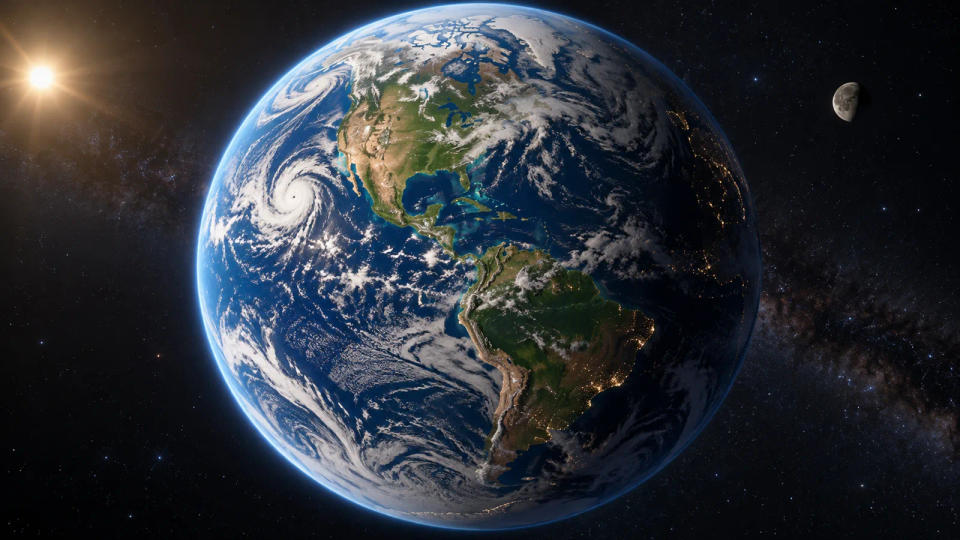
What would happen if Earth suddenly doubled in size? If its diameter doubled while its average density stayed the same, the planet would contain eight times as much mass and its surface gravity would reach roughly 2g. Humans might endure some aspects of that gravity, but a genuinely sudden expansion of the ground, oceans, and atmosphere would be a far greater threat to survival.
This is a physics thought experiment, not a forecast or a phenomenon scientists expect. Its answer depends on what “size” means, how new material appears, and whether the change damages the planet as it happens. Separating those assumptions reveals why a bigger Earth is not automatically a better home.
Does a planet twice as wide have twice the gravity?
Today, Earth's mean radius is about 6,371 kilometers, and its mass is about 5.97 × 1024 kilograms. Doubling its diameter doubles its radius to about 12,742 kilometers and expands its surface area by a factor of four. Because the volume of a sphere depends on the cube of its radius, its volume becomes eight times larger.
The vital missing detail is mass. Surface gravity follows Newton's relation g = GM/R², where M is planetary mass and R is distance from the center. With unchanged average density, an eightfold increase in mass combined with a doubled radius gives 8 ÷ 4 = 2 times today's gravity. Your mass would remain the same, but the force of your weight would double.
Imagine a person who normally has a weight corresponding to 70 kilograms on a bathroom scale. Under 2g, the scale would register a force equivalent to roughly 140 kilograms under today's gravity; the person has not gained 70 kilograms of body mass. A backpack, a wheelchair ramp, or a staircase would likewise require much more effort.
But if a magical force stretched Earth to twice its radius without adding any mass, gravity at the new surface would be only one-quarter as strong, or 0.25g. Its average density would also fall to one-eighth of today's value, making it an entirely different and physically implausible planet. “Twice the size” is therefore not a single scientific outcome.
For the rest of this article, we use the same-density, eight-times-mass, 2g scenario. We also assume the new planet somehow acquires its additional material; the actual energy and mechanism needed for an instantaneous transformation are unspecified and would themselves matter enormously.
Why the sudden expansion could be the real disaster
Earth does not have an elastic shell that can safely inflate like a balloon. Its outer crust consists of moving rock plates over a hot mantle, and the oceans sit in basins shaped by that rocky structure. Doubling the radius in an instant, while keeping recognizable geography, would force enormous rearrangements of rock and water. The details cannot be predicted from one number, but ordinary roads, foundations, dams, pipelines, and continental margins would not remain undisturbed.
Imagine a bridge whose supporting landscape is pulled apart as the distance across the planet increases. A bridge cannot simply become twice as long without new material and new engineering. The same logic applies to railway networks, tunnels, power lines, and coastal cities. Fracture, ground movement, and water displacement would be plausible consequences of many physical expansion mechanisms.
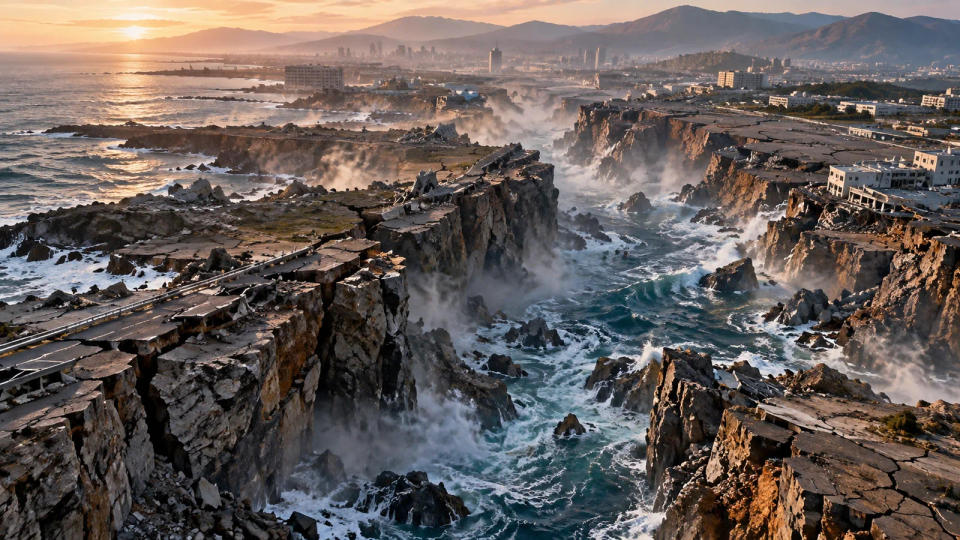
Rapid movement of the seafloor could drive devastating waves, but it would be misleading to invent a worldwide tsunami height or a guaranteed earthquake magnitude. Those depend on the change's speed, geometry, energy, and location. If the transformation were literally instantaneous, familiar earthquake and tsunami models would not capture every effect.
There is another complication: an eightfold larger, equally dense Earth is not guaranteed to remain equally dense after adjusting to its own stronger internal pressures. Real planetary interiors compress, heat, circulate, and undergo chemical changes. This thought experiment freezes average density only so the gravity calculation stays clear. A fully consistent model would need a new interior structure, rotation history, atmosphere, and ocean distribution.
Could anyone survive the initial event? Perhaps in an exceptionally protected location under carefully invented conditions, but no credible science permits a numerical survival rate. In the ordinary physical interpretation of a sudden global expansion, destruction of infrastructure and habitat would likely dominate the emergency long before people could consider adapting to 2g.
Could humans live with 2g, different air, and a changed Moon?
Suppose the impossible expansion is over and a stable surface remains. Standing, lifting, and climbing would become substantially harder at 2g. Walking uses muscles, joints, balance systems, and cardiovascular control that evolved under approximately 1g. Many people, especially those with heart or mobility conditions, would be severely disadvantaged. Routine tasks such as carrying water or getting out of a chair could become difficult.

NASA documents how changing gravity affects balance, movement, and cardiovascular regulation during space missions. That evidence demonstrates gravity matters to the body; it is not a direct experiment showing how a whole population would fare after living for years at constant 2g. Short periods of high acceleration do not establish a safe lifelong exposure limit. Some survivors might adapt partially, but medicine, architecture, transportation, and agriculture would all need redesign.
Breathing is not as simple as saying stronger gravity doubles atmospheric pressure. Atmospheric pressure is related to the weight of the air above each unit of ground area. If the planet retained exactly today's total atmospheric mass, spread it uniformly over four times the surface area, and settled under twice the surface gravity, a simple column estimate gives roughly half today's surface pressure: twice the gravitational pull divided by four times the area.
With an unchanged oxygen percentage, that would also mean roughly half the oxygen partial pressure at the surface, creating a serious high-altitude-like breathing problem. But the real atmosphere's mass, temperature, composition, and exchange with rock and oceans would not necessarily remain constant. If sufficient additional air appeared, pressure could instead be higher. This is a conditional calculation, not a firm prediction.
The oceans would also have four times as much planetary surface to occupy. If today's water volume remained unchanged, the mean water volume per square kilometer of planetary surface would fall to one-quarter its former value. That does not directly determine sea level: the shapes and depths of newly formed ocean basins are unknown. Rainfall, circulation, and coastlines would depend on the atmosphere and terrain left behind.
Finally, a planet with eight times Earth's mass would pull much more strongly on the Moon at the same center-to-center distance. NASA places the Moon an average of about 384,400 kilometers away today. Its existing orbital speed would no longer match the circular-orbit speed for the new mass, so the orbit could change substantially. The Moon would not automatically strike Earth, and its precise new path would require a dynamical calculation with the expansion history. Earth's length of day is likewise impossible to specify without knowing how its angular momentum changed.
Conclusion
A same-density Earth with twice today's diameter would have eight times the mass and approximately twice the surface gravity. But the biggest obstacle to human survival is not a neat 2g number: it is how a planet, its oceans, and its air could transform suddenly without destroying the conditions for life. If we imagine a magically smooth change instead, survival becomes conceivable for some people, although life, health, and engineering would be dramatically harder. The assumption determines the outcome.
Sources & Further Reading
- NASA Science — Facts About Earth
- NASA Swift Learning Center — Law of Gravitation Guide
- NASA Glenn Research Center — Weight Equation
- NASA Glenn Research Center — Earth Atmosphere Equation
- NASA — The Human Body in Space
- NASA Science — Moon Facts
Post a Comment