
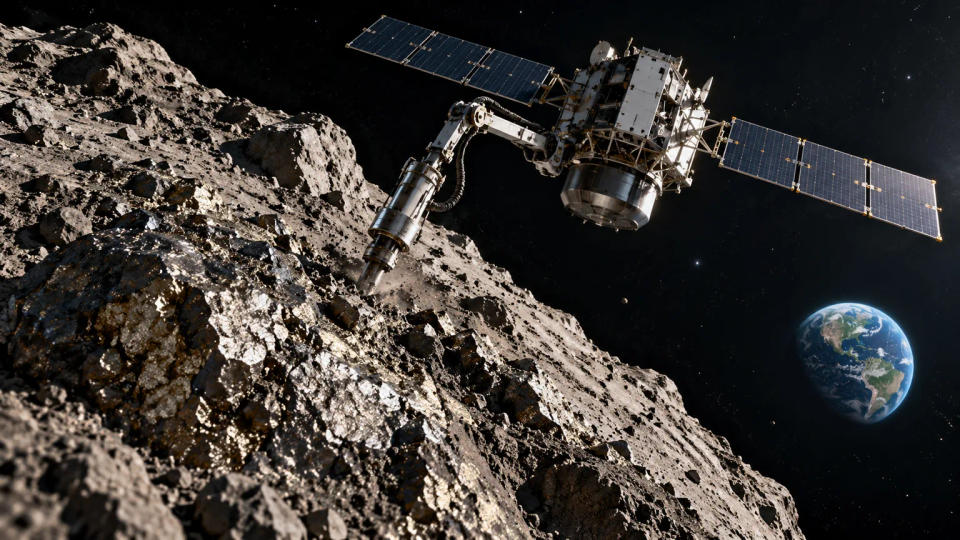
Imagine finding an asteroid with enough gold to make every terrestrial mine look tiny. Could a spacecraft dig it up, refine it, and bring the metal safely back to Earth? In principle, yes. We already know how to rendezvous with asteroids and return samples. But turning that capability into a profitable mining operation is a much harder problem.
The biggest surprise is that the word gold is almost a distraction. Asteroids can contain gold, especially in metal-rich material, but usually at trace concentrations. The real challenge is not proving that the metal exists. It is locating the right asteroid, processing huge amounts of material in microgravity, and returning enough refined metal to justify the mission.
Yes—but asteroids are not giant gold nuggets
Gold is a siderophile element, meaning it tends to associate with metallic iron. That is why iron meteorites—fragments of differentiated asteroids that have fallen to Earth—are useful clues to what some metal-rich asteroids may contain.
Measurements collected by the U.S. Geological Survey found reported gold concentrations in meteorites ranging from tiny fractions of a part per million up to several parts per million. In other words, gold in meteoritic metal is commonly discussed on the parts-per-million scale, not as giant visible seams. One part per million by mass is only about one gram of gold per metric ton of material.
That sounds less dramatic than the familiar “trillion-dollar asteroid” headlines, and that is the point. A metal-rich asteroid could contain an enormous total quantity of precious metal simply because the asteroid itself is enormous. It does not follow that the material is easy to mine or unusually rich everywhere.
Platinum-group metals may be more attractive than gold in some asteroid-mining concepts. Research on iron meteorites finds platinum-group elements at concentrations that can exceed many terrestrial ores. Even then, the valuable metals remain dispersed through much larger masses of iron, nickel, rock, and other material.
Mining in microgravity is the first brutal problem
On Earth, a mining machine can push against the ground because gravity holds both the machine and the ore in place. On a small asteroid, every shove produces an equal push in the opposite direction. A drill that bites too aggressively could send itself drifting away unless it is anchored.
And the surface may not behave like solid bedrock. NASA’s OSIRIS-REx mission discovered that asteroid Bennu is astonishingly loose. During its 2020 sample collection, the spacecraft sank much farther into the surface than expected and would have kept sinking if it had not fired its thrusters to back away. Bennu’s exterior behaved more like a loosely packed pile of particles than a hard floor.
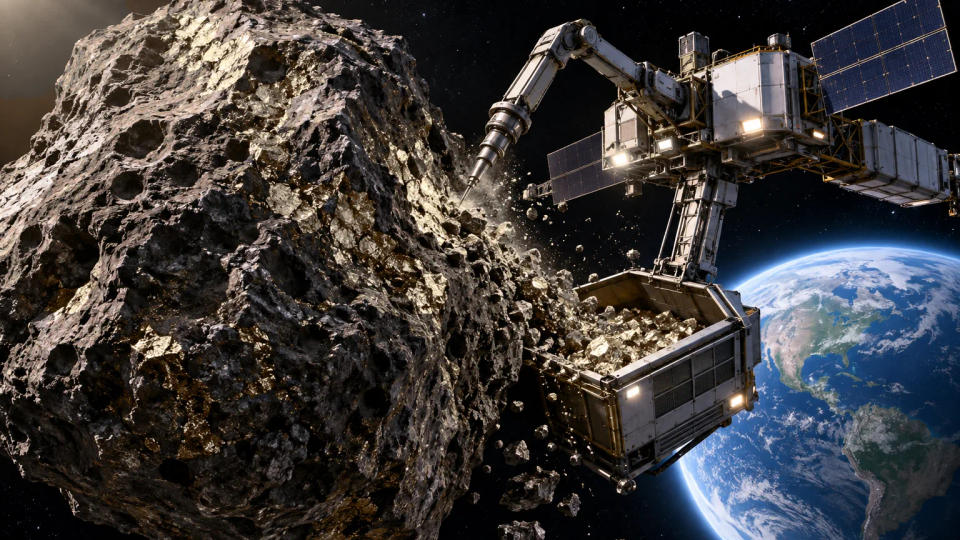
Concept visualization: real asteroid surfaces may be loose rubble, fractured rock, metal-rich material, or mixtures of all three.
A practical miner would therefore need to control several jobs at once: attach itself securely, break or collect material without losing it to space, separate useful metal from waste, manage abrasive dust, survive extreme temperature swings, and operate for months or years with little direct human help.
Refining is another major hurdle. Carrying raw asteroid rock back to Earth would waste precious return mass. A serious mining system would probably want to concentrate or refine the valuable material before departure. That means bringing furnaces, magnetic separators, chemical processing equipment, or other machinery into an environment where every kilogram of hardware is expensive to launch.
Returning asteroid material to Earth is already possible
The encouraging part is that sample return is no longer science fiction. NASA’s OSIRIS-REx spacecraft delivered 121.6 grams of material from asteroid Bennu to Earth on September 24, 2023. Japan’s Hayabusa missions also returned asteroid samples. These missions proved that a spacecraft can visit a small body, collect extraterrestrial material, navigate home, and release a capsule for controlled entry through Earth’s atmosphere.
But 121.6 grams and industrial cargo are completely different scales. A mining mission might need to move hundreds, thousands, or eventually millions of kilograms of processed material before the economics became compelling. A return vehicle would need enough propulsion, shielding, guidance, and thermal protection to deliver that mass safely.
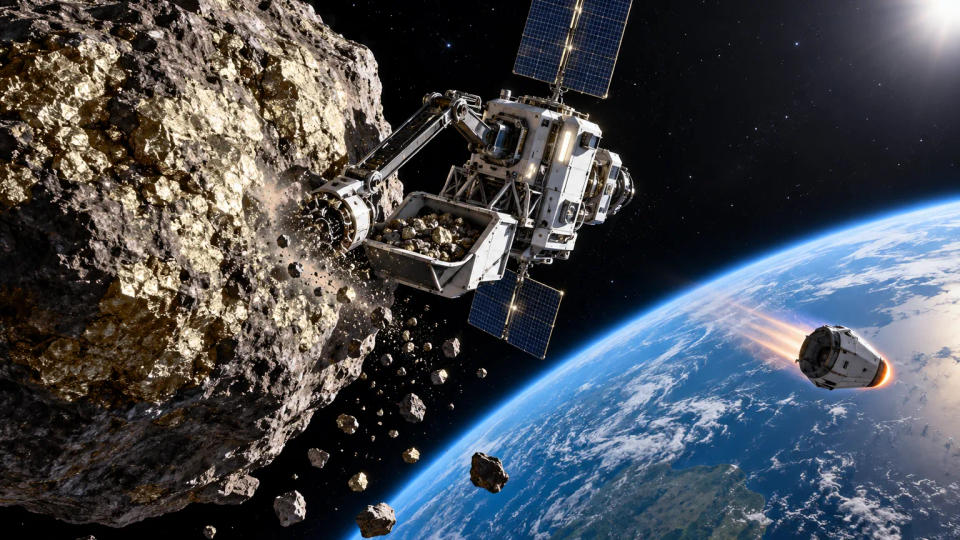
Concept visualization: sample-return technology exists, but no mission has returned commercial quantities of asteroid metal.
There is also a useful lesson from NASA’s Psyche mission. The asteroid Psyche is considered metal-rich, but current estimates suggest it may be a mixture of rock and metal rather than a solid metallic world. NASA’s spacecraft completed a Mars gravity assist on May 15, 2026, and is now continuing toward Psyche for a 2029 arrival. The mission is designed to study the asteroid, not mine it, and its results should improve our understanding of how metal is actually distributed on such bodies.
Then comes the economics. Even if a spacecraft could mine gold successfully, profitability would depend on far more than the amount of metal in the asteroid. The target must have a favorable orbit. The spacecraft must reach it with manageable propulsion needs. The ore has to be rich enough to process. The machinery must survive. The metal must then be transported back without the mission cost swallowing its value.
There is another twist: bringing a truly enormous supply of precious metal to Earth could change the market price of that metal. A deposit cannot be valued simply by multiplying its estimated mass by today’s price, because the price itself could fall if supply rose sharply.
That is why many researchers see a different near-term value in asteroid resources: use them in space instead of returning them to Earth. Iron and nickel could eventually become construction feedstock. Water from suitable asteroids could be split into hydrogen and oxygen or used directly for life support. Every kilogram obtained in space is a kilogram that might not need to be launched from Earth’s deep gravity well.
Gold could still have a role. A compact cargo of high-value refined metal is easier to imagine returning than millions of tons of bulk iron. But a profitable system would likely need excellent prospecting data, highly autonomous robots, efficient in-space refining, cheap transportation, and many successful missions—not one heroic spacecraft.
Conclusion: gold could come home, but not soon
In physical terms, returning asteroid-derived gold to Earth is possible, and asteroid sample-return missions have already demonstrated the basic return path. What we have not demonstrated is the industrial scale required to make asteroid gold a business.
The first true asteroid mines may therefore be less like flying treasure chests and more like remote factories: slow, robotic, carefully anchored, and focused on extracting the most useful material with as little waste as possible. The gold is real. The difficult part is building an entire space economy capable of reaching it.
Sources & Further Reading
- NASA — Is NASA Mining Asteroids? We Asked a NASA Scientist
- U.S. Geological Survey — Gold in Meteorites and in the Earth’s Crust
- Planetary and Space Science — Precious and Structural Metals on Asteroids
- NASA — OSIRIS-REx Bulk Sample Mass
- NASA — Asteroid Bennu’s Surprisingly Loose Surface
- NASA/JPL — Psyche Mission Completes Mars Flyby
Post a Comment