
The Sun shines because nuclear fusion in its core releases energy, without the oxygen that an ordinary fire needs.
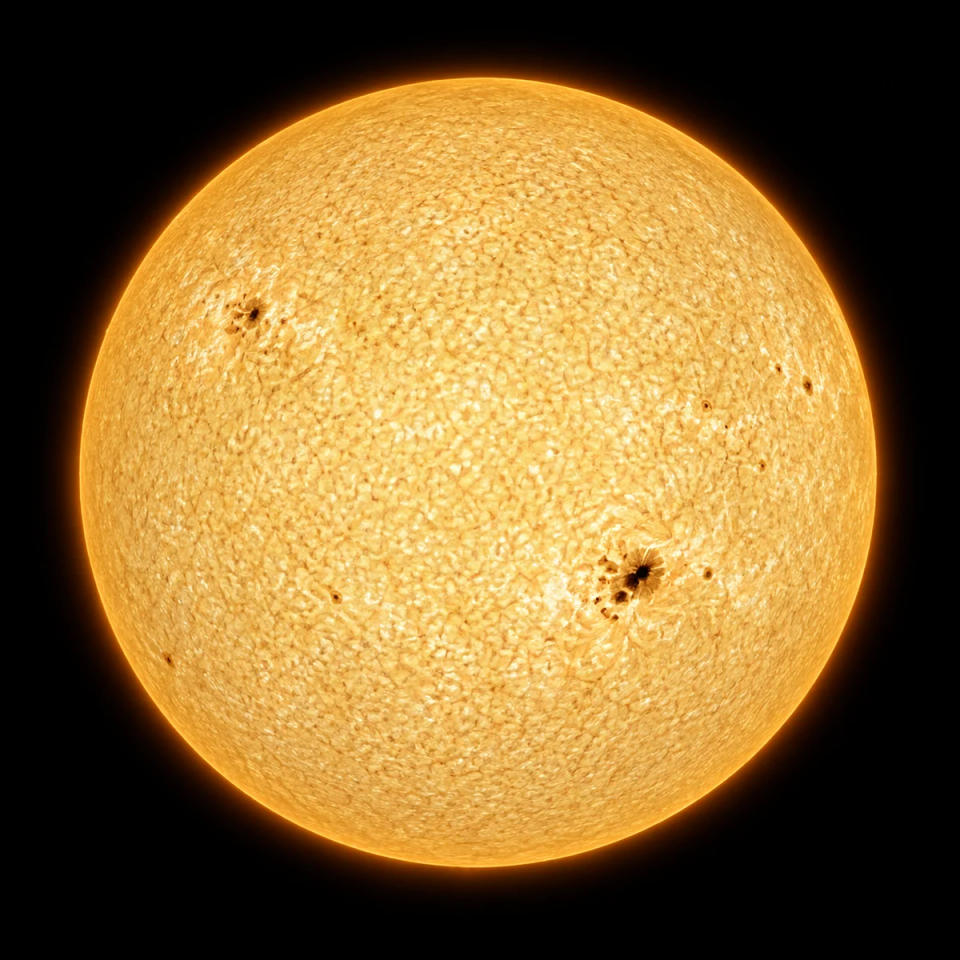
Our nearest star looks like something that ought to be burning, yet its power source works very differently from a flame. Deep inside the Sun, nuclear reactions transform hydrogen into helium and release energy. That energy heats the star and eventually escapes into space as radiation, including the sunlight reaching Earth.
The Sun formed roughly 4.6 billion years ago. That immense age raises another question: how can it keep producing light for so long? The answer combines a powerful nuclear process, an enormous supply of material and a reaction rate slow enough to stretch the supply across billions of years.
What Powers the Sun if It Is Not on Fire?
A candle or a wood fire releases energy through chemical reactions. Atoms rearrange into different molecules, and an ordinary flame needs an oxidizer such as oxygen. The Sun's main energy source is nuclear fusion, which changes atomic nuclei themselves. It does not depend on drawing in oxygen from surrounding space.
Scientists sometimes describe the Sun as “burning hydrogen.” In stellar physics, that phrase refers to nuclear processing. It does not mean that hydrogen is feeding a familiar yellow flame. NASA's StarChild explanation makes precisely this distinction between the everyday word “burning” and the mechanism inside a star.
Much of the Sun consists of plasma: hot material containing charged particles, including ions and free electrons. In its core, conditions allow hydrogen nuclei to participate in a sequence of reactions known as the proton-proton chain. The overall result is the conversion of hydrogen into helium, with energy released along the way.
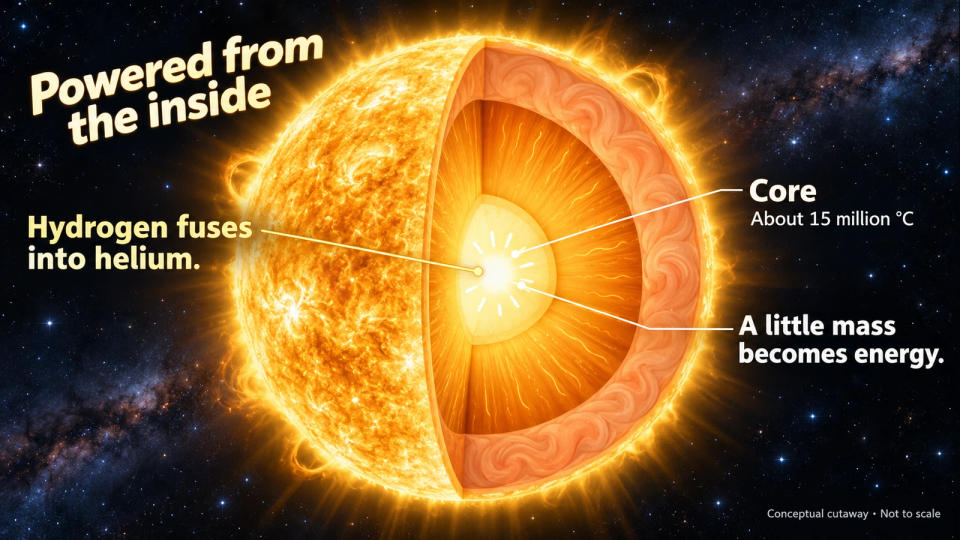
Where does that energy come from? The final products of the complete reaction sequence have less rest mass than the starting material. The difference appears as released energy, described by Einstein's relationship E = mc². Because the speed of light squared is so large, even a small mass difference corresponds to a substantial amount of energy.
This does not mean that the Sun turns all its hydrogen straight into light. Most of the material participating in the process ends up in helium. The crucial point is the energy available from the difference, rather than the disappearance of the entire fuel supply.
How Core Energy Becomes the Sunlight We See
The nuclear engine is buried inside the star. NASA gives the central temperature as about 15 million degrees Celsius, while the visible photosphere is around 5,500 degrees Celsius. Those are temperatures of very different regions; the glowing surface should not be mistaken for an exposed fusion reaction.
Energy travels outward through the Sun's interior. In the radiative zone, radiation repeatedly interacts with the surrounding material. The outward transfer is not a straight, uninterrupted flight from the center to space. Different explanations give different estimates of the travel time, so assigning every ray of sunlight one exact age would be misleading.
Farther out, convection becomes important. Hotter plasma rises, transfers energy toward the surface, and cools as it moves through the outer layers. Cooler material can descend, maintaining circulation. The visible surface carries a granular pattern associated with these convective motions.
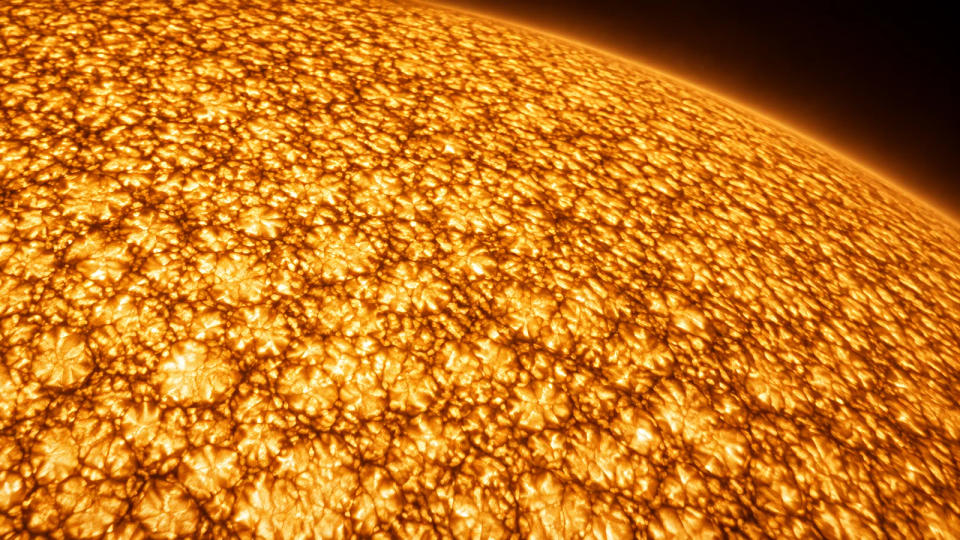
The photosphere is the layer from which much of the Sun's radiation escapes into space. Its material is hot enough to glow intensely. A familiar comparison is heated metal emitting light, although a star is vastly hotter, larger and physically different from a solid piece of metal.
Our illustrations separate these ideas deliberately. The cutaway explains a hidden interior using schematic colors, while the granular close-up represents the visible surface in a warm color treatment. Neither is an actual photograph taken inside the Sun. The energy source and the layer we observe are connected, but they are not the same place.
Why the Sun Can Keep Shining for Billions of Years
Having an enormous amount of hydrogen helps, but a large fuel supply is only part of the explanation. The initial proton-proton fusion reaction proceeds very slowly under solar conditions. The Sun can produce tremendous total power because it contains an immense number of particles, even though individual reactions are rare.
A July 2025 Department of Energy research summary highlights how difficult that slow reaction is to measure directly at solar energies. Researchers use related nuclear measurements to improve predictions of its rate. This distinction matters: the basic fusion explanation is established, while scientists continue refining the calculations that describe exactly how it proceeds.
The Sun is also a self-gravitating structure rather than an uncontained explosion. Gravity compresses its material, while the pressure of its hot interior provides support against collapse. Energy released by fusion helps maintain those hot conditions. The Department of Energy calls a plasma sustained mainly by its own fusion heating a burning plasma.
Only the central region has the right conditions for substantial fusion today. The entire Sun is not simultaneously consuming hydrogen at the same rate. Its long life therefore involves both the nuclear reaction rate and the structure of the star, rather than simply dividing all its hydrogen by an imagined universal burning speed.
The age in the title is an approximate formation age, not a claim that the Sun has maintained exactly today's brightness throughout its history. Stars develop as their interiors change. Eventually, changing fuel conditions will lead our star beyond its present phase, toward a red giant and ultimately a white dwarf. That evolution is different from a campfire simply going dark when its last log is used up.
Conclusion
The Sun's light begins with nuclear fusion in its core. Energy moves outward through its interior, and the hot photosphere radiates into space. Oxygen-fed flames are not needed for either the nuclear reactions or the resulting glow.
Its roughly 4.6-billion-year history is possible because nuclear reactions release large amounts of energy, the star has a vast reservoir of material, and the relevant reactions proceed slowly. The bright disk in our sky is the outward sign of an energy system operating deep within a changing, long-lived star.
Sources & Further Reading
- NASA: Sun — Facts.
- NASA StarChild: How can the Sun “burn”? (August 2001).
- Department of Energy: DOE Explains...Fusion Reactions.
- Department of Energy: DOE Explains...Burning Plasma.
- Department of Energy: Understanding How the Sun Shines: From Triton Decay to Proton-Proton Fusion (July 7, 2025).
- NASA/Marshall Solar Physics: The Solar Interior.
Post a Comment