
A planet becomes nearly round when its own gravity grows strong enough to overcome the strength of the material inside it.
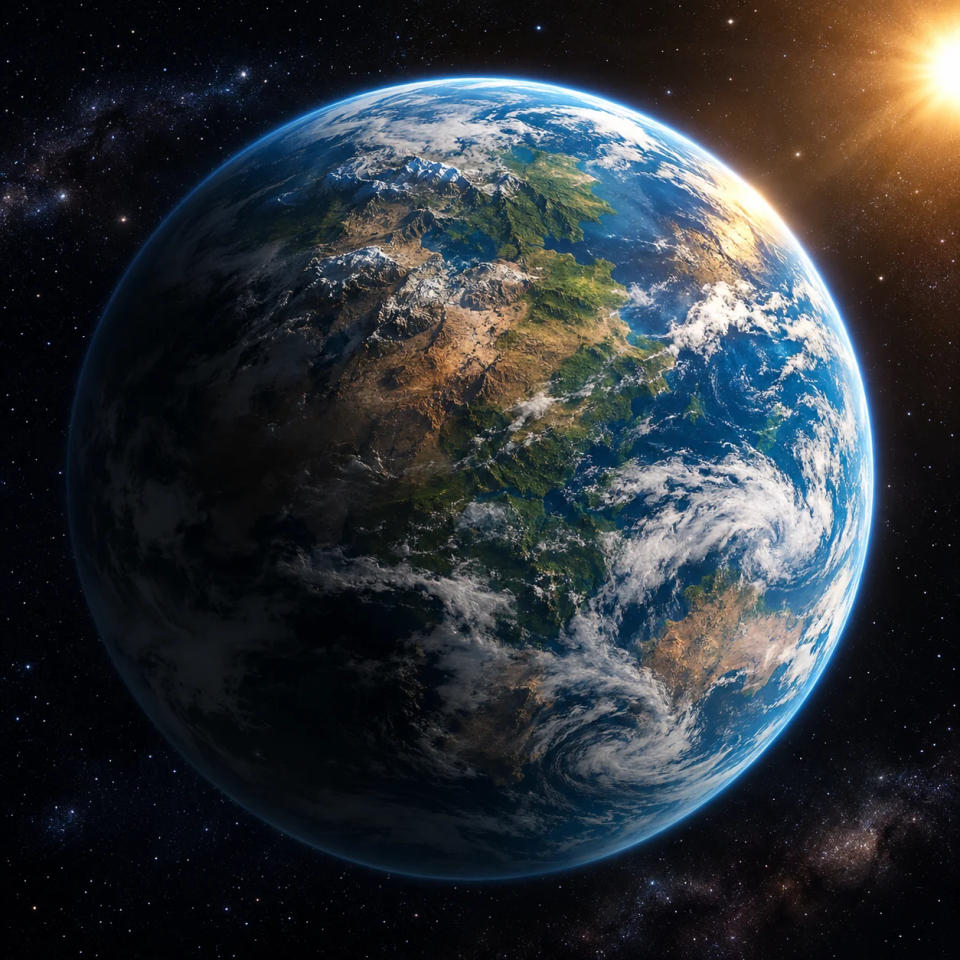
Look at a picture of the Solar System and one pattern stands out: Mercury, Venus, Earth, Mars, and the four giant planets all have rounded outlines. Yet nearby asteroids can look like potatoes, and even Earth is not a perfect ball. What decides which shape a world takes?
The short answer is self-gravity. Every piece of a planet attracts other pieces. When the body becomes massive enough, that collective inward pull can overcome the strength that holds rock or other material in an irregular shape. Matter adjusts toward a nearly spherical form. Rotation, impacts, and local geology explain why the result is not always a flawless sphere.
How Does Gravity Turn a Growing World Round?
Gravity is not simply a force pulling objects down toward the ground. It is an attraction between masses. Inside a developing planet, pieces of material attract one another from many directions. Their combined gravitational effect tends to draw material toward the body's center of mass, gradually reducing large differences in height and shape.
A useful thought experiment is a gigantic pile of loose material. If the pile is small, the bonds and friction between its pieces may keep it uneven. Add enough material, however, and the weight of the layers above becomes substantial. High regions are increasingly difficult to support, while material can settle and redistribute. In a large world, gravity has the advantage.
Early planets also experienced collisions as they grew from smaller bodies. Impacts, compression, and radioactive heating could warm their interiors and, in some cases, create molten regions. Hot or deformable material can adjust its shape more readily than a rigid, cold rock. A rocky planet may later cool and retain mountains and impact basins without losing its overall rounded form.
Scientists use the term hydrostatic equilibrium for the state in which a celestial body's large-scale shape reflects a balance between inward gravity and forces such as internal pressure. The word does not mean that the whole body must be liquid. Solid material can deform over long periods under sufficiently high stresses. Rotation also matters to the final equilibrium shape.
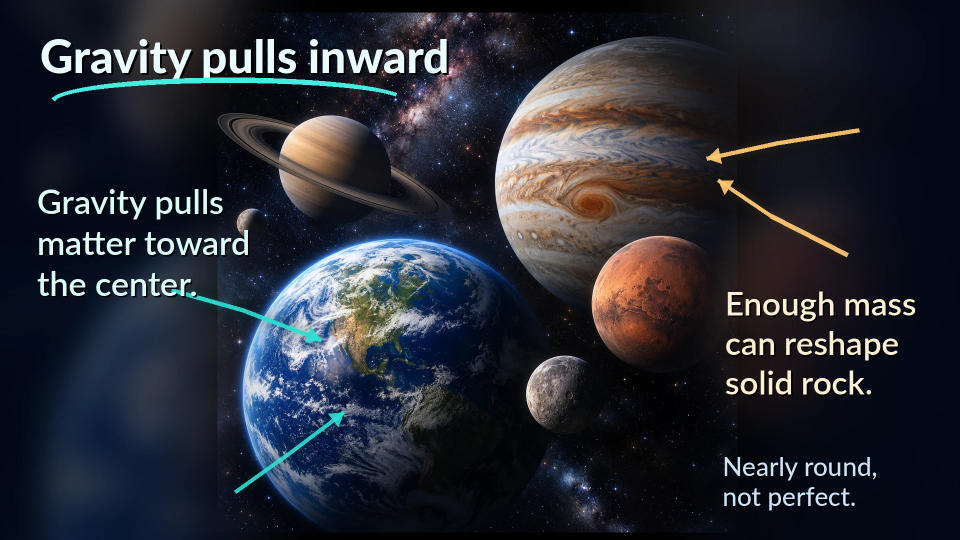
The important distinction is not that gravity stops acting on small objects. Every asteroid has gravity. The question is whether its self-gravity is strong enough, relative to its material strength, to rearrange its overall form.
Why Are Many Asteroids and Small Moons Irregular?
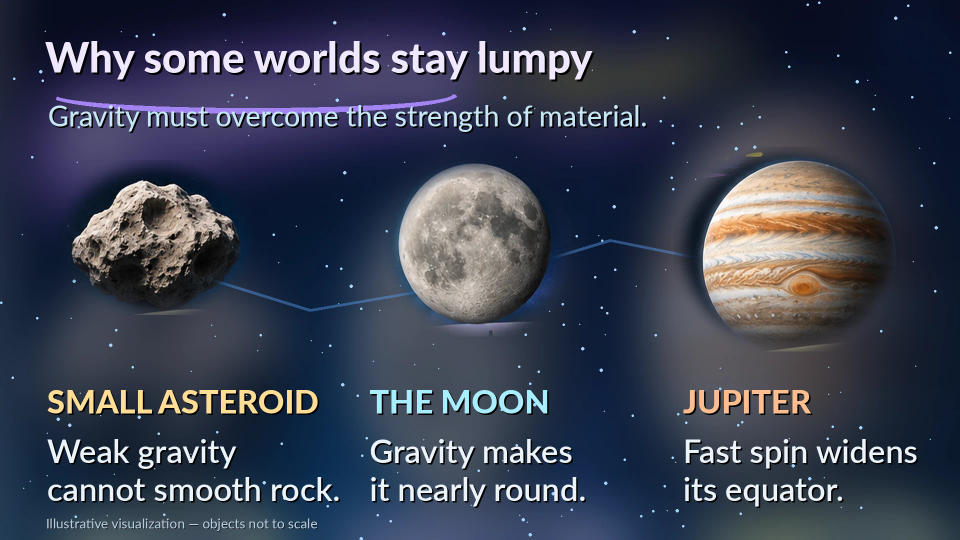
NASA notes that most asteroids have irregular shapes, although some are nearly round. A small rock can support bumps, sharp edges, and deep depressions because the electromagnetic forces binding its material and the friction between fragments can be strong compared with its weak self-gravity. These bodies may also be battered by collisions that change their outlines.
Size is a useful clue, but there is no single magical diameter at which every object suddenly becomes spherical. Composition, temperature, porosity, internal structure, and collision history all matter. A loosely packed icy body may deform differently from a dense, strong rocky one. The transition from irregular to nearly round therefore varies from object to object.
Consider the Moon. Its gravity was sufficient to produce a broadly rounded body, even though impact craters, mountain ranges, and differences beneath its surface remain. Jupiter, far larger and mostly made of hydrogen and helium, also has a rounded outline. An asteroid can be small enough for its irregular structure to persist. The accompanying illustration compares these outcomes conceptually, not at their real relative sizes.
Actual observations make the difference vivid. NASA's OSIRIS-REx spacecraft found that the asteroid Bennu has a rugged, boulder-covered, spinning-top-like form rather than the smooth spherical surface of an ideal planet. It is an example of how weak gravity, loose material, and rotation can interact to create a complicated shape.
Roundness alone also does not determine whether an object is officially called a planet. Under the International Astronomical Union's Solar System definition, both planets and dwarf planets must be sufficiently massive to become nearly round. The distinguishing orbital requirement is that a planet has cleared the neighborhood of its orbit, while a dwarf planet has not.
Why Aren't Planets Perfect Spheres?
Even when self-gravity creates a roughly round world, rotation changes its shape. At the equator, material travels around the rotation axis in a larger circle than material near the poles. The rotating body's effective gravity is reduced at the equator, so its equilibrium outline can bulge outward around the middle and flatten slightly at the poles. This is called an oblate spheroid.
Saturn provides the most dramatic Solar System example. NASA's educational comparison gives its equatorial diameter as about 10.7% greater than its pole-to-pole diameter. Jupiter is also noticeably flattened, with an equatorial diameter about 6.9% greater. These figures describe the planets' global shapes, not their local storms or cloud bands.
Earth is much closer to spherical: NASA reports that its equatorial diameter is about 0.3% greater than its polar diameter. That is a small difference when seen from orbit, but it can be measured. According to NOAA, Earth's real shape is even more complicated than a simple ellipsoid because mountains, ocean trenches, differences in the gravity field, and shifting crustal and ocean surfaces introduce further variations.
Not every bump is a rotation effect. A crater is made by an impact. A volcano is built by geology. Strong tidal forces from another nearby celestial body can also distort a world. These processes change local or global shapes without changing the central reason large isolated bodies tend to be round.
That is why a planet is best described as nearly spherical, rather than mathematically perfect. Gravity makes a rounded overall shape possible; spinning and other physical processes add the details. The same general physics helps explain why many large moons and stars look round, while countless smaller rocks in space do not.
Conclusion
Planets are mostly round because their own gravity acts throughout them, pulling material inward until large irregularities become difficult to support. During formation, collisions and internal heating can help material redistribute; over longer times, pressure and the strength of solids determine how closely a body approaches an equilibrium shape.
Small asteroids can remain oddly shaped because their gravity is too weak to overcome material strength. Large worlds generally become nearly spherical, but they are not perfect balls: rotation gives many of them a wider equator, and geological processes leave smaller features. The next time you see a row of round planets, remember that the shared shape is evidence of the same basic physical force working across very different worlds.
Sources & Further Reading
- NASA Space Place — Why Are Planets Round?
- European Space Agency — Why Are Things in Space the Shape That They Are?
- NASA Science — What Is a Planet?
- NASA Science — Asteroid Facts
- NOAA National Ocean Service — Is the Earth Round?
Post a Comment