
The Moon rises about 50 minutes later each day on average because its orbit makes Earth rotate a little farther before moonrise.
Look for the Moon at the same hour on two consecutive evenings, and you may find it in surprisingly different places. Sometimes it is already high above the rooftops. On another evening, you might have to wait for it to appear above the eastern horizon. The explanation is not that Earth suddenly slows down: the Moon is moving around Earth while our planet rotates. That orbital motion usually pushes the next moonrise later on the clock.
The familiar estimate is about 50 minutes per day, but it is an average, not a schedule that every location follows precisely. Once you understand the moving Moon, you can also make sense of why a full Moon appears around sunset and why the Moon is sometimes visible in broad daylight.
Why Does the Moon Need Extra Time to Rise?
Earth's rotation is the main reason the Moon appears to rise in the east, cross the sky and set in the west. The same rotation produces the apparent daily movement of the Sun and stars. If the Moon remained fixed against the distant stars, its rising pattern would be much easier to predict from one day to the next.
But the Moon does not stand still. It travels eastward around Earth, completing one orbit relative to the background stars in about 27.3 days. This is called a sidereal month. Dividing a full circle of 360 degrees by roughly 27.3 gives an average advance of about 13 degrees each day. NASA describes a similar shift of roughly 12–13 degrees against the stars.
Imagine that you face a particular part of the eastern horizon as the Moon rises. A day later, Earth has turned through another cycle, but the Moon has moved forward in its orbit. Your location must rotate farther before the Moon returns to the same rising horizon. That extra rotation takes roughly 50 minutes on average, although the exact value varies.
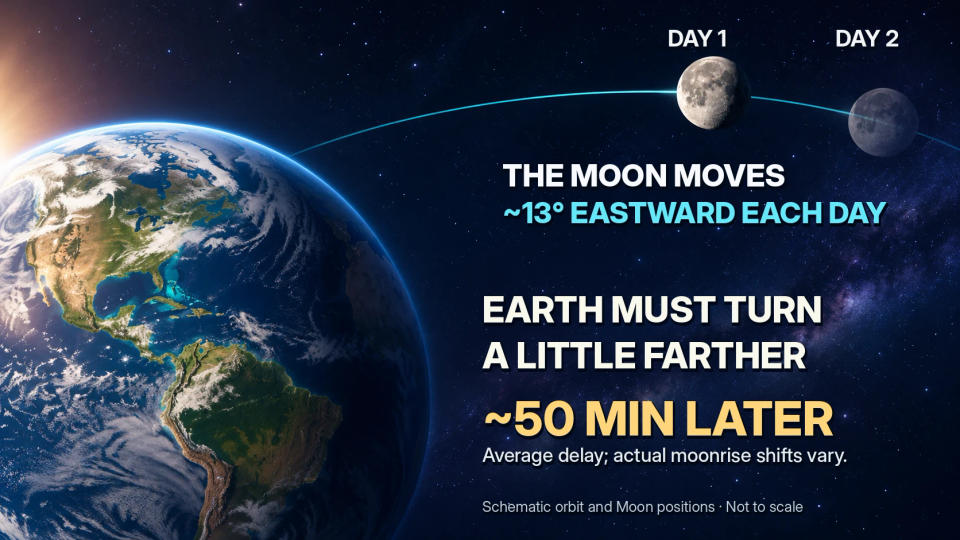
This does not mean the Moon needs 50 minutes to travel across the sky. Nor does it mean that the Moon's orbit suddenly speeds up after sunset. The delay comes from combining two continuous motions: Earth's daily spin and the Moon's slower journey around us. A handy way to remember it is that the Moon moves the target while Earth keeps turning toward that target.
How Do Moon Phases Predict the Time of Moonrise?
The Moon's changing appearance and its rising time are related because both depend on the Moon's position relative to the Sun and Earth. The Moon reflects sunlight; half of its globe is illuminated at a time. From Earth, we see different portions of that sunlit half during the roughly 29.5-day cycle of lunar phases.
At new Moon, the Moon lies near the Sun's direction in our sky, so it generally rises around sunrise and sets around sunset. It is usually invisible because its illuminated side faces away from us and its position is close to the Sun. This is why the new Moon does not normally provide a visible nighttime target.
At first quarter, the Moon is about 90 degrees from the Sun as seen from Earth. It typically rises around noon, reaches a high position around sunset and sets near midnight. That makes the first-quarter Moon a useful evening sight, even though it first appeared above the horizon hours before darkness.
A full Moon sits approximately opposite the Sun in our sky, so it generally rises around sunset and sets around sunrise. At last quarter, the Moon typically rises near midnight and sets around noon. Between these main phases, moonrise gradually shifts across morning, afternoon, evening and nighttime hours.
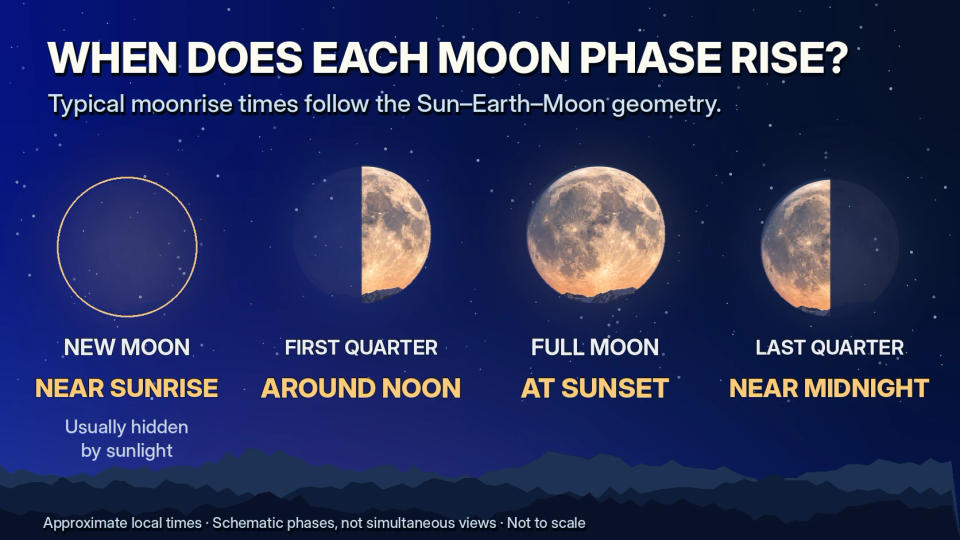
These are approximate relationships rather than four appointments fixed to the minute. They explain an everyday puzzle: a bright Moon can be visible during the afternoon, and a cloudless night can begin with no Moon at all. A phase diagram is often a better first clue than assuming the Moon must appear after dark.
Why Is the Delay Not Exactly 50 Minutes Every Day?
The 50-minute rule is useful, but the real sky is more complicated. The Moon moves along a tilted, slightly elliptical orbit, and the way its path meets the horizon changes with your latitude and the season. The angle matters: a Moon traveling along a path that meets the horizon steeply can have a different daily rise-time shift from one following a shallow path.
There is also a distinction between orbiting time and phase time. About 27.3 days describes the Moon's orbit against the distant stars. About 29.5 days describes the cycle from one new Moon to the next, because Earth also travels around the Sun during that period. These two numbers answer different questions; they are not competing estimates of the same cycle.
Near a Northern Hemisphere autumn full Moon, often called the Harvest Moon, successive moonrises can occur much closer together than the average 50-minute interval. In other seasons or at other latitudes, the shift can be larger. An observing site with mountains or tall buildings may also hide the Moon for a while after the calculated rise at a flat horizon.
Another surprise is that some calendar dates have no moonrise listed at a particular location. Since one rising event may be followed by the next more than 24 hours later, the next event can fall on the day after tomorrow. This is not a missing Moon or an astronomy-calendar error. It is a consequence of putting a repeating event on a calendar divided into 24-hour days.
For an actual observing plan, use a moonrise table calculated for your city and date, then check your eastern horizon. A published time usually refers to an unobstructed reference horizon; hills, haze, clouds and buildings can change when the Moon becomes visible to you. The Moon may also be above the horizon while sunlight prevents you from noticing it.
Conclusion
The Moon rises at a different time because it is not waiting in one fixed place while Earth turns. It advances eastward in its orbit, so our planet usually needs a little additional rotation to bring it above the horizon again. The result is an average delay of about 50 minutes per day—not a perfectly uniform interval.
Look at the Moon's phase before planning an observation. New Moon belongs near the Sun in the daytime sky; first quarter favors the evening; a full Moon rises near sunset; and last quarter is a late-night or morning sight. Together, Earth's rotation, the Moon's orbit and Sun–Moon geometry turn apparently random moonrise times into a predictable pattern.
Sources & Further Reading
- NASA Science — Skywatching FAQ
- NASA Science — Moon Phases
- U.S. Naval Observatory — Rise/Set/Transit Times for Major Solar System Bodies and Bright Stars
- U.S. Naval Observatory — Phases of the Moon and Percent of the Moon Illuminated
Post a Comment