
The Moon never changes shape; its eight phases come from how much of its sunlit half we can see from Earth.
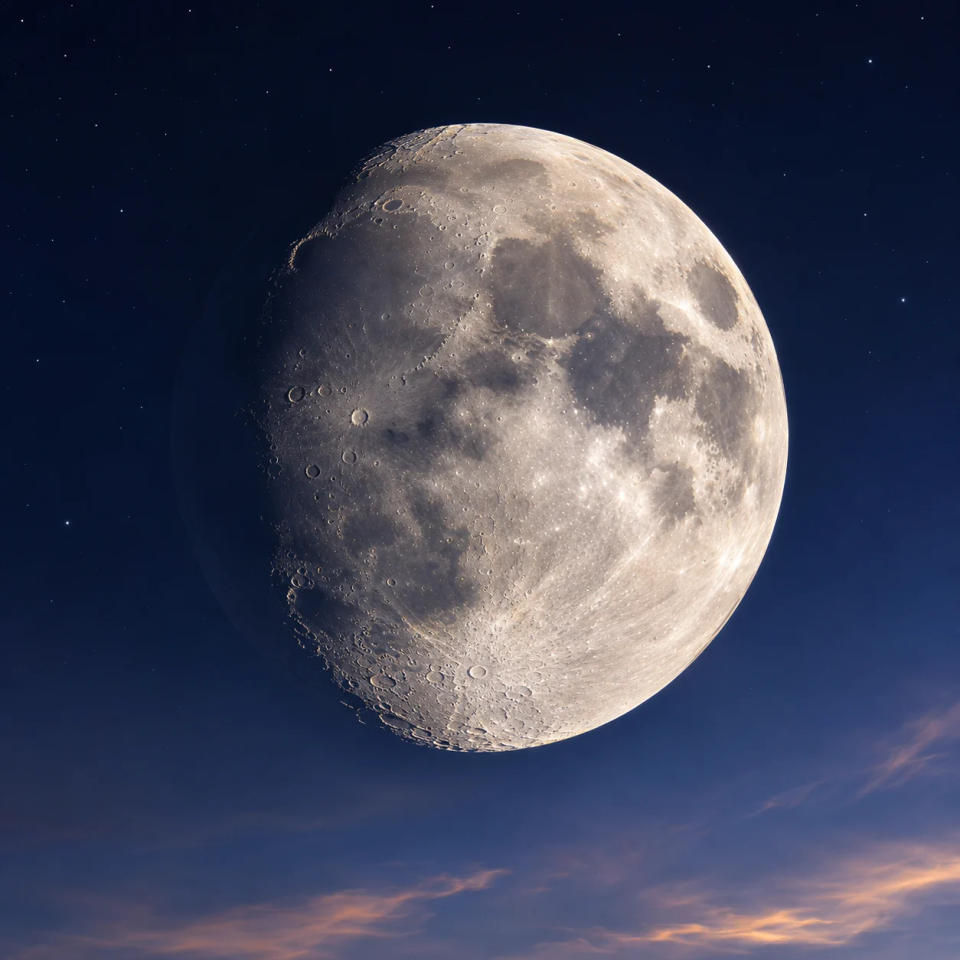
One night the Moon looks like a shining circle. A few nights later, it looks like half a circle or a thin curved slice. The change can be so clear that it almost seems as if pieces of the Moon have disappeared.
But no pieces are missing. The Moon remains a round world, and the Sun continues to light up about half of it at any moment. As the Moon travels around Earth, we see different amounts of that bright half. Those changing views are called Moon phases. There are eight commonly named phases, and the pattern repeats about every 29.5 days.
Why Does the Moon Look Different Every Night?
The Moon does not produce its own sunlight. The glow we see is sunlight reflected from its rocky surface. Imagine a ball near a lamp. One side of the ball is bright, while the side facing away from the lamp is dark. The ball has not changed shape. Only the lighting has changed.
Something similar happens in space. The Sun is the light source, and the Moon is the ball. But there is another important part: our viewing position. The Moon moves around Earth, so the angle between the Sun, Moon, and Earth changes from night to night. Sometimes we look toward most of the Moon's bright side. Sometimes we can see only a slim part of it.
The dividing line between the bright and dark parts of the Moon is called the terminator. Along this line, sunlight hits the ground at a low angle, casting long shadows across mountains and craters. That is why a half Moon can reveal surprisingly sharp details through binoculars or a small telescope.
The Moon completes one trip around Earth in about 27.3 days. However, Earth is also traveling around the Sun. The Moon needs a little extra time to return to the same lighting arrangement, so the full phase cycle takes about 29.5 days. These are two different measurements of the Moon's motion.
What Are the Eight Moon Phases, in Order?
It helps to think of the cycle as two halves. During the waxing half, the bright area we see grows. During the waning half, it shrinks. These words describe what the Moon looks like from Earth, not a real change in the Moon's size.
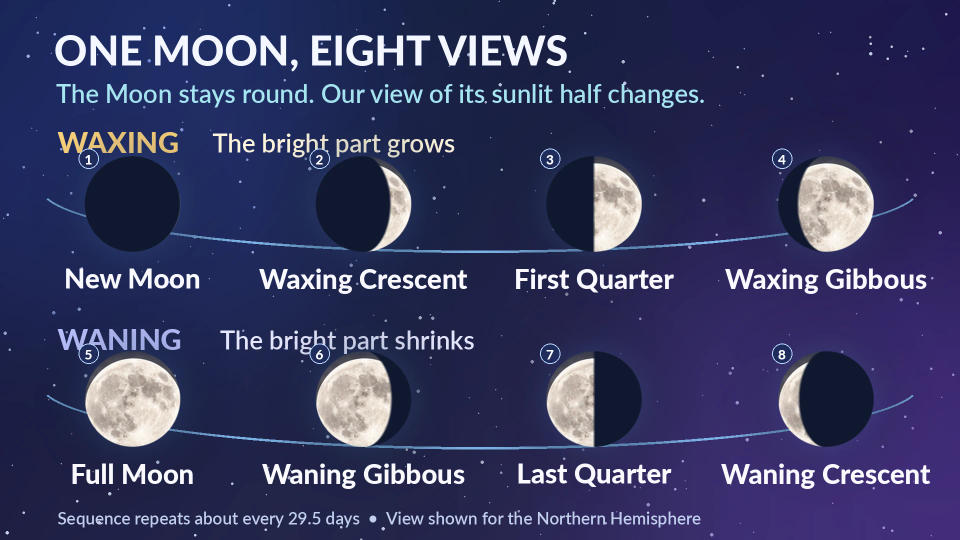
New Moon. The Moon is roughly in the direction of the Sun as seen from Earth. Its sunlit half faces mostly away from us, so the Moon is usually difficult or impossible to see. It has not vanished; we are looking toward its dark side.
Waxing Crescent. A small bright curve appears after new Moon. In a typical Northern Hemisphere view, the right side is lit. Over the next nights, the curve becomes wider.
First Quarter. Half of the Moon's visible round face appears bright. The name sounds odd because it is a quarter of the way through the cycle, not because only one-quarter of the face looks bright.
Waxing Gibbous. More than half of the visible face is illuminated, but it is not yet a full circle. The word “gibbous” simply means that the bright shape looks rounded and swollen.
Full Moon. The Moon is on the opposite side of Earth from the Sun in our sky, and nearly its entire face toward us appears illuminated. This is the familiar bright, round Moon.
Waning Gibbous. After full Moon, the bright part begins to shrink. More than half of the visible face is still lit, so it can look almost full at first glance.
Third Quarter, or Last Quarter. The visible face appears half bright again, but the opposite half is illuminated compared with first quarter in a typical Northern Hemisphere view.
Waning Crescent. The bright area becomes a thin curve once more. Eventually the cycle returns to new Moon and begins again. The Moon has stayed round throughout the entire journey.
The appearance changes gradually, not suddenly at eight exact moments. These names are useful signposts in a smooth, continuous cycle. In the Southern Hemisphere, the same phase is visible on the same date, but its bright side may look reversed or differently tilted.
Does Earth's Shadow Cause Moon Phases?
It is easy to imagine Earth's shadow covering a little more of the Moon every night. That seems reasonable, but ordinary Moon phases are not caused by Earth's shadow. They happen because we see the Moon's sunlit half from changing angles. The dark portion is simply the Moon's own nighttime side.
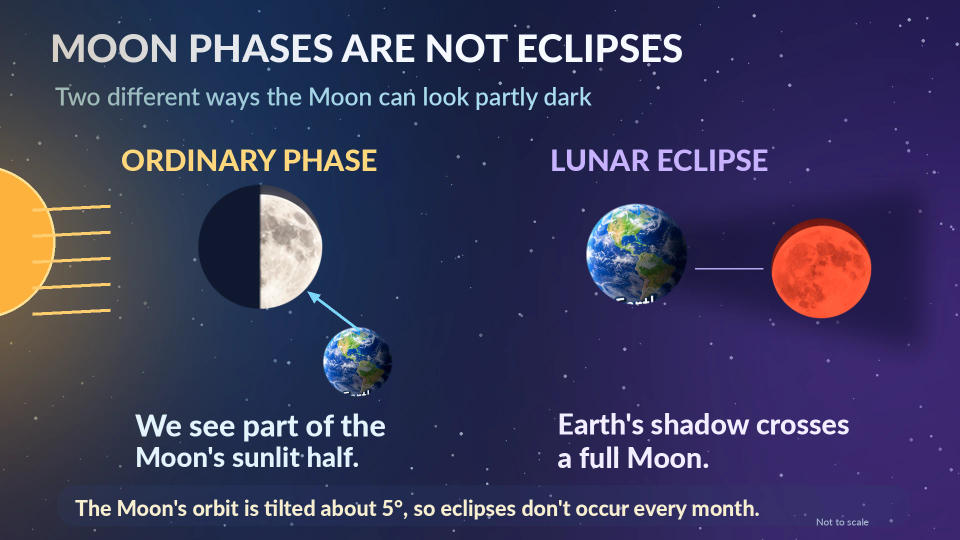
Earth's shadow really can reach the Moon, but that special event is a lunar eclipse. It occurs when the Sun, Earth, and full Moon line up closely enough for Earth's shadow to fall across the lunar surface. During some lunar eclipses, the Moon turns coppery red because sunlight passing through Earth's atmosphere reaches it.
If the Moon becomes full roughly once a month, why don't we get a lunar eclipse every month? The Moon's orbit is tilted by about 5 degrees compared with Earth's path around the Sun. Most months, the full Moon passes above or below Earth's shadow instead of through it. A normal full Moon is therefore not an eclipse.
There is another surprise: the Moon does not need darkness on Earth to appear in our sky. Depending on its phase and position, it can be visible in the afternoon or morning. The Moon does not switch itself on at sunset. It reflects sunlight whether the sky behind it is blue or black.
Conclusion
From a thin crescent to a glowing full circle, every Moon phase is another view of the same round Moon. The Sun lights about half of it, and the changing positions of the Sun, Earth, and Moon decide how much of that light we can see.
New Moon, Waxing Crescent, First Quarter, Waxing Gibbous, Full Moon, Waning Gibbous, Last Quarter, and Waning Crescent form a cycle that lasts about 29.5 days. Watching the Moon on several evenings in a row can make the pattern feel almost like a slowly turning picture in the sky. The most interesting part is that the Moon itself never has to change shape at all.
Sources & Further Reading
- NASA Science — Moon Phases
- NASA Science — Top Moon Questions
- NASA Science — Eclipses and the Moon
- NASA Scientific Visualization Studio — Moon Phase and Libration, 2026
Post a Comment