
Earth is falling toward the Sun, but its sideways motion turns that fall into an orbit.
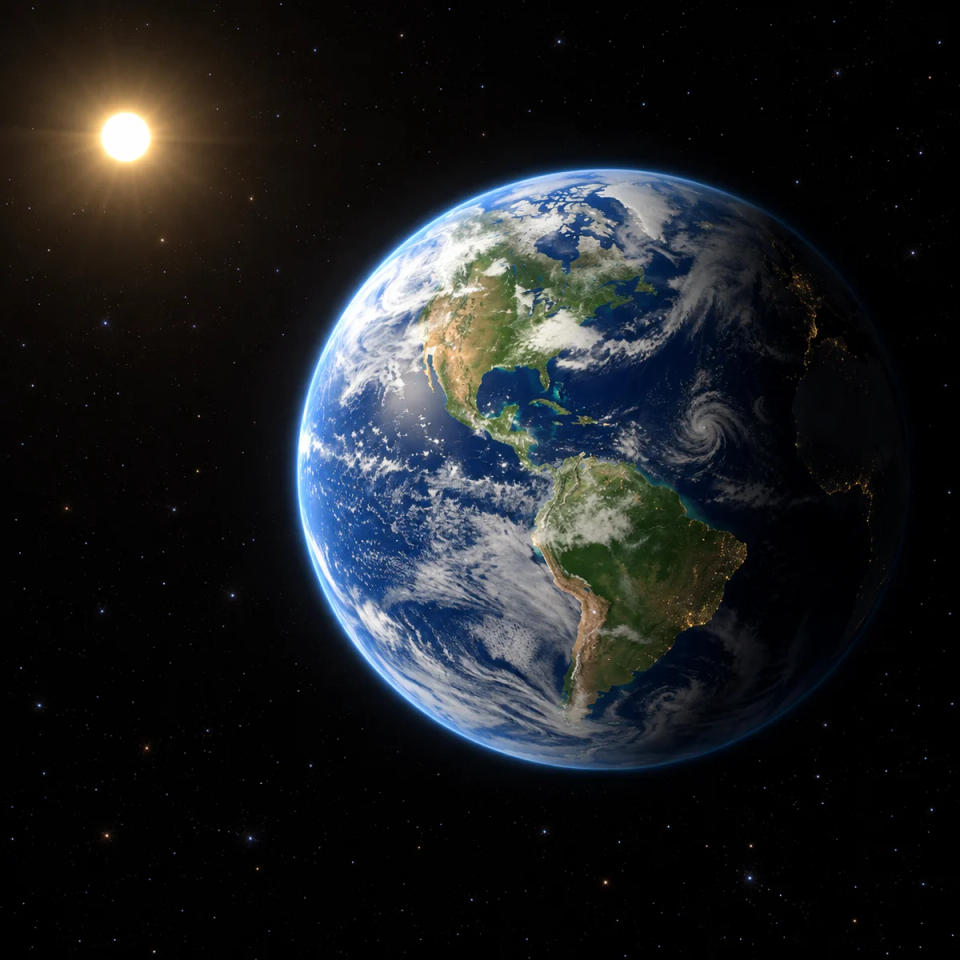
The Sun pulls on Earth every moment, yet our planet keeps traveling around it. Earth avoids plunging straight into the Sun because it already has a large sideways velocity, while gravity continuously curves its path. An orbit is the resulting motion: an ongoing fall that goes around the Sun.
That can sound strange if “falling” means dropping straight downward. In space, the important question is where an object is already moving when gravity acts. Earth's motion and the Sun's attraction work together to produce the journey we call a year.
Gravity Bends Earth's Forward Motion
Imagine looking down on Earth's orbit. At any particular moment, our planet is moving along its path, rather than aiming straight at the Sun. Inertia means that an object continues moving at constant velocity unless a net force changes that motion. The Sun provides such a force through gravity.
For a simplified circular orbit, Earth's velocity points along a tangent to the circle, while the gravitational force points inward. The force continually changes the direction of the velocity. Changing direction counts as acceleration, even when the speed stays constant. This inward change is called centripetal acceleration; gravity supplies it.
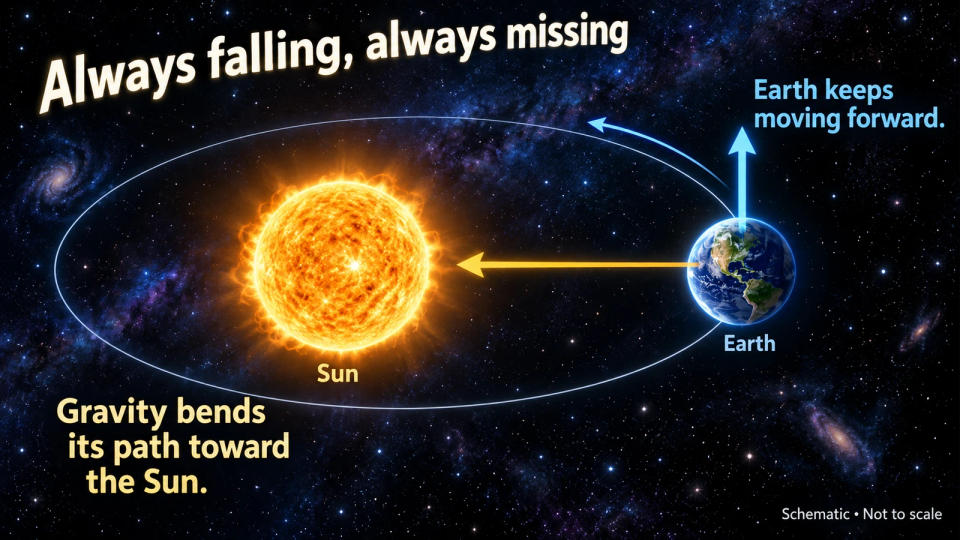
The arrows describe different things. The forward arrow represents velocity, and the inward arrow represents force. In this Sun-centered, approximately inertial description, there is no extra outward force canceling gravity. If the net force vanished, Earth would not keep following the same curved path: it would continue in a straight line in the simplified model.
NASA's 2018 explanation of the difficulty of flying to the Sun gives Earth's speed as about 67,000 miles per hour, approximately 30 kilometers per second. Spacecraft departing Earth begin with that solar-orbital motion too. Merely heading inward does not erase the sideways component, which is why reaching very close to the Sun requires careful changes to an orbit.
Real Earth's orbit is slightly elliptical. NASA's overview of Kepler's laws explains that the Sun lies at one focus of an elliptical planetary orbit, and that a planet moves faster when nearer the Sun. The simple circular picture captures the essential mechanism without reproducing every detail of Earth's changing velocity.
Why the Orbit Needs No Engine
A car slows down when its engine stops pushing because tires, air and machinery resist its motion. That everyday experience makes continuous motion seem to require continuous propulsion. Orbital motion follows the same physical laws, but the surrounding conditions are very different.
In an ideal gravitational orbit without drag, no engine is needed to keep an object moving. Gravity changes its motion continuously, but it does not act like a brake that removes orbital energy on every circuit. There is no solid track rubbing against Earth and no dense atmosphere surrounding its entire path around the Sun.
NASA illustrates this idea with Newton's imaginary cannonball. A slowly launched ball curves downward and hits the ground. With sufficient sideways speed, and with atmospheric resistance ignored, the surface curves away beneath its falling path. The ball can keep missing the ground and complete an orbit. The mountain and cannon are a thought experiment, rather than a practical launch design.
The same orbital principle applies around the Sun. The comparison does not give Earth the same speed or distance as a satellite; it explains why falling and orbiting are compatible. NASA lists Earth's average solar distance as roughly 150 million kilometers and its orbital period as about 365.25 days. A much larger orbit has its own appropriate relationship between motion and gravity.
The idealization also has clear limits. Low satellites can lose energy to Earth's thin upper atmosphere and eventually descend unless their orbits are maintained. Earth circling the Sun is a different situation. The presence of gravity alone does not imply that every orbit must automatically spiral inward.
Where Earth's Orbital Motion Came From
Earth did not begin as a stationary finished planet waiting for the Sun to start pulling. NASA describes the Sun's formation about 4.6 billion years ago from a rotating cloud of gas and dust. As that cloud collapsed, it spun faster and flattened into a disk. Most material gathered in the young Sun, while some of the remaining material assembled into planets.
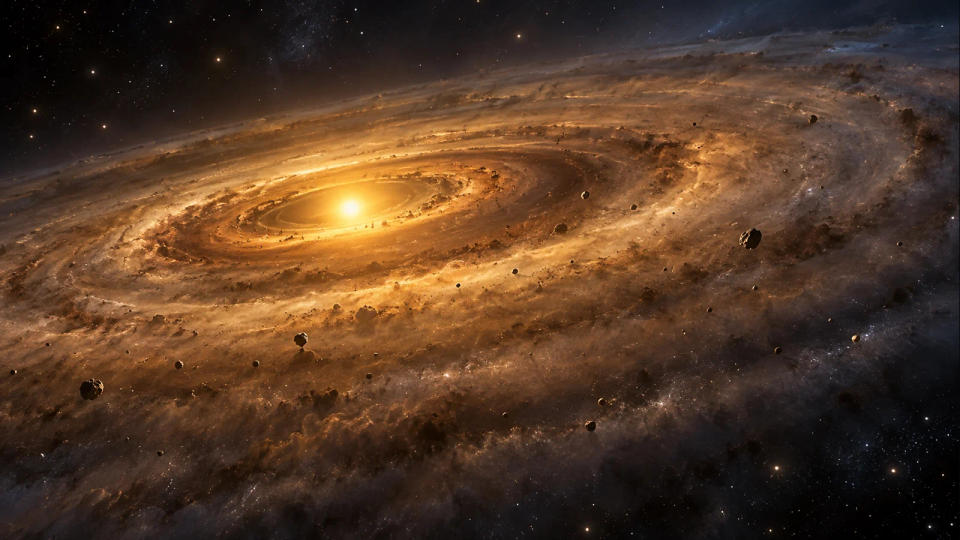
Our planet formed from material that was already moving around the developing Sun. Today's orbital motion therefore has a history in that rotating system. The young-disk illustration represents a formation scenario; it does not show the environment through which modern Earth travels.
It also helps separate three movements that are easy to confuse. Earth's rotation is its turning on its axis, associated with day and night. Its revolution around the Sun produces an orbital year. The whole solar system also travels through the Milky Way. Spinning Earth on its axis is not what prevents it from dropping into the Sun.
What if Earth's orbital motion were removed? As an artificial Newtonian thought experiment, canceling its entire velocity relative to the Sun while leaving the Sun's gravity acting would make it fall inward. A smaller change would generally reshape the orbit instead; slowing an orbiting body does not always produce an immediate collision. The outcome depends on its position and the size and direction of the change.
Gravity is also mutual: Earth pulls on the Sun. More precisely, the pair moves around a shared center of mass, although the Sun's much greater mass makes the familiar Sun-centered description useful. Other solar-system bodies add complications. None of these refinements overturns the basic explanation of forward motion being bent by gravity.
Conclusion
Earth stays in orbit because it is already moving while the Sun keeps pulling inward. Gravity does not need to switch off, and our planet does not need an engine to keep circling. Its orbit is a continuing gravitational fall with enough sideways motion to carry it around the Sun.
The surprising part is that the pull we might expect to cause a collision is also what makes the curved orbit possible. Understanding that relationship connects the yearly journey of our planet with the paths of satellites and spacecraft throughout the solar system.
Sources & Further Reading
- NASA: Chapter 3 — Gravity & Mechanics, Acceleration in Orbit and Kepler's Laws.
- NASA: Chapter 3 — Gravity & Mechanics, How Orbits Work and Freefall.
- NASA: It's Surprisingly Hard to Go to the Sun (August 8, 2018).
- NASA: Facts About Earth.
- NASA: Sun — Facts.
- NASA: Forces.
Post a Comment