
Webb found a carbon-rich atmosphere on PSR J2322-2650b, a pulsar planet that gravity stretches into a lemon-like shape.

A planet shaped like a lemon sounds more like a science-fiction prop than a real world. Yet the extraordinary gas giant PSR J2322-2650b may be stretched into just such a shape by the gravity of a nearby pulsar. In December 2025, NASA announced that the James Webb Space Telescope had found something equally surprising: an atmosphere with strong molecular-carbon signatures. Webb did not photograph a lemon-shaped planet, and it did not discover the planet for the first time. Its measurements revealed unusual atmospheric chemistry, while a physical model explains the planet's distorted form.
Can a Planet Really Be Shaped Like a Lemon?
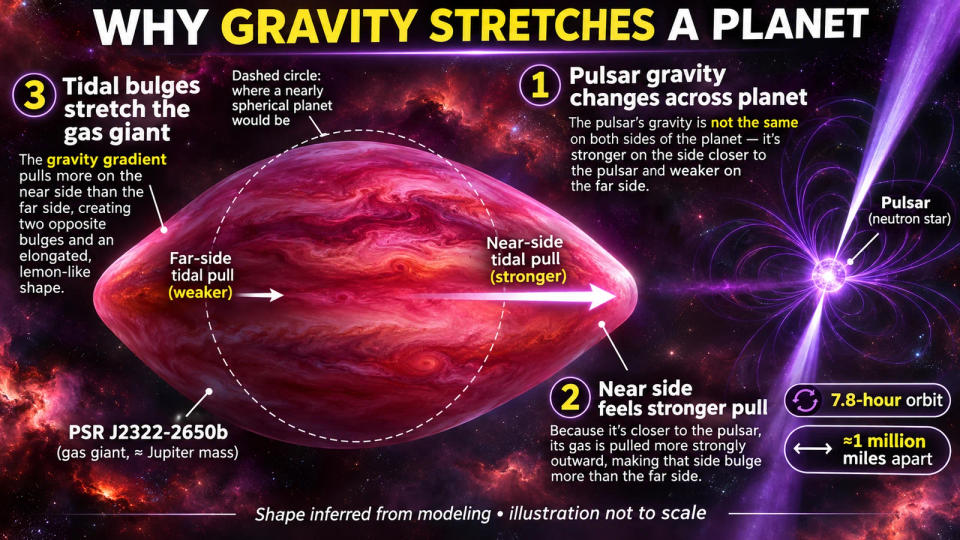
Yes—although “lemon-shaped” is a useful description, not a claim that a planet has a fruit's pointed ends or a solid peel. A planet's own gravity generally pulls its material toward a rounded shape. Rapid rotation can flatten that sphere, while the gravitational pull of a nearby companion can stretch it along the line connecting the two objects. Astronomers call this distortion a tidal deformation.
The key is that gravity is not equally strong across a large planet. The side closest to its companion experiences a stronger pull than the center does; the far side experiences a weaker pull. That difference creates a stretching effect. On Earth, related tidal forces help produce ocean tides. Around an extraordinarily compact stellar remnant, they can help reshape an entire gas giant.
PSR J2322-2650b orbits a pulsar—a rapidly spinning neutron star left after the death of a massive star. The planet completes an orbit in only about 7.8 hours, at a distance of roughly 1 million miles (about 1.6 million kilometers). The pulsar rotates around 300 times each second. That tight arrangement means the companion's gravity changes significantly from one side of the planet to the other.
Researchers use the planet's orbit, its changing infrared brightness and models of how gas responds to tidal forces to infer its elongated, lemon-like figure. The outline is therefore a scientifically motivated reconstruction—not a resolved Webb photograph. A similar physical principle has been detected in another world: ESA's Cheops mission measured tidal distortion of the exoplanet WASP-103b, which was described as rugby-ball-shaped. It is a different planet in a different system, but an instructive comparison.
What Did Webb Find in the Planet's Atmosphere?
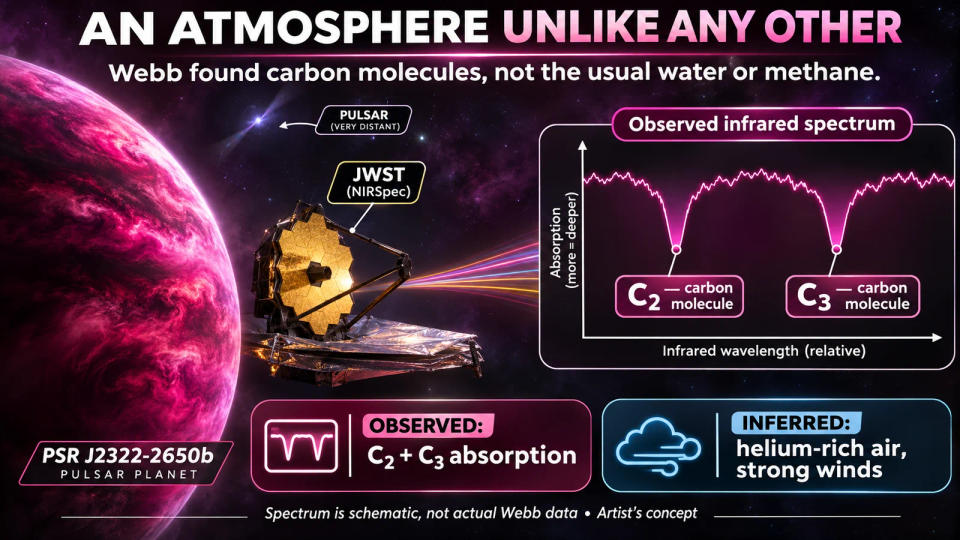
Webb's most striking discovery concerns chemistry rather than shape. Scientists observed PSR J2322-2650b with the telescope's Near-Infrared Spectrograph, or NIRSpec, across a full 7.8-hour orbit. The resulting infrared spectrum revealed signatures associated with diatomic carbon (C₂) and triatomic carbon (C₃). Those are molecules made entirely of carbon atoms, and their strong appearance in this planet's atmospheric signal was unexpected.
How can a telescope detect molecules on a planet that is far too distant to examine like a nearby object? Different molecules absorb and emit light at characteristic wavelengths. By separating the incoming infrared light into a spectrum and comparing it with molecular behavior, researchers can identify chemical clues. The process is rather like finding a fingerprint in light, although interpreting a planetary atmosphere also requires sophisticated modeling.
In this case, the carbon signatures are the observational result. A possible helium-dominated atmosphere, depleted in oxygen and nitrogen, is part of the team's interpretation of the data—not a directly collected atmospheric sample. Researchers also modeled the way the planet's brightness changes during its rapid orbit, obtaining evidence consistent with unusual atmospheric circulation and westward-moving winds.
There is a further complication: the pulsar's radiation and energetic environment are nothing like the sunlight warming Earth. Because this system is so unconventional, scientists must test whether ordinary assumptions about hot gas giants hold. Webb's ability to examine an infrared spectrum over an entire short orbit makes this planet an especially valuable laboratory for extreme atmospheric physics.
Why Is This Strange Planet So Hard to Explain?
Most familiar planet-formation stories begin with dust and gas gathering around a young, ordinary star. PSR J2322-2650b instead lives beside the compressed remnant of a star that underwent a dramatic transformation. The system belongs to the broader family of pulsar companions sometimes associated with “black widow” systems, in which a pulsar can strip material from a close companion. How a roughly Jupiter-mass object ended up in this configuration remains an open scientific question.
The carbon-rich atmosphere adds another puzzle. Scientists can recognize molecular signatures without yet having a complete explanation for how those molecules became so prominent. The planet's history, its unusual energy source and its atmospheric mixing all matter. Researchers are investigating how carbon-rich gas behaves and whether clouds or circulation could influence the spectrum Webb recorded.
Some descriptions of this discovery mention soot clouds or diamond rain. These are intriguing possibilities suggested by extreme carbon chemistry, not features Webb actually saw falling through the atmosphere. No telescope image has revealed diamonds, and the observations alone do not demonstrate that such precipitation occurs. Keeping that distinction clear is important: the confirmed news is unusual molecular-carbon evidence; the exotic weather remains a hypothesis.
Nor does the planet's elongated shape mean worlds like this are common. Detecting distortion depends on precise observations and a strong tidal interaction. PSR J2322-2650b combines several uncommon ingredients—an extraordinarily close orbit, a fast-spinning pulsar and an atmospheric spectrum that challenges expectations. Each ingredient makes the system informative, but also prevents easy comparisons with the planets in our solar system.
The next step is to refine atmospheric models, test competing explanations for the spectrum and observe other extreme companions where possible. The value of Webb's result lies not in a sensational image of a fruit-shaped planet, but in evidence that pushes scientists to rethink what planetary atmospheres can look like.
Conclusion
Can a planet be shaped like a lemon? Under powerful tidal forces, a gaseous world can indeed become elongated, and researchers model PSR J2322-2650b as an extreme example. What did Webb actually discover? Infrared evidence of unusual C₂ and C₃ molecular-carbon chemistry in its atmosphere. The shape is a gravitational interpretation; the carbon signatures are the telescope's remarkable observation. Together, they make this fast-orbiting pulsar planet one of the strangest worlds astronomers have studied—and a reminder that nature can outdo even our boldest science-fiction designs.
Sources & Further Reading
- NASA Science — NASA's Webb Observes Exoplanet Whose Composition Defies Explanation
- Zhang et al. — A Carbon-Rich Atmosphere on a Windy Pulsar Planet (research paper)
- Space Telescope Science Institute — Webb News Release on PSR J2322-2650b
- European Space Agency — Cheops Reveals a Rugby Ball-Shaped Exoplanet
- NASA Science — Artist's Concept of PSR J2322-2650b Orbiting a Pulsar
Post a Comment