
Solar eclipses skip most new moons because the Moon’s orbit is tilted about 5°, sending its shadow above or below Earth.
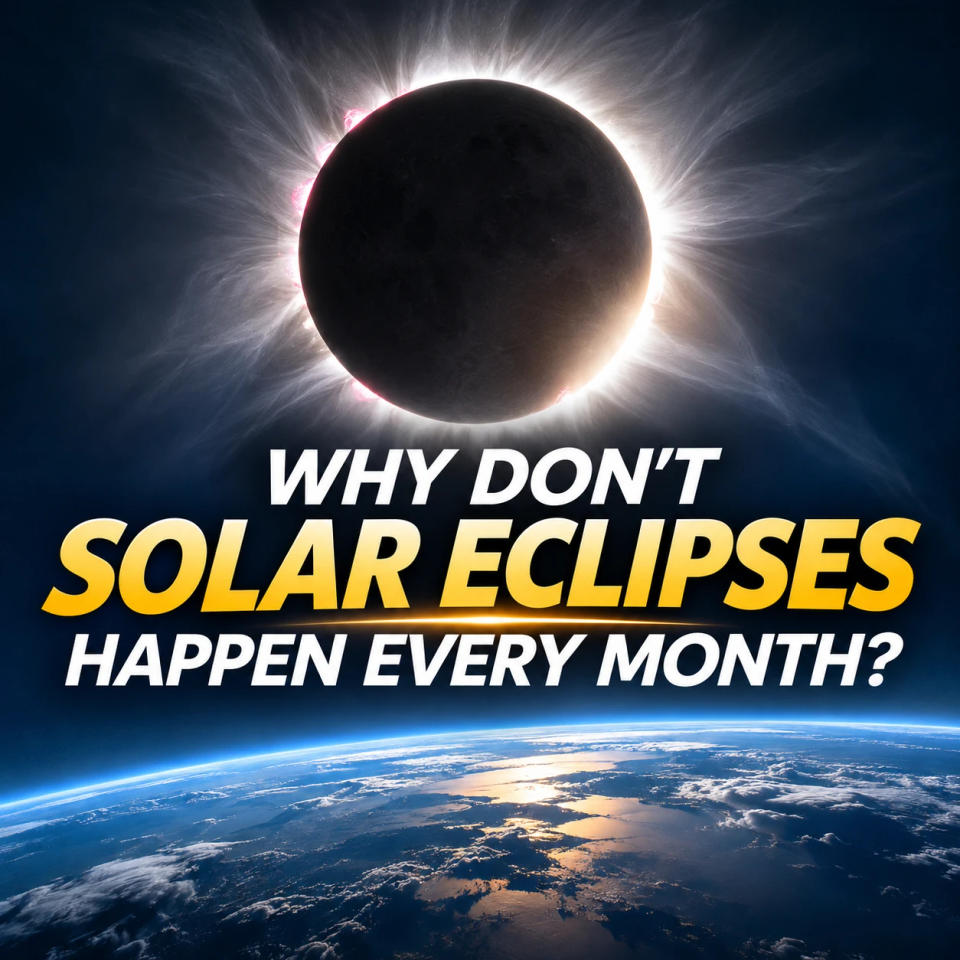
A new moon comes around roughly every 29.5 days. So why doesn't the Moon block the Sun twelve times a year? The answer is that the monthly lunar phase is only one part of the geometry: the Moon must also travel close enough to the plane of Earth's orbit for its shadow to reach our planet.
That extra condition turns a common lunar phase into an occasional sky event. It also explains why an eclipse might occur somewhere on Earth without being visible from your own backyard. Here is how the tilted orbit, lunar nodes, and eclipse seasons fit together.
Why Isn't Every New Moon a Solar Eclipse?
A solar eclipse happens when the Moon moves between the Sun and Earth and blocks part or all of the Sun for observers in the right location. This arrangement is possible only at new moon, when the Moon lies roughly in the direction of the Sun as viewed from Earth. But "roughly" is the important word: a new moon is not necessarily a perfect three-body alignment.
Earth travels around the Sun in a plane called the ecliptic plane. The Moon follows a different orbital plane around Earth, tilted about 5.1 degrees relative to the ecliptic. Although five degrees sounds small, it makes a tremendous difference when the alignment must place a moving shadow onto a planet hundreds of thousands of kilometers away.
At most new moons, the Moon appears slightly above or below the Sun from our perspective. Its shadow then passes above or below Earth rather than falling onto the surface. In other words, the Moon still goes through its usual phase, and the Sun is still shining normally, but there is no solar eclipse anywhere on Earth. NASA's eclipse geometry explanations identify this orbital tilt as the main reason that monthly eclipses do not occur.
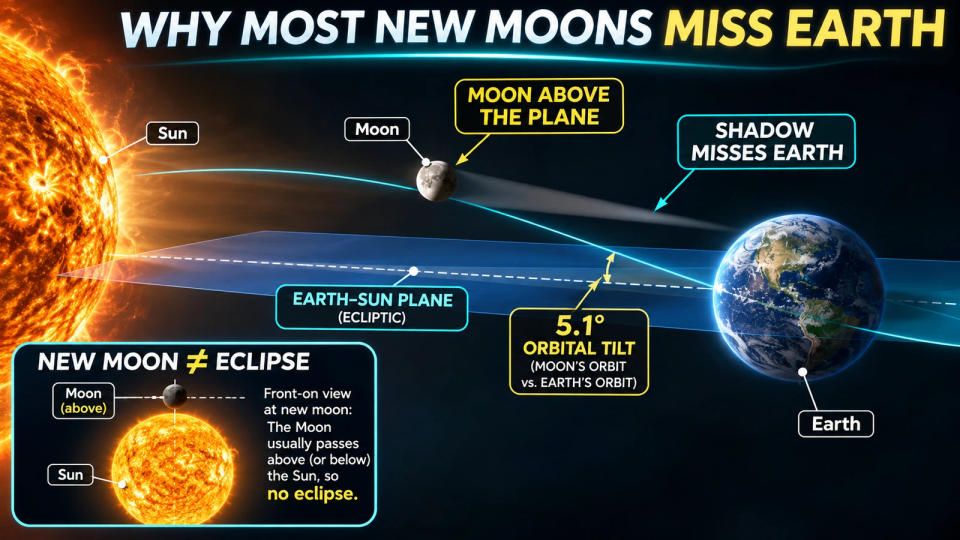
It helps to imagine two overlapping hoops, each slightly slanted relative to the other. One represents the Earth-Sun orbital plane; the other represents the Moon's path around Earth. The hoops cross, but they do not coincide along their entire circumference. Only near the crossing points is the Moon in the right orbital position to put its shadow near Earth during a new moon.
What Are Lunar Nodes and Eclipse Seasons?
The two locations where the Moon's orbital plane crosses the ecliptic are called lunar nodes. At the ascending node, the Moon crosses from south to north of the ecliptic; at the descending node, it crosses in the opposite direction. These are positions in the Moon's orbit around Earth, not places on Earth's path around the Sun.
For a solar eclipse to occur, the new moon must happen sufficiently near one of these nodes. NASA's Goddard Space Flight Center explains that a solar eclipse is possible when new moon occurs within roughly 17 degrees of a node, with the exact boundary varying because real orbits are not perfect circles. That is why some alignments create a central eclipse and others allow only a partial eclipse.
As Earth and the Moon travel, the direction from Earth to the Sun comes into alignment with the lunar nodes during short periods known as eclipse seasons. Each season lasts about 34.5 days, long enough to contain at least one new moon and, occasionally, two. The midpoints of consecutive eclipse seasons are separated by about 173.3 days, a little less than six calendar months.
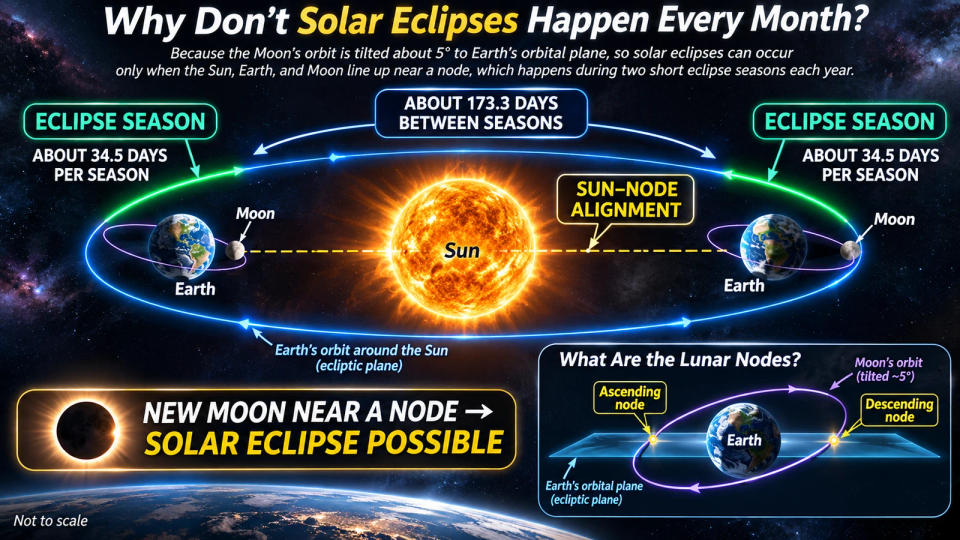
The schedule is not exactly six months apart because the lunar nodes themselves slowly shift around Earth's sky. Their motion changes when the Sun-node geometry repeats. The number 173.3 days describes the average interval between eclipse-season centers, not the time from one solar eclipse to the next. In some seasons there can be two solar eclipses, while other events are separated by several lunar months.
A helpful distinction is that lunar phases describe how much of the Moon's sunlit half we see, while eclipse seasons describe when the orbital planes line up favorably. The phase must be new and the Moon must be close to a node. Without both conditions, the shadow will not strike Earth.
Why Can't Everyone See the Same Solar Eclipse?
Even when the geometry is right, the Moon does not cast one giant, uniform shadow over all of Earth. Its shadow has a darker central region called the umbra and a broader, lighter outer region called the penumbra. Someone standing in the umbra during the appropriate alignment can see the Sun completely covered. Observers in the penumbra see the Sun only partly covered. People outside the shadow see no eclipse at all.
That is why the path of totality for a total eclipse is a narrow corridor across Earth's surface, not an event witnessed by the entire daytime hemisphere. Many eclipses also occur over oceans or remote regions. From a single town, a total solar eclipse can therefore feel far rarer than the worldwide frequency of solar eclipses might suggest.
Not every solar eclipse is total. An annular eclipse can occur when the Moon appears too small to cover the whole solar disk, leaving a bright ring around it. A partial eclipse occurs when the Moon blocks only a portion of the Sun from a particular viewing location. These different appearances depend on the Sun-Moon-Earth geometry and the observer's position, rather than on a different kind of lunar phase.
One essential viewing rule never changes: do not look directly at the uneclipsed or partially eclipsed Sun without appropriate solar-viewing protection. Regular sunglasses are not safe. The brief, fully covered phase of a total eclipse has different viewing conditions, but precise local timing and official safety instructions matter.
Conclusion
Solar eclipses are not monthly because a new moon by itself is not a precise enough alignment. The Moon's orbit is tilted about 5.1 degrees relative to Earth's orbital plane, so its shadow usually misses Earth. A solar eclipse becomes possible when new moon and a nearby lunar node occur together during an eclipse season.
Those seasons recur on an average cycle of about 173.3 days, but where an eclipse is visible still depends on the Moon's moving shadow. The next time you see a new moon on a calendar with no eclipse announcement, nothing unusual has happened: the Moon has simply followed its tilted path above or below the perfect alignment.
Sources & Further Reading
- NASA Science — Why Do Eclipses Happen?
- NASA Science — Eclipses and the Moon
- NASA Goddard — Periodicity of Solar Eclipses
- NASA Science — Total Solar Eclipse 2024: The Moon’s Moment in the Sun
Post a Comment