
NASA spacecraft have reached nearby planets in months, but Voyager 2 needed about 12 years to fly past Neptune.
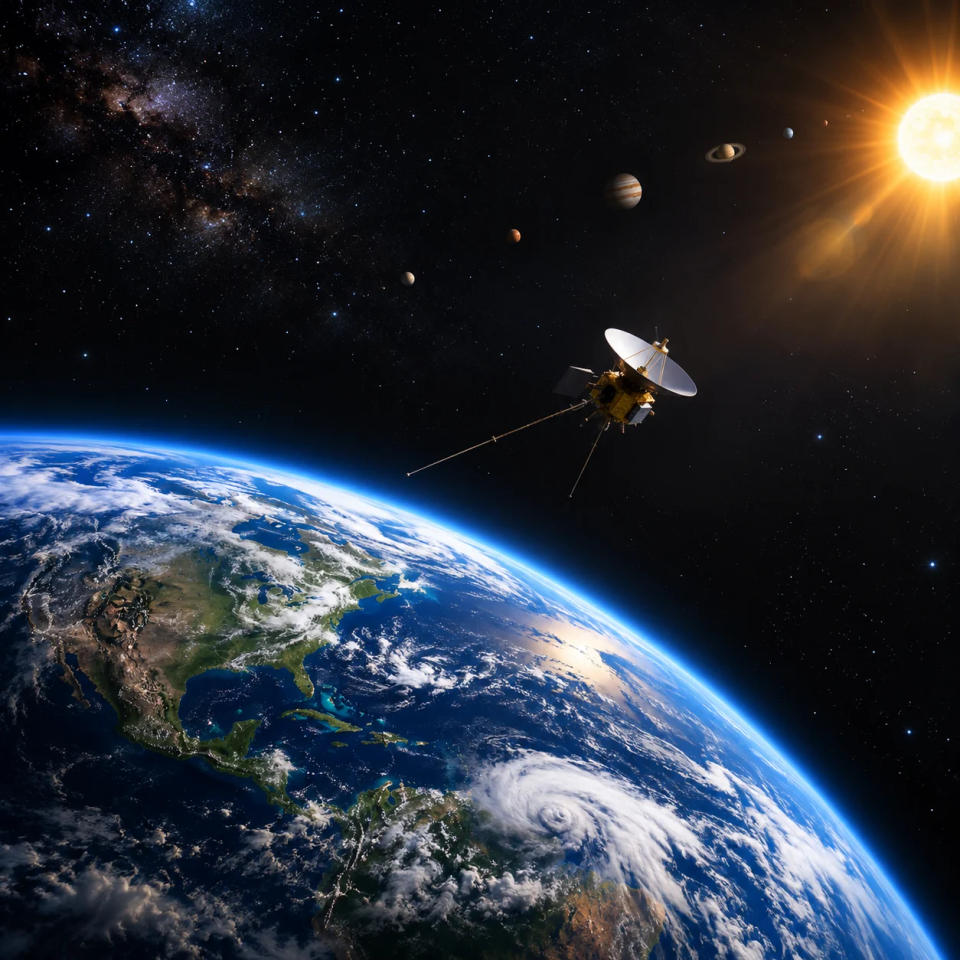
How long would it take a spacecraft to travel from Earth to Mercury, Venus, Mars, Jupiter, Saturn, Uranus, or Neptune? Real missions offer a more useful answer than a simple distance divided by speed. NASA's Mariner 10 reached Venus in 94 days, Perseverance landed on Mars after 203 days, and Voyager 2 flew past Neptune roughly 12 years after launch.
There is one essential catch: planets move. The distance between Earth and a destination changes continuously, and a spacecraft usually follows a carefully shaped orbit around the Sun rather than a straight line. Below, the distance figures are simplified differences between average solar orbital distances; the travel times are documented examples from specific robotic missions.
How Far Is Each Planet From Earth, Really?
Earth orbits the Sun about 150 million kilometers (93 million miles) away on average. Mercury and Venus orbit closer to the Sun, while Mars and the four giant planets orbit farther out. Subtracting their average distances from the Sun gives an intuitive picture of how widely separated the planetary orbits are. It does not tell us how far apart the planets are at a particular moment.
For example, the orbit-radius difference between Earth and Venus is about 41 million kilometers using more precise orbital averages. Yet the two planets can lie on different sides of the Sun, making their actual separation much greater. Eccentric orbits and the planets' changing positions make any single Earth-to-planet distance misleading.
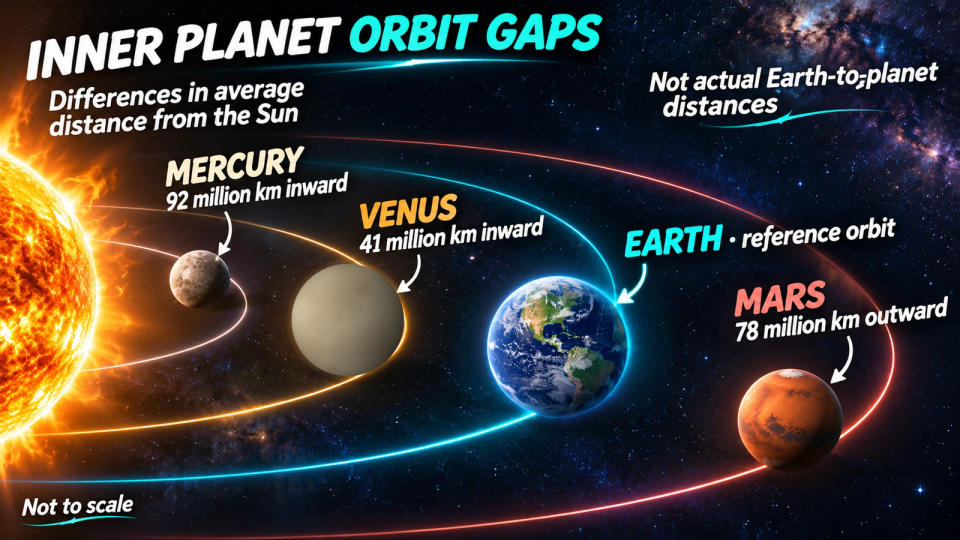
The same simplified method puts Jupiter's orbit roughly 630 million kilometers beyond Earth's, Saturn's roughly 1.25 billion kilometers beyond, Uranus's roughly 2.75 billion kilometers beyond, and Neptune's roughly 4.35 billion kilometers beyond. Those values are orbital reference gaps, not current Earth-to-planet distances. NASA publishes rounded planetary orbital distances, so the most distant figures here are deliberately approximate.
How Long Did Real Spacecraft Take to Reach All Seven Planets?
The following examples use the elapsed time from launch on Earth to the first cited planetary flyby, landing, or orbital arrival. Different missions were designed for different goals, so the times are historical examples—not a timetable or a prediction for a future launch.
| Planet | Approx. orbital gap | Example mission | Launch to arrival |
|---|---|---|---|
| Mercury | 92 million km | Mariner 10 · flyby | 146 days |
| Venus | 41 million km | Mariner 10 · flyby | 94 days |
| Mars | 78 million km | Perseverance · landing | 203 days |
| Jupiter | 630 million km | Juno · orbit | 4.9 years |
| Saturn | 1.25 billion km | Cassini · orbit | 6.7 years |
| Uranus | 2.75 billion km | Voyager 2 · flyby | 8.4 years |
| Neptune | 4.35 billion km | Voyager 2 · flyby | 12.0 years |
Mariner 10 launched on November 3, 1973, flew by Venus on February 5, 1974, and first encountered Mercury on March 29, 1974. Venus's gravity helped redirect the spacecraft toward Mercury. NASA's Perseverance rover launched on July 30, 2020, and landed on Mars on February 18, 2021. Its seven-month cruise was part of a route selected for both a favorable planetary alignment and a safe landing opportunity.
For the outer planets, Juno launched on August 5, 2011, and entered Jupiter orbit on July 4, 2016. Cassini launched on October 15, 1997, and arrived at Saturn on July 1, 2004 (UTC). Voyager 2 launched on August 20, 1977, encountered Uranus on January 24, 1986, and reached Neptune on August 25, 1989. These dates produce the rounded durations shown above.
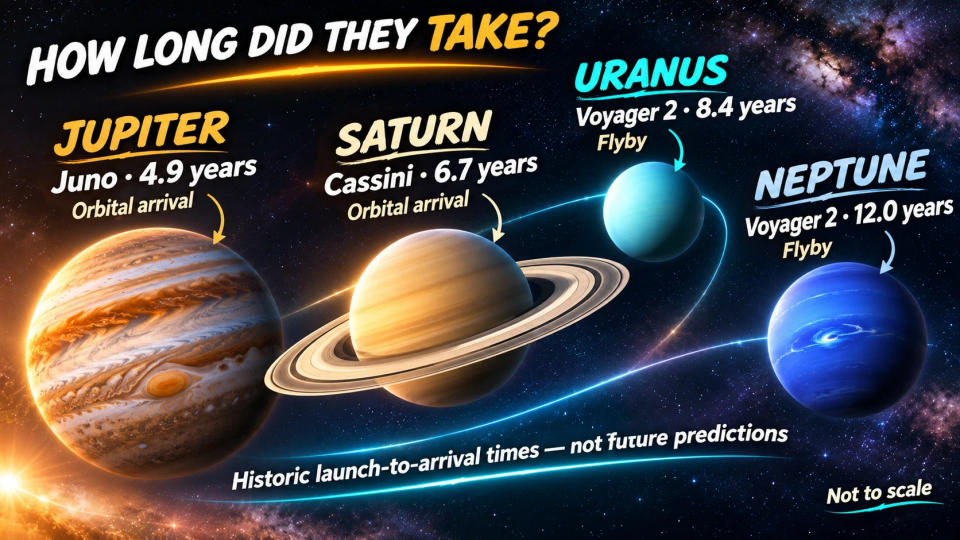
Notice that the examples mix orbital arrivals with flybys. A probe that must enter orbit generally needs a different approach speed and a way to slow down, while a flyby probe can keep going. The comparison does not mean that every Jupiter mission takes nearly five years or that Neptune is only a fixed number of years away.
Why Is Spacecraft Travel Time Not Just Distance Divided by Speed?
Imagine trying to meet a moving train. You must aim for where the train will be, not where it is now. Planetary navigation works on the same principle, except both the departure planet and destination travel around the Sun. Mission planners calculate a trajectory that intersects the target's future position at the right time.
A spacecraft also starts with Earth's motion around the Sun. After launch, it follows an orbit governed mainly by solar gravity, with engine burns adjusting its path. That curve can be far longer than the simplified orbital gap in the table. Flying toward a planet closer to the Sun, such as Mercury, can be particularly demanding because a spacecraft must manage the large change in its solar-orbit energy.
Gravity assists add another surprising twist. A spacecraft can fly past a planet and exchange a tiny amount of orbital energy and momentum with it, changing the craft's speed and direction relative to the Sun. Mariner 10 used Venus in this way. Juno returned for an Earth gravity assist before reaching Jupiter. Cassini used Venus, Earth, and Jupiter flybys on its approximately 6.7-year route to Saturn; Voyager 2's encounters helped set up its journey to Uranus and Neptune.
Finally, arriving is not the same as taking photographs during a flyby, entering orbit, or landing safely. A fast flyby may be excellent for visiting several worlds, but it gives instruments only a limited time nearby. An orbiter needs an insertion maneuver, and a lander must survive descent. These mission choices can make a more distant destination appear quicker or slower than expected from distance alone.
Conclusion
For nearby planets, actual robotic missions demonstrate journeys of roughly three to seven months in the examples above. Jupiter and Saturn orbital missions can take several years, and Voyager 2 took more than a decade to reach Neptune. But the key lesson is that distance alone does not determine spacecraft travel time. Planetary positions, launch windows, gravity assists, propulsion, and the goal at arrival all matter.
Use the distances as a scale comparison and the mission durations as examples from spaceflight history. They answer two different questions—and together they show how carefully a spacecraft's journey through the Solar System must be planned.
Sources & Further Reading
- NASA Science — Planet Sizes and Locations in Our Solar System
- NASA Science — Mariner 10
- NASA Science — Mars 2020: Perseverance Rover
- NASA Science — Juno
- NASA Science — Cassini Trajectory
- NASA Science — Voyager 2
Post a Comment