
Stars begin inside cold clouds of gas and dust, where gravity draws dense pockets inward until a young star takes shape.
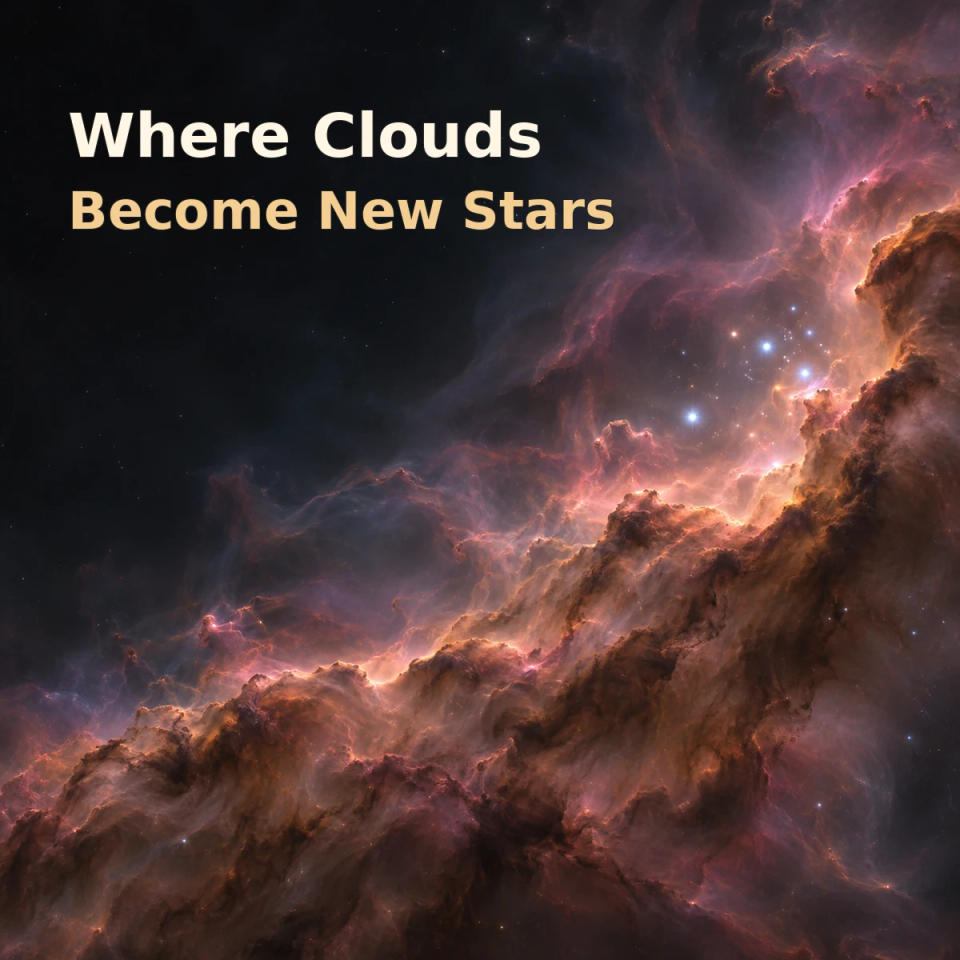
A nebula is an enormous cloud of gas and dust in space. Some nebulae contain the raw material for new stars: gravity gathers denser parts of a cloud, compressing them into hot, growing objects called protostars. Others are clouds expelled by dying stars, so a beautiful nebula is not automatically a stellar nursery.
That distinction changes how we read an image of space. A dark patch may hide the earliest stages of a star, while a bright shell may mark the end of another star's life. The word describes a cloud; its light, surroundings, and contents reveal the story happening inside.
What is a nebula made of?
Most nebular gas is hydrogen and helium, mixed with tiny dust particles. These clouds belong to the interstellar medium, the material between stars. They can look thick and almost solid in processed telescope images, but their dramatic ridges are not mountains or smoke hanging above a surface. They are structures within extremely thin material spread across immense distances.
A cloud's appearance depends partly on how it interacts with light. In an emission nebula, radiation from nearby hot stars supplies energy to the gas, which then glows. In a reflection nebula, dust scatters neighboring starlight. A dark nebula is conspicuous because its dust blocks light from objects behind it. Different appearances can occur within the same larger complex.
The name also covers material produced by stellar death. A planetary nebula forms from outer layers shed by an aging star; despite the name, it is not a cloud made by planets. A supernova remnant contains material associated with a stellar explosion. These clouds help explain why nebulae feature in both the beginning and the ending of stellar lives.
How does a cold cloud become a star?
Star formation begins in cold molecular clouds, where hydrogen can exist in molecules. The cloud is not equally dense everywhere. Pockets collect more material, and some become concentrated enough for gravity to pull them inward. Smaller dense cores emerge within the larger cloud. The whole nebula does not suddenly collapse into one enormous star.
NASA's explanation of stellar birth describes a competition: gravity draws material together, while gas pressure and magnetic fields can resist contraction. Collisions or compression can help create favorable conditions, but no single trigger explains every nursery. What matters locally is whether a dense region can continue contracting instead of dispersing.
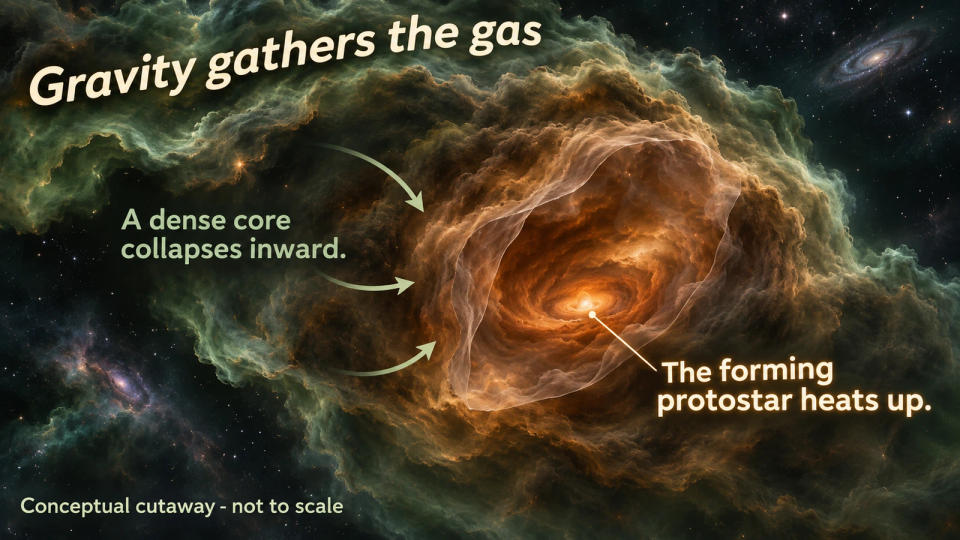
As a core contracts, its center heats up and a protostar develops. Its early glow does not mean it is already powered like the Sun. Initially, much of that energy comes from gravitational contraction and the accumulation of incoming material. Gravity is changing a diffuse reservoir into a much smaller, hotter object.
Surrounding material can settle into a rotating disk. Gas from this disk feeds the growing protostar, while some material is expelled through outflows. That makes a young stellar system more dynamic than a simple ball swallowing everything nearby. The disk is also the environment in which planets may eventually assemble, linking star birth with the origins of planetary systems.
If the object develops the necessary central conditions, sustained hydrogen fusion becomes its long-term power source. This marks its arrival on the main sequence, the stable life phase that includes our Sun. The transition is gradual rather than an instantaneous ignition, and the pace depends on the star being formed. A cloud, a protostar, and a main-sequence star are related stages, not interchangeable names.
What do telescopes reveal inside stellar nurseries?
Dust makes the earliest stages difficult to investigate with visible light alone. Infrared observations can reveal embedded objects and structures that are obscured at shorter wavelengths. The James Webb Space Telescope studies these dusty environments, helping astronomers examine young stars, surrounding material, and the chemical ingredients present during formation.
Webb's observations have identified ices and molecules in molecular clouds and investigated the environments around individual young stars. These measurements go beyond finding attractive shapes: they connect the cloud's material with the matter available to a developing stellar system. A bright knot becomes more informative when researchers can examine what it contains and how it relates to its surroundings.
Infrared pictures also require careful interpretation. Infrared wavelengths are invisible to human eyes, so published images assign visible colors to different measurements. Those colors help separate structures and signals; they are not necessarily what a traveler would see through a window. The illustrations here are conceptual AI visualizations, not observations or reproductions of a particular telescope dataset.
A nursery can form many stars in neighboring cores, producing a group rather than an isolated object. Those young stars then change their birthplace. Radiation and winds from massive stars can remove surrounding gas and limit further formation. In other circumstances, the same feedback compresses nearby dense material and may encourage another round of collapse. A glowing cloud therefore records an evolving interaction, not an unlimited supply of future stars.
Conclusion
A nebula is a cloud with more than one possible history. Some preserve the material released by dying stars; others contain cold, dense regions where new stars are taking shape. To understand a stellar nursery, follow the material: cloud gas gathers into cores, a protostar heats and grows, and sustained hydrogen fusion eventually powers a mature star.
The spectacle is not simply that space contains colorful clouds. It is that matter spread between stars can become a new source of light, while the stars already shining reshape what can happen next.
Sources & Further Reading
- NASA Space Place: What Is a Nebula?
- NASA Science: Stars
- NASA Science: Hubble's Nebulae
- NASA Science: Webb's Star Formation Discoveries
- NASA Science: Chapter 1 - A Star is Born
- NASA Science: Awakening Newborn Stars
Post a Comment