
The Moon has gravity: at the same upward launch speed, its weaker pull lets an ideal jump rise about six times higher.
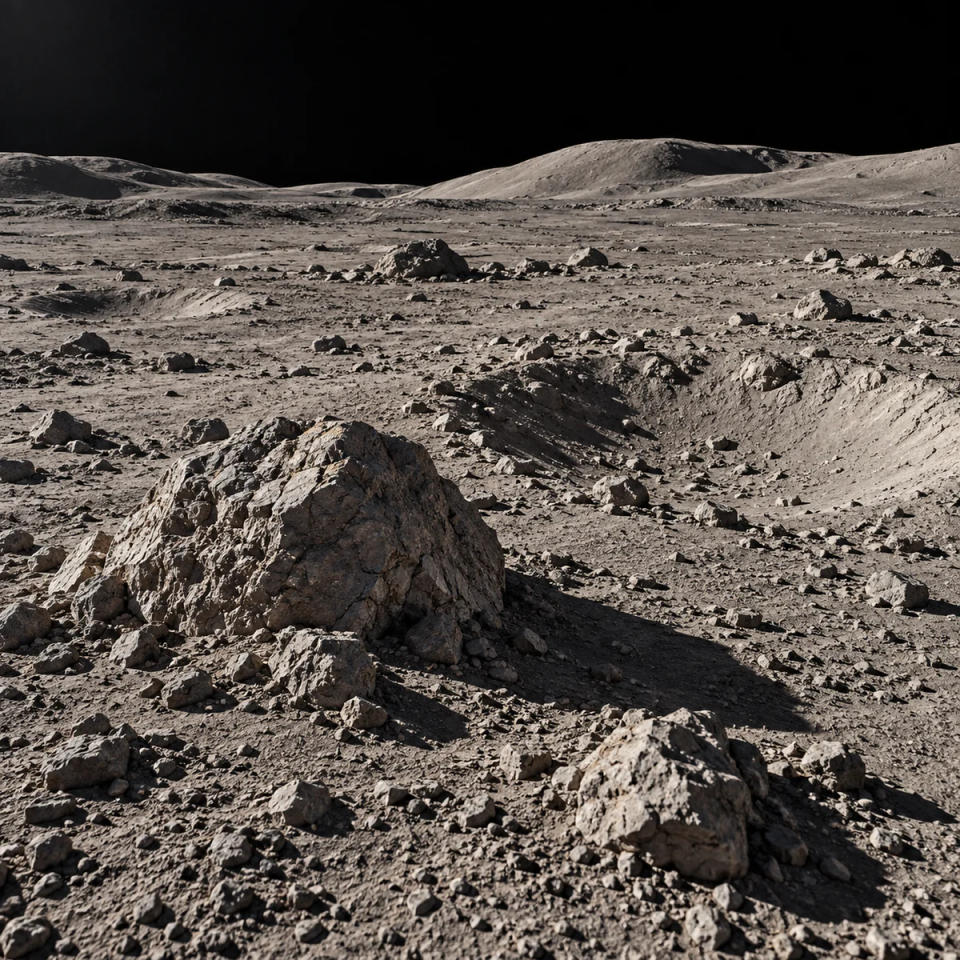
The Moon definitely has gravity. It pulls people, rocks and equipment toward its surface, although much less strongly than Earth does. That weaker pull can allow a higher jump, provided we compare launches with the same initial upward speed.
The familiar “six times higher” claim is a useful physics comparison, not a promise about every astronaut's performance. A real jump involves muscles, body movement, equipment and a landing. Separating those details from an ideal calculation reveals both why lunar hopping looks unusual and why nobody simply floats away.
The Moon Pulls You Downward, Even When You Jump
NASA's comparison of Earth and the Moon lists surface gravitational accelerations of about 9.81 meters per second squared for Earth and 1.624 for the Moon. Rounded to 9.8 and 1.62, the lunar value is about one-sixth of Earth's. Those numbers describe how rapidly gravity changes an unsupported object's velocity near the surface.
The difference involves the bodies' masses and their sizes. Gravity strengthens with the attracting mass and weakens with distance from its center. The Moon has much less mass than Earth, while standing on its smaller surface also places you nearer its center. Together, those properties produce the measured surface gravity; size alone is not the explanation.
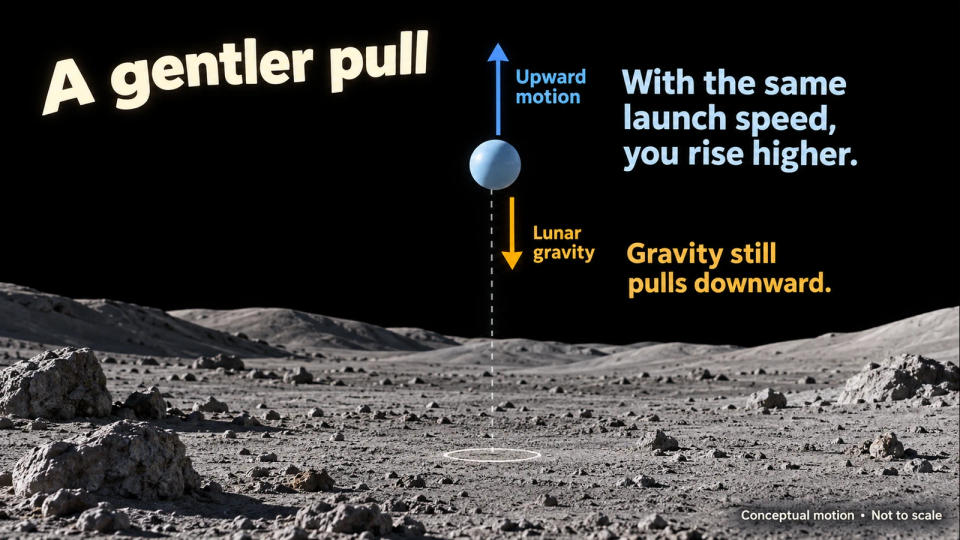
On either world, an upward-moving object remains under gravity's influence after it leaves the ground. Gravity slows the rise, the upward velocity reaches zero at the highest point, and the object then falls. At that highest point, its vertical speed is momentarily zero, but the gravitational pull has not stopped.
Your mass and your weight are different quantities. Mass describes how much matter you have and also relates to resistance to changes in motion. Weight is the gravitational force acting on that mass. Moving to the Moon reduces your weight without removing most of your body or making your inertia disappear.
That is why “lighter” does not mean effortless control of every movement. Equipment still has to be accelerated and stopped, and an astronaut still has to keep balance. The Moon is a reduced-gravity environment, not a place where gravity has been switched off.
Where the Six-Times-Higher Claim Comes From
For an ideal vertical launch, maximum rise above the starting point is h = v² / (2g). Here, v is upward speed at takeoff and g is gravitational acceleration. This assumes negligible air resistance and treats gravity as effectively constant over the small height involved.
Keep the launch speed the same and reduce gravity to about one-sixth: the calculated rise becomes about six times larger. The table is a worked example using an upward speed of 2 meters per second and rounded NASA gravity values. It is not a measured astronaut jump.
| Quantity | Earth | Moon |
|---|---|---|
| Upward launch speed | 2 m/s | 2 m/s |
| Rounded surface gravity | 9.8 m/s² | 1.62 m/s² |
| Calculated rise above launch point | About 0.20 m | About 1.23 m |
The unrounded calculated ratio is approximately 6.05. Notice that the comparison fixes speed, rather than vaguely fixing “effort.” Muscles pushing through a takeoff movement do not automatically produce identical launch speeds in different gravity or equipment.
Height also needs a clear definition. The formula gives a rise from the launch position. Applied to a simplified human jump, it concerns the body's center of mass after takeoff, not the person's total height above the ground or how high their raised hand reaches.
What a Real Lunar Jump Would Be Like
Apollo supplied a memorable demonstration that lunar gravity remains active. During Apollo 15, David Scott released a geological hammer and a falcon feather from approximately the same height. With essentially no air resistance, they fell together, reaching the lunar surface at the same time within the experiment's observational accuracy.
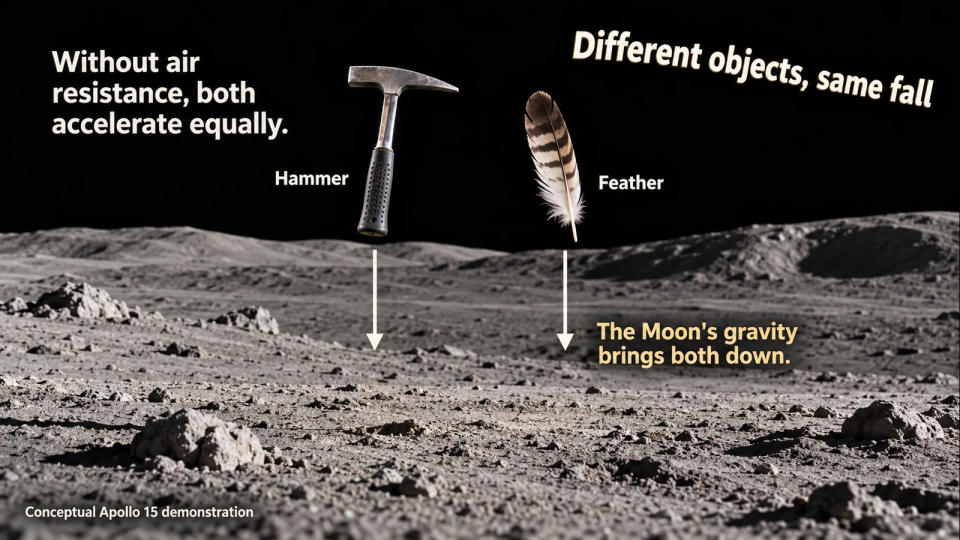
The feather's behavior was not evidence of weightlessness. It was evidence that Earth's familiar feather-versus-hammer difference comes from air resistance. On the Moon, both objects were being accelerated downward. Their different masses meant different gravitational forces, but not different gravitational accelerations in this demonstration.
For astronauts, protective equipment adds another layer to the picture. NASA's history of Apollo spacesuit testing describes the need to protect crews from vacuum and extreme temperatures while preserving enough flexibility for surface mobility. Suit design was refined to improve comfort and movement. A jump calculation that ignores those constraints is useful as a model, rather than a forecast of a suited person's performance.
Takeoff technique, body posture and the surface underfoot also affect the movement. It follows that knowing lunar gravity alone cannot tell us exactly how high a particular astronaut will jump. Once airborne, the weaker pull allows a longer, slower-looking flight for a given launch speed, but gravity still determines the return.
Nor does a normal jump come close to escaping the Moon. NASA's comparison lists lunar escape speed at roughly 8,550 kilometers per hour, or about 2.4 kilometers per second. A brief hop is very different from acquiring the enormous speed needed to leave without further propulsion.
Conclusion
The Moon has real gravity, about one-sixth of Earth's near the surface. That makes people weigh less while leaving their mass unchanged. It also lets an ideal launch rise about six times higher when the initial upward speed is held constant.
The condition is the key. Real astronauts must move inside protective suits and manage takeoff and landing, so a sixfold personal jump height is not guaranteed. The more dependable lunar rule is simple: going up is easier to prolong, but gravity still brings you back down.
Sources & Further Reading
- NASA: Top Moon Questions.
- NASA: Compare Earth and the Moon.
- OpenStax: University Physics Volume 1, 4.3 Projectile Motion.
- NASA: The Apollo 15 Hammer-Feather Drop.
- NASA: 50 Years Ago — Certifying Apollo Spacesuits.
- NASA: Forces.
Post a Comment