
Mars has seasons because its axis tilts like Earth's, but its longer, more elliptical orbit gives those seasons very different lengths.
Mars has spring, summer, autumn, and winter for the same basic reason Earth does. Each planet spins on a tilted axis, so its hemispheres take turns receiving more direct sunlight. Mars also takes nearly twice as long to orbit the Sun and changes speed more over the course of its orbit, giving it a seasonal calendar quite unlike ours.
Why does a tilted Mars have four seasons?
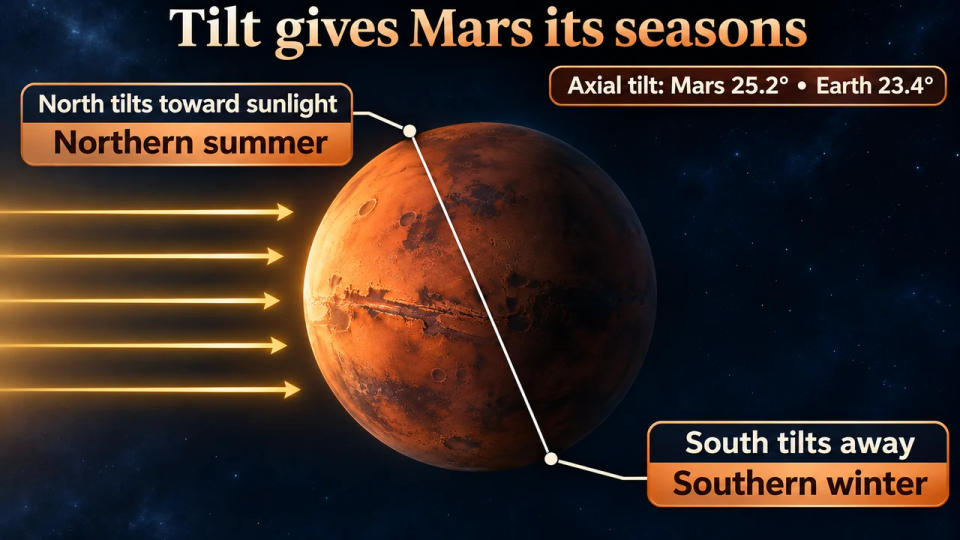
Mars's axis tilts about 25.2 degrees from a line perpendicular to its orbital plane. Earth's tilt, measured the same way, is about 23.4 degrees. On both worlds, the direction of the spin axis stays nearly fixed over a single orbit. As the planet moves around the Sun, the hemisphere leaning toward the sunlight changes.
During northern summer on Mars, the Sun climbs higher in the northern sky and stays above the horizon longer at northern midlatitudes. The higher Sun concentrates its rays on a smaller area of ground, while the longer day gives that ground more time to absorb energy. At the same time, southern midlatitudes get a lower Sun and shorter days. Roughly half an orbit later, the situation reverses.
The two equinoxes mark the transitions when the Sun is directly over the equator. The solstices mark the greatest northward and southward shifts in where the Sun is directly overhead. These four landmarks divide the orbit into four seasons, just as they do on Earth. The opposite seasons in the two hemispheres are a useful clue. Mars has the same overall distance from the Sun for both hemispheres at any given time, while the tilt exposes each half to a different pattern of sunlight.
A day on Mars is familiar in length, even though its calendar is longer. A Martian solar day, called a sol, lasts about 24 hours and 40 minutes. One orbit takes about 687 Earth days, or about 668.6 sols. By the time Mars completes a single cycle of spring through winter, Earth has nearly completed two.
Why are Martian seasons so unequal in length?
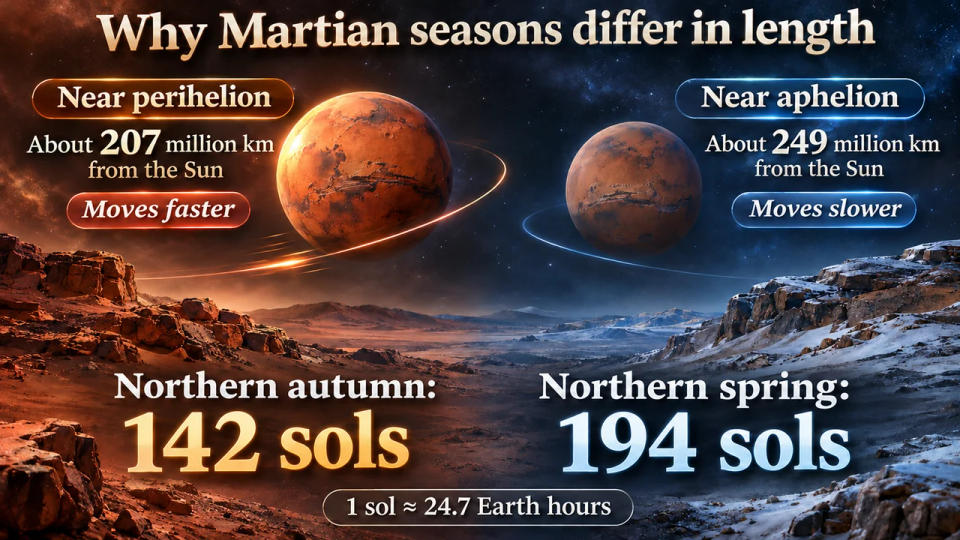
Mars follows an ellipse more noticeably different from a circle than Earth's orbit. It comes within about 207 million kilometers of the Sun at perihelion, its closest approach, and reaches roughly 249 million kilometers at aphelion, its farthest point. Like Earth, Mars moves faster closer to the Sun and more slowly farther away. Because its distance varies more, the change in pace is more pronounced.
Think of the solstices and equinoxes as four checkpoints around the orbit. Mars covers the stretch between some checkpoints faster than it covers others. In the Northern Hemisphere, spring lasts about 194 sols, summer 178, autumn 142, and winter 154. Northern spring, which includes the slow passage near aphelion, is about 52 sols longer than northern autumn, which includes the fast passage near perihelion. Earth's astronomical seasons vary in length too, though by less.
Distance also changes the intensity of the sunlight reaching the planet. Using NASA's orbital distances and the inverse-square law, a surface facing the Sun above Mars's atmosphere would receive about 45 percent more solar power per square meter at perihelion than at aphelion. That comparison is between two points in the Martian orbit. The amount that actually reaches the ground also depends on the Sun's angle and on dust in the air.
Perihelion falls shortly before southern summer begins. The south therefore gets its summer near the brighter, faster part of the orbit, while northern summer comes near the dimmer, slower part. Southern summer lasts about 154 sols, compared with about 178 sols for northern summer. The two summers differ in duration and in the strength of the sunlight available to heat the surface.
What do the seasons change on the ground?
The Martian poles show one of the clearest differences from Earth. In a Martian polar winter, part of the carbon dioxide in the atmosphere freezes onto the surface as frost. With the return of sunlight in spring, much of that seasonal frost sublimates, changing directly from solid ice back into gas. Mars also has longer-lasting polar ice, so the seasonal retreat does not mean the entire cap disappears.
The frost cycle changes how much gas is in the atmosphere. Curiosity recorded a rise in surface pressure at Gale Crater between two observation days during southern spring. The mission team linked that rise to carbon dioxide returning to the air as the winter cap in the south warmed. A change near the pole could therefore be detected at a rover far away.
Dust is another visible part of the seasonal story. In the warmer portion of the orbit around southern spring and summer, Mars is more prone to major dust storms. Some storms can spread widely enough to obscure much of the planet, but they vary from year to year. The orbital calendar helps scientists anticipate when large storms are more likely, while observations show how an individual storm actually develops.
Conclusion
Mars shares Earth's four-season pattern because both planets have tilted spin axes. Its longer year stretches those seasons out, and its more elliptical orbit makes some seasons pass faster than others while amplifying the difference in sunlight between the two summers. On the ground, the calendar shows up in changing dust conditions and in polar frost that takes carbon dioxide out of the air each winter and returns it each spring.
Sources & Further Reading
- NASA Science — Mars: Facts
- NASA Science — Helio and You: Seasons on Earth, Mars, and Beyond
- NASA NSSDC — Mars Fact Sheet
- ESA — Seasons on other planets
- NASA GISS — Mars24 Sunclock: Technical Notes on Mars Solar Time
- NASA Science — Pressure Cycles on Mars
Post a Comment