
Earth comes closest to the Sun in early January, but its tilted axis gives the Northern Hemisphere shorter days and a lower winter Sun.

January can bring snow to New York and beach weather to Sydney, even though Earth is near its closest point to the Sun. The timing comes from the shape and orientation of Earth's orbit. The difference between the two hemispheres comes mainly from the tilt of Earth's axis, which changes both the angle of sunlight and how long it shines each day.
Why does Earth reach its closest point in January?
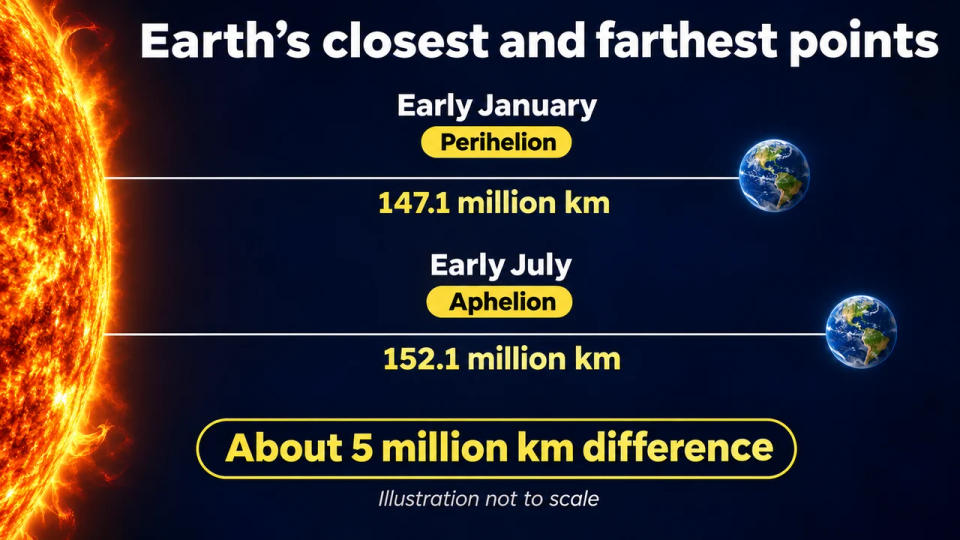
Earth follows a slightly elliptical path around the Sun. The Sun lies at one focus of the ellipse, a little off center, so the distance between the two bodies changes throughout the year. Astronomers call the closest point perihelion and the farthest point aphelion. Today, Earth reaches perihelion in early January and aphelion in early July.
NASA's Earth Fact Sheet gives typical distances of about 147.1 million kilometers (91.4 million miles) at perihelion and 152.1 million kilometers (94.5 million miles) at aphelion. The difference is about 5 million kilometers. That sounds enormous on a road map, but it amounts to only about 3.3 percent of the greater distance. Viewed from directly above, Earth's orbit would look nearly circular.
January is where the closest approach happens to fall in the current relationship between the orbit and the seasonal calendar. The December solstice marks the point in Earth's yearly trip when the Northern Hemisphere is tilted farthest away from the Sun. Perihelion marks the point where the centers of Earth and the Sun are closest. In 2026, the U.S. Naval Observatory placed perihelion on January 3 at 17:15 UTC and aphelion on July 6 at 17:30 UTC.
The exact date can shift from one year to the next. Earth and the Moon both circle a common center of mass, and the Moon's position changes the timing of Earth's closest approach slightly. Over thousands of years, there is a deeper change. Earth's spin axis slowly changes direction, and the orientation of its orbit shifts too. Together, those changes gradually move perihelion through the seasonal calendar.
Why is January winter in the Northern Hemisphere?
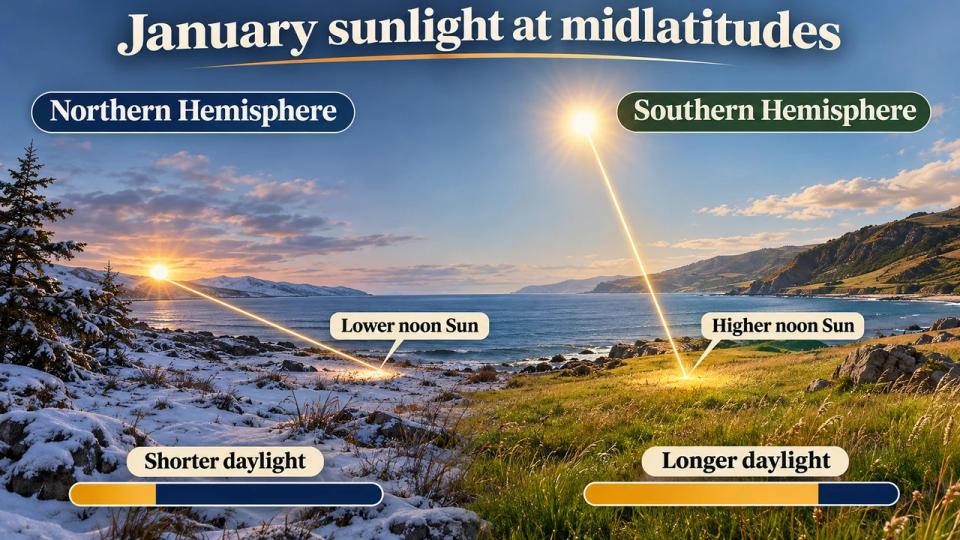
Earth spins around an axis tilted about 23.4 degrees from a line perpendicular to its orbital plane. That axis keeps roughly the same orientation in space during a single trip around the Sun. In early January the north end of the axis still leans away from the Sun, while the south end leans toward it. The two hemispheres therefore receive sunlight at different angles even though they share the same orbital distance.
At northern midlatitudes the January Sun follows a low, short path across the sky. Around solar noon, a beam of sunlight hits the ground at a shallow angle and spreads over a wider surface. Picture a flashlight aimed straight at a table. Tip it so the beam strikes the table from the side and the bright patch stretches out. The beam's energy now has more surface to cover.
The short winter day compounds that effect. A place with fewer daylight hours has less time to gain solar energy and more time to cool after sunset. At comparable southern midlatitudes, January brings a higher midday Sun and longer days. The difference shows up in shadows as well. A vertical pole casts a longer shadow when the Sun is low and a shorter shadow when it is high.
This comparison works best away from the equator. Near the equator, day length varies much less over the year. Farther toward either pole, the seasonal contrast grows. Some polar locations have stretches when the Sun stays below the horizon all day in winter or above it all day in summer.
Does Earth's changing distance affect sunlight at all?
The amount of sunlight reaching Earth does change with distance. If you compare the same size surface facing straight toward the Sun at each orbital extreme, above the atmosphere, it receives about 7 percent more solar power per square meter at perihelion than at aphelion. That estimate follows from the inverse-square law. Dividing 152.1 by 147.1 and squaring the result gives about 1.07.
That extra sunlight is available to the whole planet at the top of the atmosphere. The angle and length of daylight still determine how much of it arrives at a particular place over a day. A 7 percent increase in the incoming beam cannot give a northern city the long days and high Sun it has in summer. It also cannot give the dark side of Earth any sunlight.
Temperature has another complication. The ground and oceans store heat and release it gradually, so air temperatures often lag behind changes in daylight. Local clouds, winds, elevation, and nearby water also shape the conditions you feel. January's distance tells you something about incoming sunlight, while a city's temperature reflects how that energy is received, stored, and moved around.
One way to see the distinction is to compare noon shadows from the same pole in January and July. Use a level patch of ground and look near local solar noon, when the shadow is shortest that day. At northern midlatitudes, the January shadow is longer. That simple observation reveals the change in the Sun's angle that matters for the season at your location.
Conclusion
Earth reaches perihelion in early January because that is where its present orbit brings it closest to the Sun. Around the same time, Earth's tilt gives northern midlatitudes low-angle sunlight and short days, while southern midlatitudes get higher-angle sunlight and long days. A single Earth–Sun distance can therefore coincide with winter in one hemisphere and summer in the other.
Sources & Further Reading
- NASA NSSDC — Earth Fact Sheet
- NASA Space Place — What Causes the Seasons?
- U.S. Naval Observatory — The Seasons and the Earth's Orbit
- U.S. Naval Observatory — Variation in Times of Perihelion and Aphelion
- U.S. Naval Observatory — Earth's Seasons for 2026
Post a Comment