
The Great Attractor helps shape our galaxy's motion, but the pull comes from a vast region rather than one hidden object.
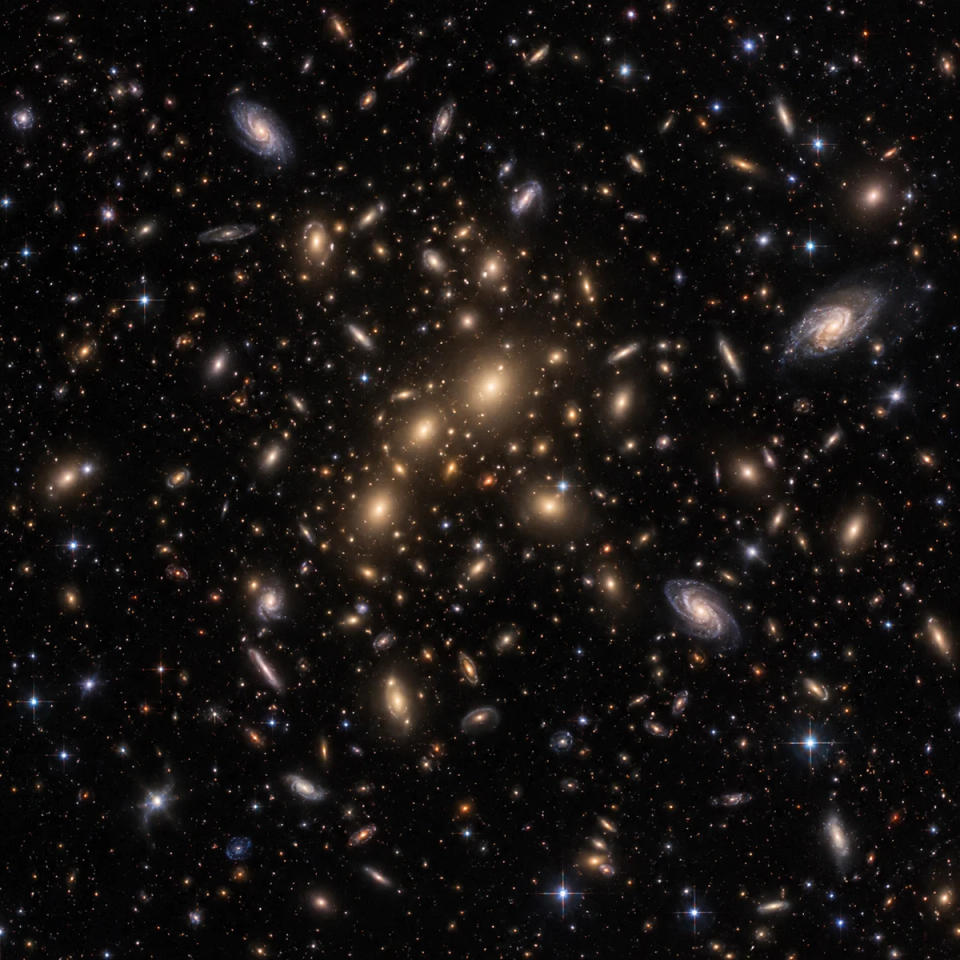
Something enormous influences the Milky Way's journey through the universe. The Great Attractor is part of the answer: a broad concentration of matter whose gravity helps shape the motions of nearby galaxies. Understanding our movement also means looking beyond it, toward larger structures and regions containing unusually little matter.
The name suggests a single mysterious destination, perhaps an invisible monster waiting in darkness. Observations instead reveal an intricate neighborhood of galaxies and clusters. The real mystery is how their combined gravitational influence fits into a much bigger cosmic landscape.
What Is the Great Attractor Actually Pulling?
The Milky Way belongs to the Local Group, alongside Andromeda and smaller galaxies. A widely used measurement quoted in a 2017 study puts the Local Group's speed at about 631 kilometers per second relative to the cosmic microwave background, the ancient radiation filling the sky. That reference frame matters: this is not Earth's orbital speed, and it cannot all be assigned to the Great Attractor.
Galaxies participate in the universe's overall expansion while also responding to unevenly distributed matter. Astronomers call departures from the average expansion peculiar velocities. Here, “peculiar” simply means an additional motion relative to that smooth background.
The Great Attractor emerged as an explanation for a pattern of these motions. The University of Hawaiʻi's 2017 account describes it as a region of rich galaxy clusters roughly 150 million light-years away. Because the name covers an extended concentration rather than a sharply bounded object, that distance is an approximate guide to the region.
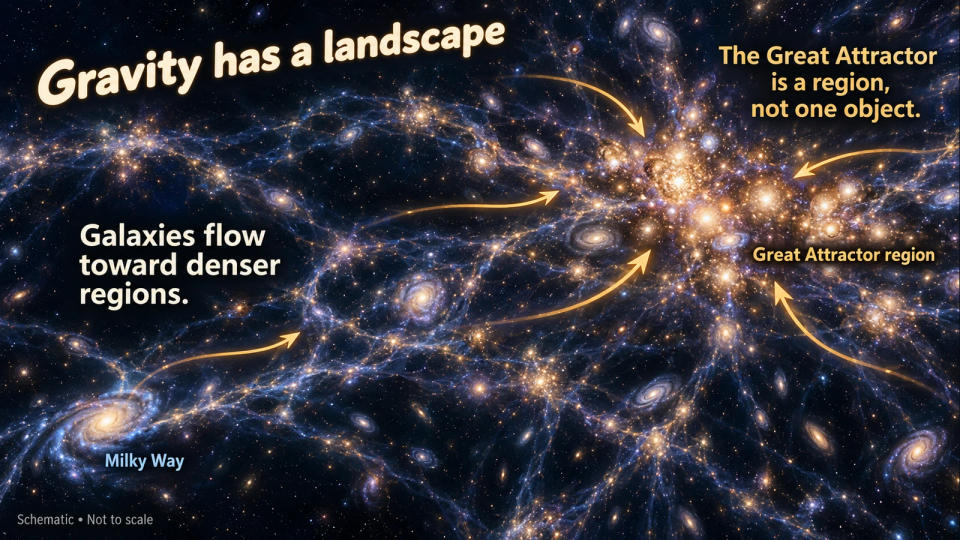
A useful analogy is a landscape with broad valleys. Different concentrations of matter contribute to the gravitational landscape, so many galaxies can share a general drift. The illustration shows that relationship schematically; its bright filaments and oversized galaxies are explanatory choices, not measured positions or an optical photograph of gravity.
One important landmark is the Norma cluster, also called ACO 3627. In The Core of the Great Attractor, submitted in 1999, researchers described Norma as comparable to the Coma cluster in size, richness and mass. They placed it near the intersection of the Centaurus Wall and the Norma Supercluster, supporting a picture built from multiple structures.
Why Is the Great Attractor So Hard to See?
We observe the universe from inside the Milky Way. Toward parts of the Great Attractor region, our own galaxy places stars and dust in the foreground. Stars crowd the image, while dust obscures background light. This troublesome band of sky is traditionally called the Zone of Avoidance, reflecting the difficulty of mapping distant galaxies there.
A striking example comes from ESO's December 1999 view toward the Great Attractor. Its half-degree-wide field contains foreground Milky Way stars and background galaxies belonging to ACO 3627. The larger yellowish galaxies stand out from the sharper stellar points. The published picture combines blue, red and near-infrared exposures into a false-color image.
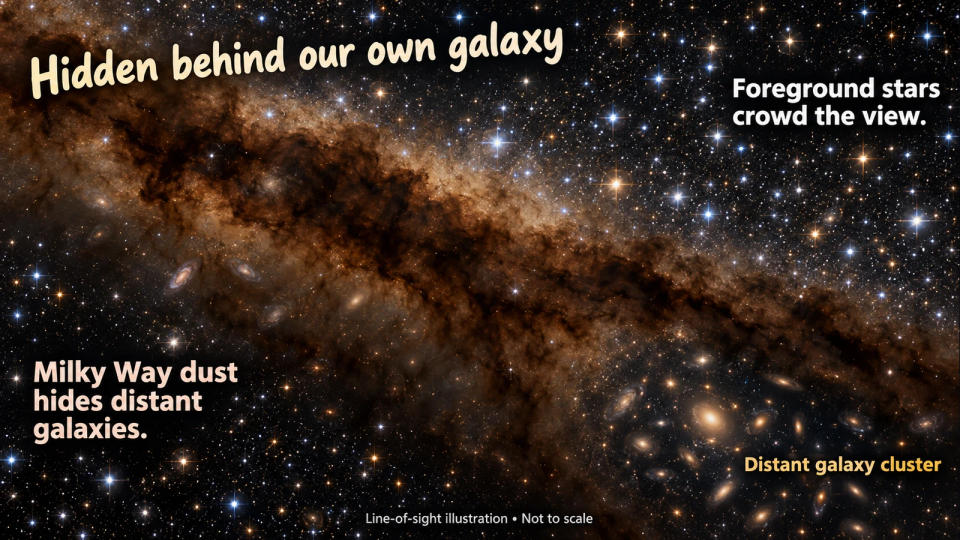
That observation makes an important distinction: obscured does not mean entirely unseen. Researchers have identified substantial structures in this direction. The challenge is assembling a complete account through a crowded foreground, rather than proving that a completely invisible object exists.
The 1999 Norma study combined a deep optical search with a redshift survey. Its authors also considered whether another heavily obscured cluster could contribute. That uncertainty illustrates why locating a major cluster does not automatically settle the total extent or mass distribution of the whole region.
How Laniakea and Shapley Change the Picture
In 2014, a team led by R. Brent Tully introduced a way to define our supercluster through galaxy motions. Their reconstruction identified a local basin of attraction called Laniakea. The university's announcement described a structure about 500 million light-years across, containing approximately 100,000 galaxies, with the Milky Way near its outskirts.
The method goes beyond drawing a boundary around a crowded patch of galaxies. Researchers estimate distances, compare observed velocities with the expected expansion, and reconstruct a broader flow field. After separating the mean expansion and longer-range flows, they can identify neighboring regions whose local motions converge toward different gravitational basins.
These boundaries resemble watersheds, but the analogy has limits. Galaxies are not floating in a literal river. The lines summarize a reconstructed velocity field; they are not guaranteed future travel routes. Calling a region a basin does not establish that every galaxy inside it will eventually collide at one destination.
The wider view became especially clear in the 2017 Dipole Repeller study. Using Cosmicflows-2 measurements and a statistical reconstruction, the authors connected the large-scale flow with the Shapley Concentration and an inferred low-density region. The analysis showed why overdense attractors alone provide an incomplete description.
A low-density region contributes less gravitational attraction than an average patch of the universe. Relative to the expanding background, the resulting pattern can look like motion away from it. “Repeller” describes that effect; it does not require exotic antigravity. The reconstruction depends on measured distances, survey coverage and cosmological assumptions, so its explanatory lines should never be mistaken for directly photographed forces.
Conclusion
What is pulling the Milky Way? The answer involves a surrounding distribution of matter, with the Great Attractor forming an important part of our local gravitational landscape. Norma supplies a visible landmark, Laniakea describes a local flow basin, and more distant structures help explain the broader motion.
The enduring fascination is that astronomers can investigate hidden structure through the behavior of galaxies. A difficult view through our own Milky Way becomes a scientific puzzle that combines images, distances and motion—revealing a neighborhood far larger than the galaxy we call home.
Sources & Further Reading
- ESO: View towards the Great Attractor (December 21, 1999).
- Woudt, Kraan-Korteweg and Fairall: The Core of the Great Attractor (1999).
- Tully and colleagues: The Laniakea supercluster of galaxies (2014).
- University of Hawaiʻi: UH scientist maps supercluster of galaxies, names it Laniākea (September 3, 2014).
- Hoffman and colleagues: The Dipole Repeller (2017; original submitted manuscript).
- University of Hawaiʻi: Newly discovered intergalactic void repels Milky Way (January 30, 2017).
Post a Comment