
The first stars likely formed from nearly pure hydrogen and helium, shone intensely, and changed the cosmos—but none has been conclusively identified.
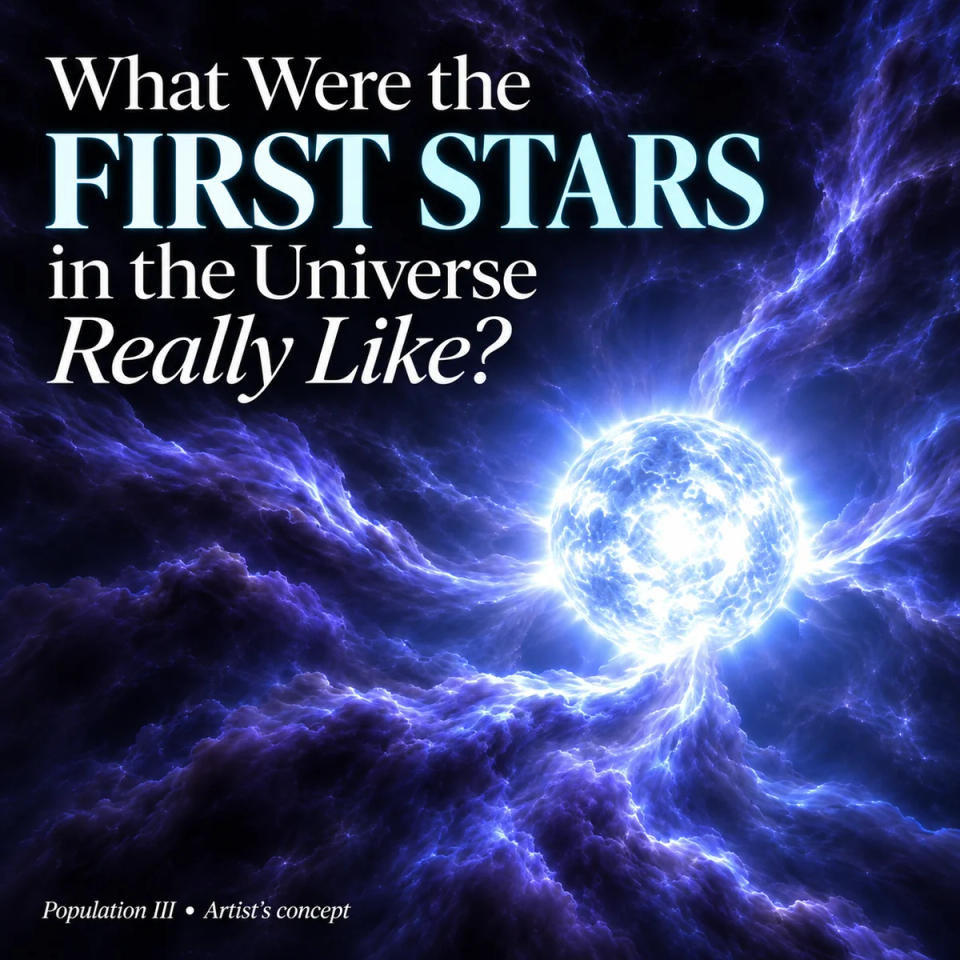
Imagine looking into a universe without the Sun, Earth, planets, or even a single familiar star. For millions of years after the Big Bang, there were no stellar lights to puncture the darkness. Eventually, gravity gathered ancient gas into the first stars, known as Population III stars. Scientists have strong reasons to think these pioneers were unlike many stars we see today, but their exact sizes, numbers, and life stories remain uncertain.
How Did the First Stars Form from Almost Nothing?
The universe did not begin with a ready-made supply of stars. During the first few minutes after the Big Bang, nuclear reactions produced mostly hydrogen and helium, along with minute traces of lithium. Approximately 380,000 years later, the cooling universe allowed electrons to join atomic nuclei, leaving large amounts of neutral gas. This was the beginning of the cosmic Dark Ages: space was not empty, but no stars had yet switched on.
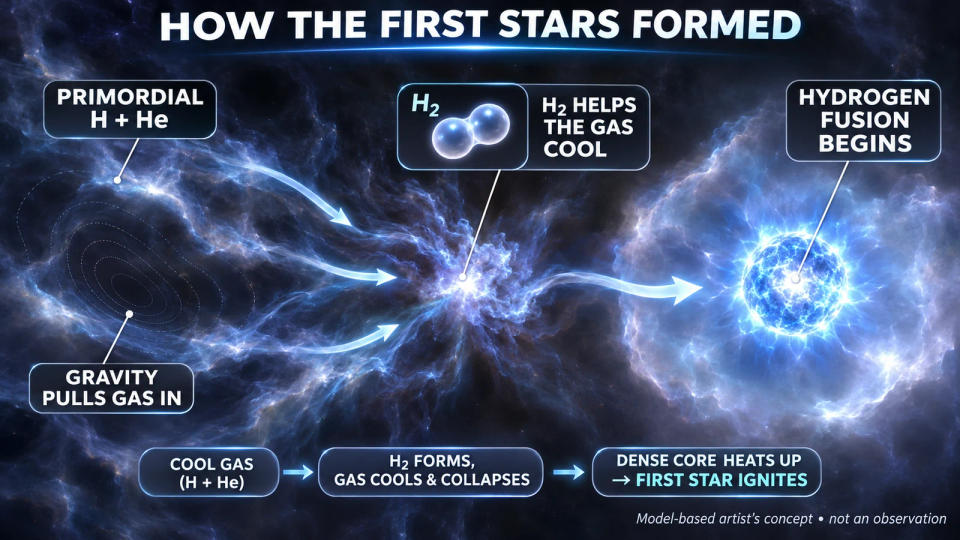
Researchers think the first stars began forming perhaps as early as about 100 million years after the Big Bang. The exact timing is still debated. Dark matter supplied gravitational wells where ordinary gas could accumulate. As pockets of hydrogen and helium became denser, gravity compressed them further. A small amount of molecular hydrogen, H₂, helped the gas shed heat, allowing collapse to continue. Eventually a central protostar became hot and dense enough for hydrogen fusion, and a new source of starlight appeared.
There was an essential difference from star-forming clouds in the modern Milky Way. The first clouds had almost no elements heavier than helium. Astronomers call these heavier elements metals, even when they mean familiar nonmetals such as carbon and oxygen. With no carbon-rich dust or oxygen-bearing molecules to cool the gas efficiently, the conditions for fragmentation and star formation were different from those found in many present-day stellar nurseries.
This is why the first stars are called Population III: the term identifies a hypothetical stellar generation born before widespread chemical enrichment. It does not mean they were the third generation. The gas-collapse picture comes mainly from cosmological calculations and the known physics of gravity, cooling, and fusion—not from a photograph of a Population III star being born.
Were the First Stars Huge, Hot, and Short-Lived?
Probably many were—but “every first star was enormous” is not an established fact. NASA describes tens to hundreds of solar masses as a plausible range for massive Population III stars, with models often discussing roughly 10 to 300 times the Sun's mass. Their limited cooling could have favored unusually massive objects. Yet the gas might have broken into several smaller fragments, making multiple stars rather than one giant.
That uncertainty is not academic nitpicking. A 2026 study using 138 cosmological simulations found that the predicted mass distribution changes with the surrounding dark-matter halo and gas motions. The researchers did not measure individual primordial stars; they modeled how environmental conditions could influence their formation. The result challenges a simple, universal recipe for the mass of every first star.
If some of these stars were exceptionally massive, they would also have been spectacularly hot and bright. Models suggest that a roughly 100-solar-mass primordial star could reach a surface temperature near 100,000 kelvins. Much of its energy would emerge as invisible ultraviolet radiation rather than the comfortable-looking visible light of an artist's illustration. That radiation could knock electrons off nearby hydrogen atoms and contribute to the long process called cosmic reionization.
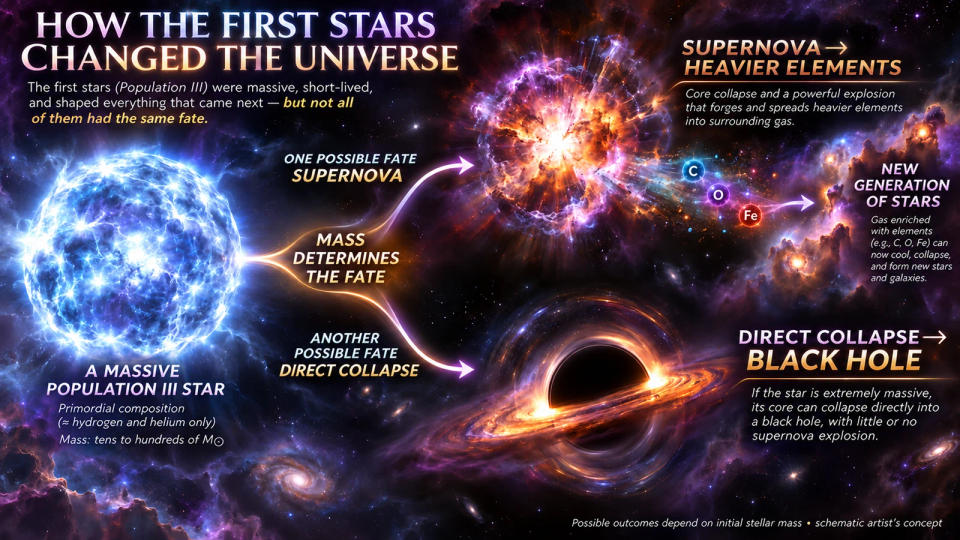
The trade-off for such brilliance was a short life. Massive stars consume nuclear fuel rapidly, sometimes surviving only a few million years or less, compared with billions of years for a Sun-like star. Their ultimate fate depended on details such as initial mass and stellar evolution. Some likely exploded as supernovae, dispersing newly formed heavier elements into surrounding gas; other sufficiently massive stars may have collapsed into black holes, sometimes without a spectacular explosion. Certain very massive models also predict pair-instability supernovae that leave no compact remnant.
That chemistry changed everything. Later clouds could contain carbon, oxygen, iron, and other elements that did not exist in substantial amounts before stars began nuclear processing. Over many generations, enriched gas helped build new stars and eventually rocky planets. The first stars did not manufacture Earth directly, but they helped start the universe's long history of chemical enrichment.
Have Telescopes Actually Seen a First-Generation Star?
Here is the most important distinction: a conclusively identified, genuinely metal-free Population III star remains elusive. Astronomers have discovered very distant galaxies, extremely old stars, and chemically primitive gas, but those achievements do not automatically identify one of the universe's very first stars. A star observed today can be ancient without being first-generation; even tiny amounts of heavy elements show that some earlier stellar processing occurred.
The James Webb Space Telescope searches for clues in the infrared light of very early galaxies. Because the universe has expanded while ancient light traveled toward us, originally ultraviolet and visible radiation is stretched to longer wavelengths. Webb's spectroscopy can test the chemical composition and energetic radiation of faint early systems, while gravitational lensing sometimes magnifies objects that would otherwise be too dim.
A particularly interesting 2026 study of the galaxy LAP1-B reported extremely low oxygen abundance—only a small fraction of the Sun's level—and radiation consistent with very metal-poor stars. This is valuable evidence about early chemical enrichment, not direct proof that Webb photographed the first star. In fact, the study measured some oxygen, and the galaxy was observed as it existed roughly 800 million years after the Big Bang, well after the earliest stars may have formed.
Scientists therefore piece the story together from three kinds of evidence: models of primordial gas collapse, observations of the earliest accessible galaxies, and the chemical fingerprints preserved in later stellar populations. As telescopes and simulations improve, they may reveal how varied the first stars really were. For now, the strongest honest answer combines confidence about their pristine ingredients with humility about their individual properties.
Conclusion
So what were the first stars in the universe really like? They were born from nearly pure hydrogen and helium in the cosmic Dark Ages. Many may have been hotter, brighter, and more massive than our Sun, helping ionize hydrogen and seed later generations with heavier elements. Yet their precise masses, lifetimes, and fates are still being tested—and no single star has been conclusively certified as Population III. Their legacy, rather than a clear portrait, is what astronomers can currently study most reliably.
Sources & Further Reading
- NASA Science — What Were the First Stars Like?
- NASA Science — Early Universe
- Nature (2026) — An Ultra-Faint, Chemically Primitive Galaxy Forming in the Reionization Era
- Monthly Notices of the Royal Astronomical Society (2026) — Formation of First Star Clusters: Environmental Trends
- NASA Science — First Stars: Temperature, Brightness, and Color
Post a Comment