
Astronauts can temporarily gain up to about 3% in height because their spines carry less load and lengthen in microgravity.
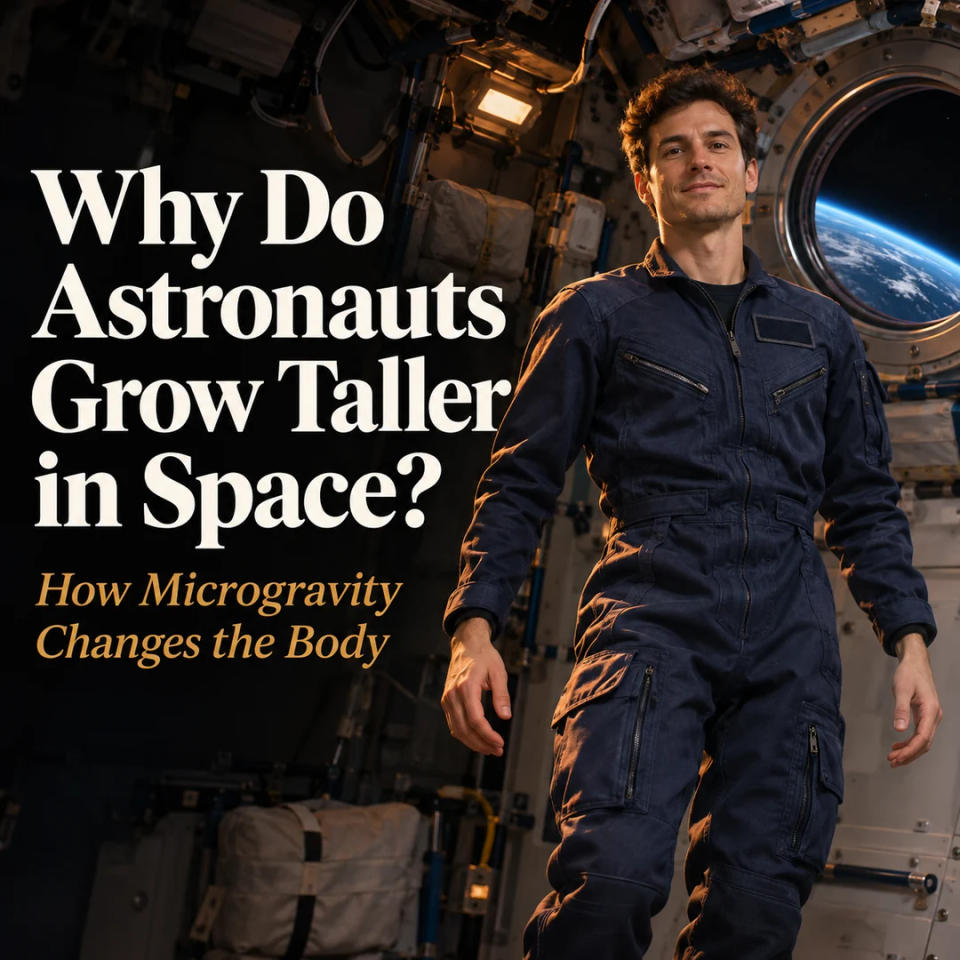
An astronaut can leave Earth at one height and measure a little taller aboard the International Space Station. The change comes from the spine, which carries less of the body's weight in orbit and can lengthen. After landing, everyday loading returns and the extra height fades.
Why does the spine get longer in orbit?
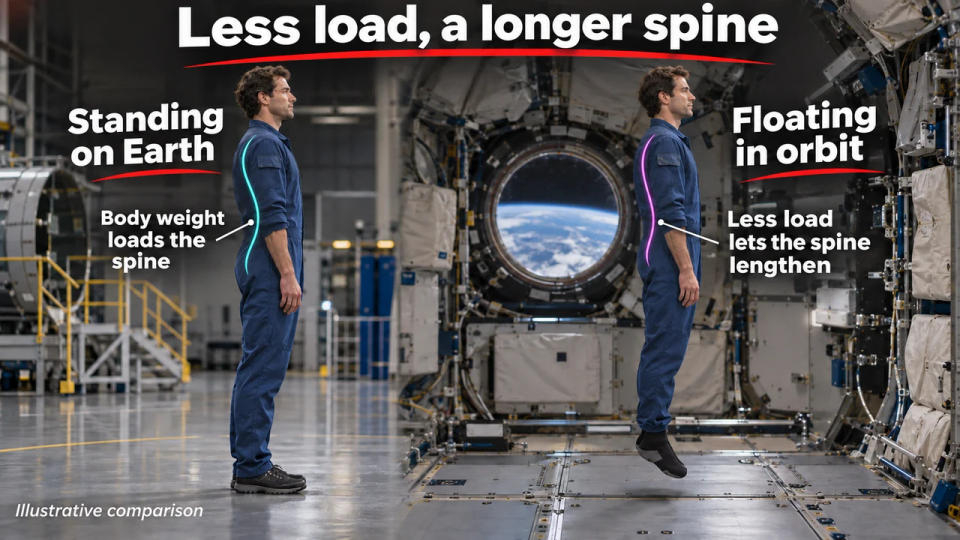
Imagine standing in a queue on Earth. The floor pushes up through your feet while gravity pulls down on your body. Your spine carries part of the weight above each level, and the muscles around it help keep you upright. When you lie down, your weight is supported along more of your body, so the head-to-foot load on your spine eases. ESA researchers use this everyday difference to explain why people tend to measure a little taller in the morning than later in the day.
On the space station, the crew and their spacecraft fall around Earth together. Earth's gravity supplies the acceleration that bends the station's path into an orbit. Inside, a freely floating astronaut rarely needs the floor to support their weight the way it does during standing on Earth. That near-weightless environment is what astronauts experience as microgravity.
With less load along its length, the spine can settle into a slightly different shape. Some of its natural curves can flatten, increasing the distance from one end of the spinal column to the other. Think of a gently bowed strip of paper. Ease the bend and the ends move farther apart even though the paper itself stays the same length. The human spine is much more complex, but the analogy shows how a change in shape can add to measured height.
The cushions between vertebrae, called intervertebral discs, also respond to loading. On Earth, fluid can move in and out of them over the day as we rest and stand. NASA and ESA researchers have investigated whether changes in disc fluid contribute to the height gain in orbit. The gain reflects the behavior of the whole spine, and a tape measure alone cannot tell researchers how much comes from discs, curvature, or other changes.
How much taller can astronauts get?
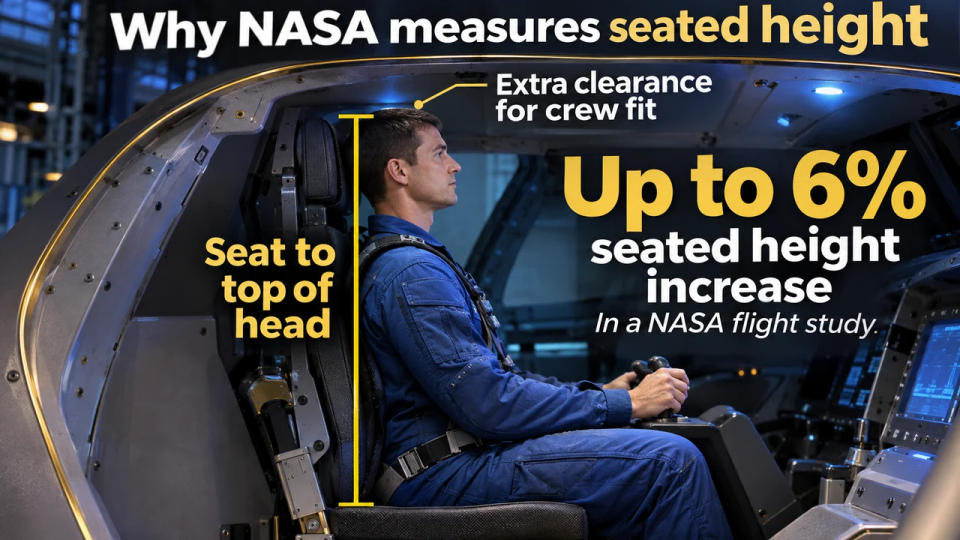
In a NASA flight study that collected seated measurements from 29 shuttle and space station crew members, researchers reported gains of up to 3% in overall stature and up to 6% in seated height. Stature is full body height. Seated height is the distance from the sitting surface to the top of the head. They use different starting lengths, and the reported maxima describe the study's observations rather than what everyone should expect.
A 3% increase for someone who measures 175 centimeters on Earth would be about 5.3 centimeters, or just over 2 inches. That is an example based on the reported upper figure. Any individual's change can differ. It also explains why a few centimeters make for an interesting story without changing the way the whole body is proportioned by very much.
For engineers, the more relevant measurement can be how far the head reaches above the seat. Think of a spacecraft cabin with tight clearance above a crew member's head. An astronaut's Earth measurement gives the designers a starting point, and the in-flight measurement tells them how much room to allow when that person returns to the seat after time in microgravity. NASA's study collected the measurements in part to inform the design of the Orion spacecraft.
Spacesuit fit raises a similar question. A change in torso length can matter to the way a suit fits even if the change seems small compared with someone's full height. ESA and its research partners have tested a stretchy experimental Skinsuit that applies a head-to-foot load, using both a ground-based waterbed model and trials aboard the station to explore how that load affects the body.
What happens after astronauts come home?
Once astronauts are back under normal loading, they return to their usual height. That recovery tells us something about the nature of the original change. The spine had adapted to a different mechanical environment. Standing and walking restore the kinds of forces it encounters day after day on Earth.
Space agencies also track changes that are separate from the temporary boost in height. Over longer missions, bones that normally carry body weight can lose mineral density, and the muscles used to maintain posture can become smaller or weaker. Resistance exercise gives muscles and bones work to do in orbit and helps limit those losses. How tall someone measures on a particular day tells researchers little about those slower changes on its own.
Researchers use different tools to separate these effects. A height measurement captures the overall result. In NASA's Spinal Ultrasound Investigation, crew members used a portable scanner aboard the ISS to study the spine in orbit, while it was still experiencing microgravity. Scans before and after a mission can also show changes in tissues such as bone and muscle. Taken together, these measurements help teams ask which changes reverse with ordinary loading and which need more time or targeted study.
Conclusion
Astronauts get taller in space because floating in orbit reduces the usual load on the spine, allowing it to lengthen temporarily. Measuring both stature and seated height helps researchers understand the body and gives engineers practical numbers for crew fit. Once the astronaut is back on Earth, the usual loads return and so does their usual height.
Sources & Further Reading
- NASA Science — Chapter 3: Gravity & Mechanics
- Young and Rajulu, NASA NTRS — The Effects of Microgravity on Seated Height (Spinal Elongation)
- NASA — Astronauts Perform Spinal Ultrasound Investigation
- ESA — Waterbeds simulate weightlessness to help Skinsuits combat back pain in space
- NASA — Risk of Spaceflight-Induced Bone Changes
- NASA — Astronauts’ Spines Under Scrutiny
Post a Comment