
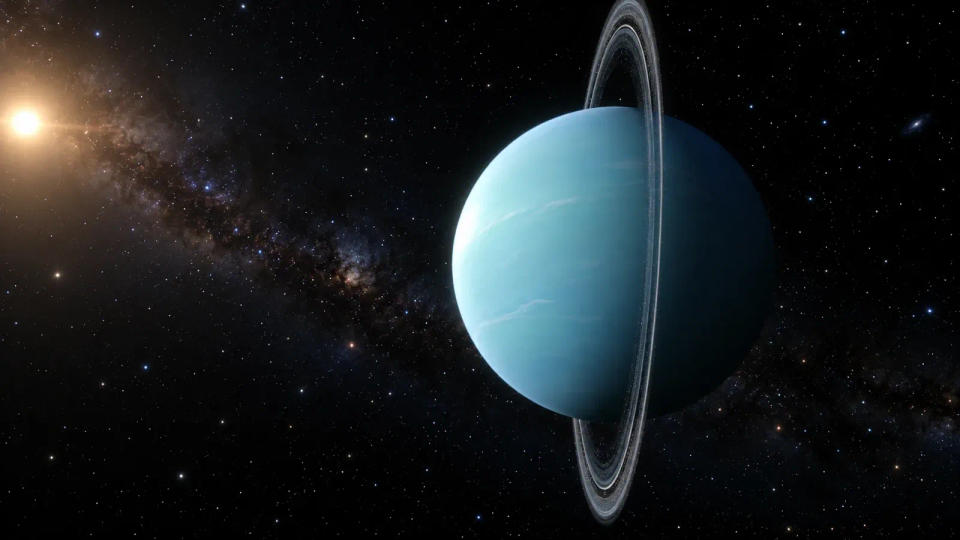
Picture the planets as spinning tops circling the Sun. Most turn with their poles pointing roughly above and below their paths. Uranus looks as though someone knocked its top over and left it rolling on its side.
That odd pose is real. Uranus has an axial tilt of about 97.77 degrees, far beyond Earth's 23.4 degrees. But the reason it ended up that way is still unknown. Scientists have two particularly intriguing explanations: an enormous collision early in the solar system, or the slow gravitational pull of a moon that no longer exists.
What Does It Mean for Uranus to Rotate Sideways?
A planet's axis is the imaginary line running through its north and south poles. As a planet spins, that line tells us which way its rotation is pointed. Earth's axis leans a little, which helps produce our familiar seasons.
Uranus takes the idea of leaning to an extreme. Its axis is tilted almost 98 degrees away from the direction perpendicular to its orbit. In other words, the axis lies only about eight degrees from the plane of its path around the Sun.
Imagine placing a basketball on the floor and turning it like a globe. Now tip the basketball almost completely onto its side while keeping it spinning. That is a useful picture of Uranus, although the planet isn't literally rolling along anything in space.
Uranus completes one rotation in roughly 17 hours, while one journey around the Sun takes about 84 Earth years. Since its tilt exceeds 90 degrees, astronomers also describe its spin as retrograde, or opposite to the usual direction of planetary rotation. Venus rotates retrograde too, but Uranus is the only planet tipped so close to sideways.
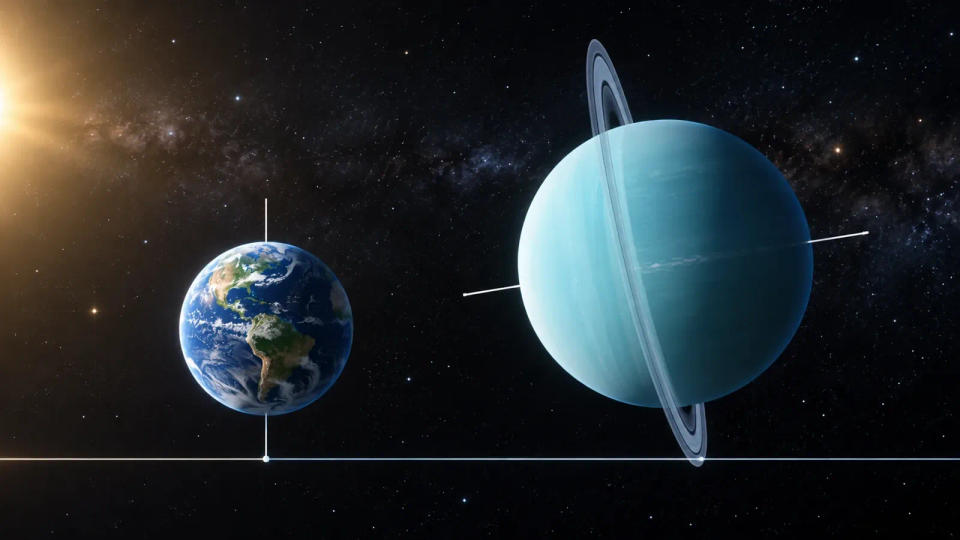
Illustration: Earth is only modestly tilted, while Uranus rotates with its axis nearly in the plane of its orbit. Not to scale.
Could a Giant Collision Have Knocked Uranus Over?
The classic explanation is dramatic but scientifically plausible. More than four billion years ago, the young solar system contained many growing worlds moving on intersecting paths. Some collided, merged, or scattered material into space.
If a large protoplanet struck young Uranus at the right angle, it could have changed the direction of the planet's spin. Think of tapping the edge of a spinning ball: where and how you strike matters just as much as the strength of the blow.
Researchers have tested this idea using computer simulations, not recordings of an ancient event. Studies of impacts involving bodies around one or more Earth masses show that a powerful, off-center collision could tip Uranus dramatically. Simulations also explore whether the debris might help explain parts of its moon system and whether material deposited inside the planet could affect the way internal heat escapes.
There is an important catch. A model showing that a collision is possible does not prove that one happened. Scientists still need to explain why Uranus and Neptune are otherwise fairly similar, and how the tilted planet ended up with its present rings and orderly major-moon orbits.
Could a Lost Moon Have Slowly Tilted the Planet?
Another possibility is quieter and, in some ways, stranger. What if Uranus wasn't knocked sideways in a single blow? What if a large moon gradually helped pull its axis over?
A 2022 study in Astronomy & Astrophysics explored this possibility with mathematical models and simulations. In the scenario, a substantial ancient moon slowly migrated outward. Its changing gravitational influence could have entered a kind of rhythm, called a resonance, with the motion of Uranus's spin axis.
For a familiar comparison, imagine giving a playground swing a series of gentle pushes at just the right moments. No single push needs to be huge. Over time, repeated, well-timed pushes can have a large effect. The proposed moon would not be pushing Uranus in the ordinary sense, but the resonance idea is similar.
In the researchers' simulations, the planet could approach a sideways orientation. Eventually the moon's orbit became unstable; in some modeled outcomes it fell into Uranus, leaving the planet with a tilt resembling the one we see today.
It is a compelling hypothesis, not a discovered missing moon. Astronomers have not observed such a satellite or confirmed that it ever existed. Other gravitational interactions in the early solar system may also have played a role.
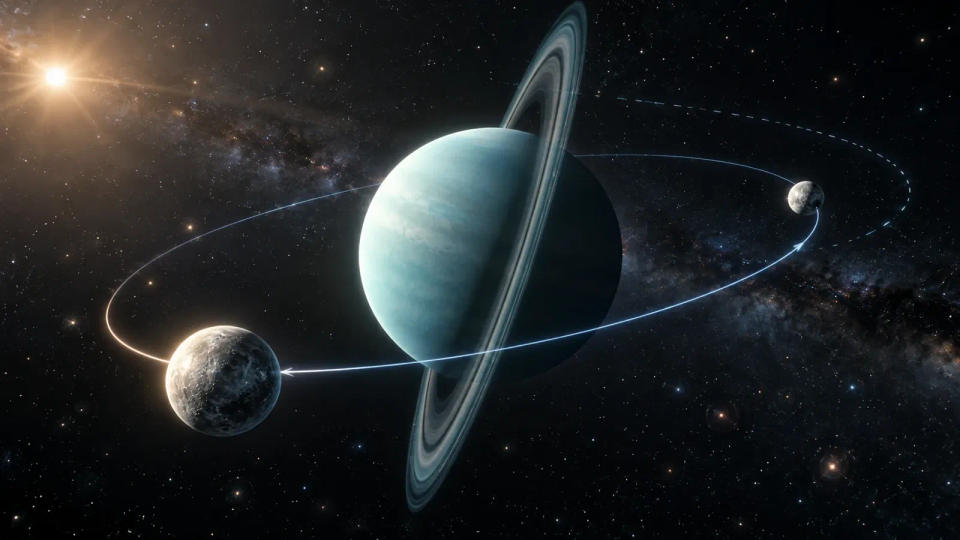
Artist's impression of a proposed ancient-moon scenario. The moon and its illustrated path are hypothetical, not an observation.
What Happens to the Seasons on a Sideways Planet?
Whatever caused the tilt, its effects are easy to appreciate. Earth's seasons change because each hemisphere alternately leans toward and away from the Sun. On Uranus, that pattern is taken almost to its limit.
Near a Uranian solstice, one pole points almost directly toward the Sun while the other faces away. At the poles, that can mean about 42 Earth years of continuous daylight followed by about 42 years without the Sun rising. A single Uranian season lasts roughly 21 Earth years.
Now imagine waiting decades for sunrise. You would not experience a normal Earth-like alternation of day and night at the pole even though the planet keeps spinning every 17 hours. The direction of sunlight, rather than the speed of rotation, creates that extraordinary polar experience.
Uranus's rings and its major moons also lie close to the planet's tilted equatorial plane, so the whole system seems to have been tipped together. Depending on where Uranus is in its long orbit, telescopes on Earth can see its rings more face-on or nearly edge-on.
The atmosphere does not simply follow a neat seasonal script, however. It stores and redistributes heat, and winds and clouds respond in complicated ways. Hubble and the James Webb Space Telescope have observed changing views of Uranus, including its bright polar region and shifting cloud features. Those observations reveal the consequences of the tilt, even if they do not tell us how it began.
How Could Scientists Finally Solve the Mystery?
The best clues may be hidden in the planet's interior and its moons. A giant impact could leave different fingerprints from a long period of gravitational tilting, especially in the distribution of heavy materials, the structure of the interior, and the history of orbiting satellites.
But Uranus is difficult to investigate from nearly three billion kilometers away. Voyager 2 remains the only spacecraft to have visited it, flying past in 1986. That brief encounter transformed our understanding of the planet, yet left many questions unanswered.
A future spacecraft that spends years orbiting Uranus could map its gravity and magnetic field, study how its atmosphere changes with season, and inspect its rings and moons in detail. These measurements could help researchers test competing histories rather than relying only on simulations and distant telescope images.
Even then, there might not be a single piece of evidence that settles the argument. Reconstructing an event from billions of years ago is like solving a mystery after most of the clues have been rearranged. Each new measurement narrows the possibilities.
Conclusion
We know how Uranus spins: almost on its side, with one of the most extreme tilts in the solar system. What we do not yet know is why. A colossal impact and a lost moon both offer possible answers, but neither is confirmed. That uncertainty is precisely what makes Uranus worth exploring again.
Sources & Further Reading
- NASA Science — Uranus Facts
- NASA Science — Hubble Monitors Weather and Seasons at Uranus
- NASA — Webb's View of Uranus and Its Rings
- Durham University — Giant Impact Simulations for Uranus
- Saillenfest et al. (2022), Astronomy & Astrophysics — Tilting Uranus via an Ancient Satellite
- NASA (2025) — Have We Been to Uranus?
Post a Comment