
Why do rocky planets come first and giant planets farther out? Explore the solar nebula, temperature differences, and early orbital migration.
Start at the Sun and travel outward. You encounter Mercury, Venus, Earth, and Mars, followed by Jupiter, Saturn, Uranus, and Neptune. Why this particular sequence? The short answer is that planets grew inside a disk with different temperatures and materials at different distances. Gravity, collisions, and later changes in planetary orbits helped shape the arrangement we see today.
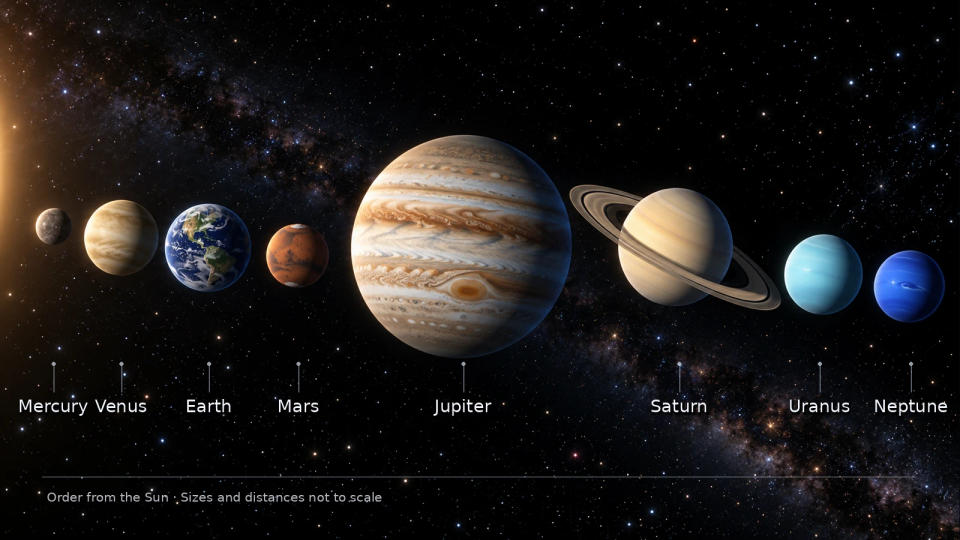
That explanation does not mean every planet formed at its present address. The broad distinction between the small inner rocky worlds and the outer giants is well established, but the detailed history of individual orbits remains an active area of research.
How Did a Spinning Cloud Become the Solar System?
About 4.6 billion years ago, the region that became our Solar System was part of a cloud of gas and dust. Gravity drew a portion of that material inward. As the cloud contracted, it rotated faster and flattened into a disk around the growing young Sun. This is the basic idea behind the nebular model of Solar System formation. A nearby stellar explosion may have contributed to the initial collapse, but that possibility is not established as the unique trigger.
Most material collected near the center, where the Sun formed. The remaining gas and solid particles orbited in a broad, relatively flat protoplanetary disk. That shared origin helps explain why the eight planets revolve around the Sun in the same general direction and in nearly the same plane. Their orbital paths are not identical circles, but they retain the disk's overall organization.
At first there were no full-sized planets in tidy lanes. Microscopic grains collided and sometimes stuck, growing into pebbles, larger clumps, and eventually planetesimals: the building blocks of planets. Many collisions helped objects grow, while other impacts broke them apart. Gravity enabled the largest bodies to collect additional material and become planetary embryos. The details of how tiny particles overcame all the obstacles to growth are still studied.
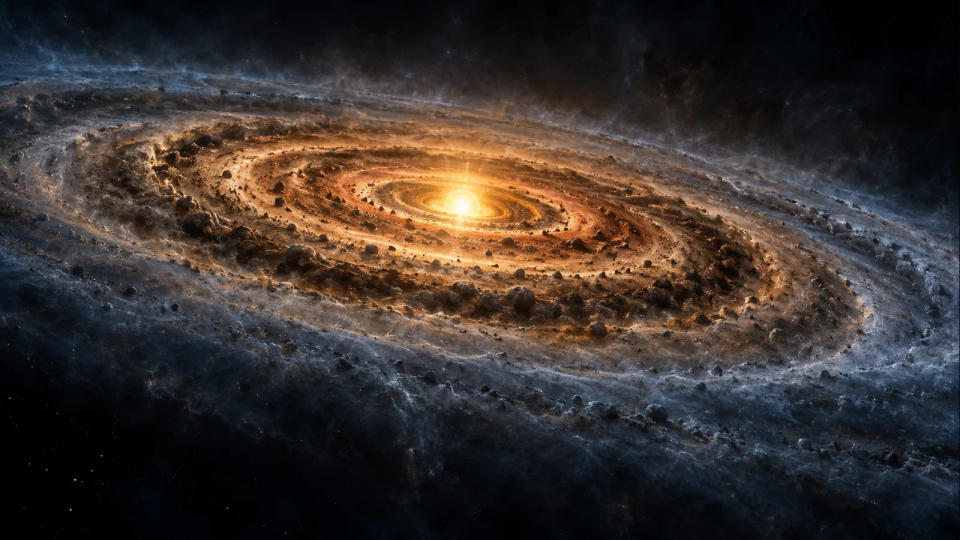
Scientists do not have a photograph of our own Solar System at that age. Instead, they investigate meteorites and returned samples, study disks around other young stars, and compare those observations with physics-based models. NASA notes that the young disk's gas dispersed after only a few million years, while rocky bodies could continue colliding for much longer. Different planets therefore had different opportunities to gather solid material and gas.
Why Are the Four Inner Planets Rocky and the Four Outer Planets Giant?
The young disk was much hotter near the Sun and cooler farther away. Close to the Sun, heat limited which materials could remain solid. Rock and metal endured, so Mercury, Venus, Earth, and Mars developed as relatively compact terrestrial worlds with solid surfaces. Their familiar order is based on distance from the Sun, not size or the order in which they finished forming.
Farther out, temperatures were low enough for water and other volatile compounds to freeze in appropriate regions. The boundary where water ice could persist is often called the snow line or ice line. It was not a fixed, painted ring; its location changed as the young disk cooled and evolved. Adding ice to rock and metal increased the quantity of solid building material available for growing large planetary cores.
Some outer cores then gathered substantial hydrogen and helium before much of the nebular gas vanished. Jupiter and Saturn became gas giants. Uranus and Neptune are more accurately described as ice giants: they contain a greater proportion of heavier constituents associated with water, ammonia, and methane than Jupiter or Saturn, although their interiors remain difficult to determine precisely. Calling all four outer planets simply “gas giants” hides this important difference.
Timing mattered, too. NASA describes Jupiter and Saturn as likely forming quickly, within the Solar System's first roughly ten million years, while the rocky planets could take tens of millions of years to complete their growth. The gas reservoir was temporary. A growing core that reached the right conditions early could capture a massive envelope; a smaller body forming later could not do the same.
This hot-inside, cold-outside pattern explains the major planetary families, but not every detail. It does not by itself specify why Mars is small, how Earth acquired all its water, or why Jupiter sits at exactly its present distance. The asteroid belt between Mars and Jupiter also preserves a complex history of bodies that did not assemble into another large planet.
Did the Planets Always Orbit in Their Present Order?
Probably not at their current distances. Young planets interacted with leftover gas, countless smaller bodies, and one another through gravity. Such interactions can move a planet inward or outward without changing its basic identity. Planetary migration is a major ingredient in modern models of Solar System history, even though the exact path and timetable cannot be watched directly.
One influential family of simulations, known as the Nice model, proposes that the giant planets began in a more compact configuration. Exchanges of momentum with smaller icy bodies and gravitational interactions among the giants then altered their orbits. In these model histories, Jupiter can move somewhat inward while Saturn, Uranus, and Neptune spread farther outward. This is a model-based reconstruction, not a recorded sequence of ancient positions.
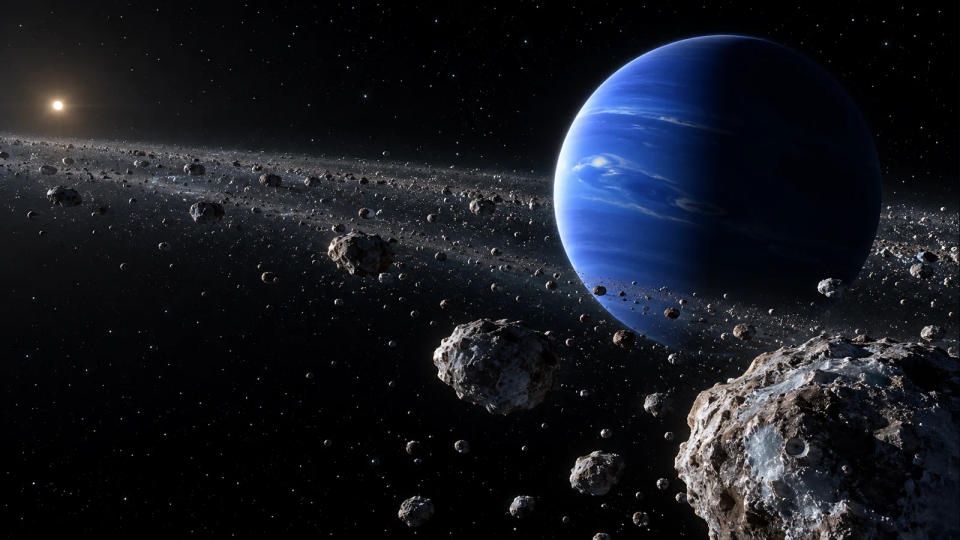
Why take migration seriously? Neptune's influence provides clues in the Kuiper Belt beyond its orbit. Some icy objects occupy orbital resonances, meaning their revolution periods follow repeating ratios with Neptune's. Others have tilted or stretched orbits that record strong gravitational encounters. Those populations are evidence that the outer Solar System changed, although several model histories can still be tested against the observations.
So the phrase “arranged in this order” has two meanings. The outward sequence of the eight named planets is what we observe now. The underlying architecture—rocky planets inside, giants outside, and belts of leftover material—grew from the disk's chemistry and temperature as well as its later gravitational evolution. There is no simple rule that planet distances increase by a constant amount, and the illustration above is explicitly not to scale.
Conclusion
The Solar System did not begin as eight finished planets placed in a row. It emerged from a spinning disk about 4.6 billion years ago. The hot inner region favored rocky and metallic solids; colder outer regions supplied ice-rich building blocks and conditions that helped giant planets grow. Collisions built worlds, while gravitational interactions reshaped some of their orbits.
That is why our planetary neighborhood has a recognizable structure, even though its exact formation history is not completely settled. The next time you recite Mercury through Neptune, think of the names as the surviving result of a long physical process—not a perfectly fixed blueprint from day one.
Sources & Further Reading
- NASA Science — Solar System: Facts
- NASA Science — Planetary Systems
- NASA Science — How Do Planets Form?
- NASA Science — NASA's Lucy Mission: A Journey to the Young Solar System
- NASA Science — Kuiper Belt: Facts
Post a Comment