
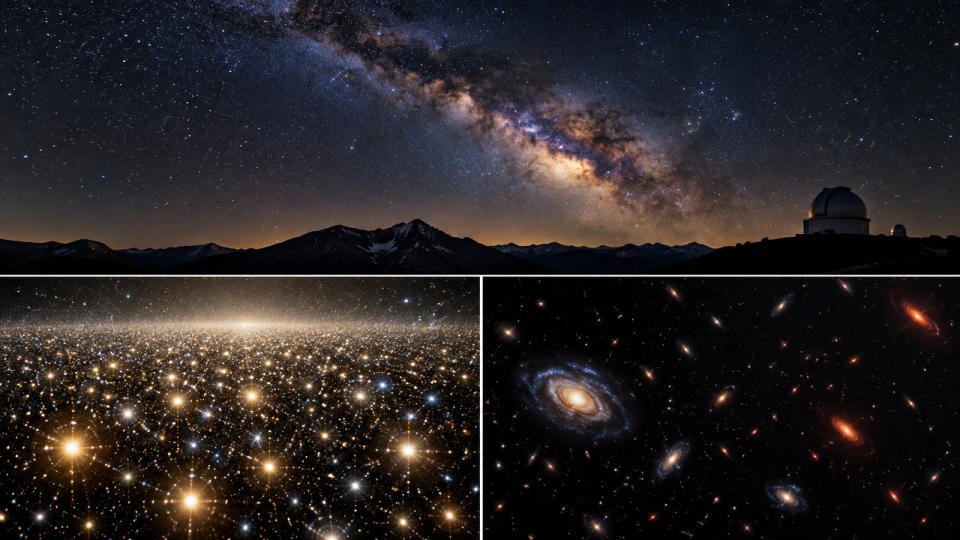
Look up on a clear night and you see stars scattered across an almost black sky. But if the universe contains an extraordinary number of stars, why don't their lights combine to turn the whole sky bright?
The short answer is that the universe has not been shining forever. Light takes time to travel, stars have finite lifetimes, and the expanding universe stretches much of the most distant light beyond what our eyes can see. That everyday darkness is a clue to the history of the cosmos.
The Puzzle: Shouldn't Every Direction Lead to a Star?
Imagine standing inside an enormous forest. Nearby trunks block part of your view, but look between them and you find more trees farther away. If the forest stretches endlessly in every direction and is dense enough, virtually every line of sight eventually meets a trunk.
Now replace those trees with stars. In a universe that is infinite, unchanging, and filled with stars that have been shining forever, every direction should eventually point toward a stellar surface. Rather than a few bright dots on black, the sky would have an almost continuous glow.
This is Olbers' paradox, named after the German astronomer Heinrich Wilhelm Olbers, who discussed the problem in the nineteenth century. The question is older than Olbers, and it exposes something surprising: an apparently simple observation can challenge an entire picture of the universe.
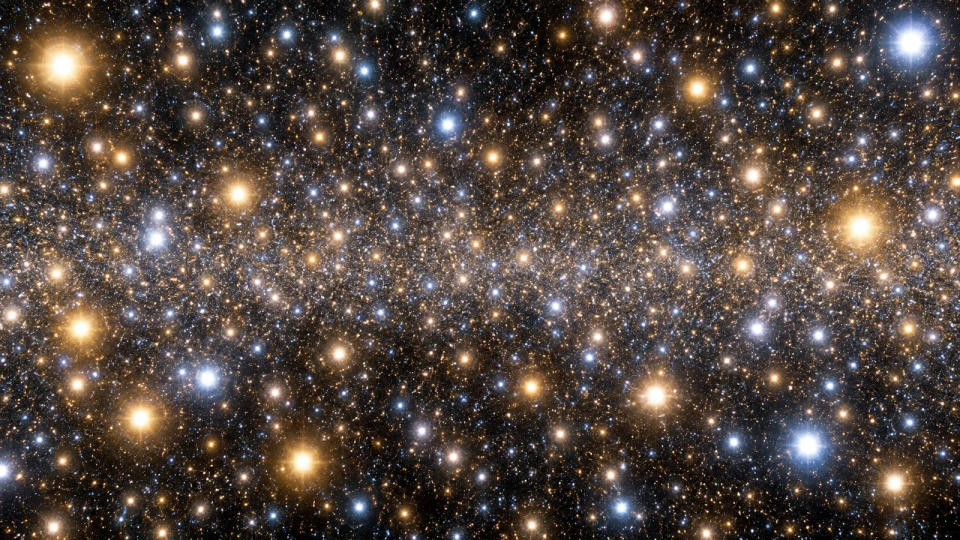
There's a clever reason distance alone cannot solve the puzzle. If stars are twice as far away, an individual star appears one-quarter as bright. But a spherical layer of space twice as far away contains roughly four times as much area—and, with a uniform distribution, about four times as many stars. In this simplified model, one layer contributes roughly as much light as another.
Stack up endlessly many layers and the problem becomes impossible to ignore. Our real universe must differ from that imaginary, eternal forest.
Why a Universe With a Beginning Changes Everything
The universe is about 13.8 billion years old, based on the standard cosmological model and measurements including the cosmic microwave background. That sounds like an unimaginably long time, but it is not forever.
Light has a speed limit: approximately 300,000 kilometers per second in a vacuum. Even light from the nearest stars takes years to reach Earth, while light from extremely distant galaxies travels for billions of years. We see those objects as they were when the light began its journey, not as they are today.
That creates an observational horizon. There are regions so distant that their light, emitted after stars first appeared, has not had enough time to reach us. The universe may extend far beyond what we can observe, but its unseen regions cannot brighten our night sky with light that has not arrived.
One detail matters here: the universe did not begin with stars already shining. After the early universe cooled enough for atoms to form, there was a long period before the first stars ignited. Every star has also formed at a particular time and emits energy for a limited lifetime. The total history of starlight is therefore finite.
This explanation does not require proving that space itself has an edge. The entire universe could be much larger than the observable part, perhaps even spatially infinite. A finite history of light is enough to break the assumptions behind the paradox.
How Expanding Space Makes Distant Light Harder to See
There is a second effect at work. The universe is expanding, which means the space between widely separated galaxies generally grows over time. As light travels through that expanding space, its wavelength stretches too. Astronomers call this cosmological redshift.
Think of a wave drawn on a rubber band. Stretch the band and the peaks move farther apart. In a similar way, light emitted as visible blue or red light can arrive at Earth with a longer wavelength, shifted into the infrared. At even greater stretches, radiation moves beyond the infrared into still longer wavelengths.
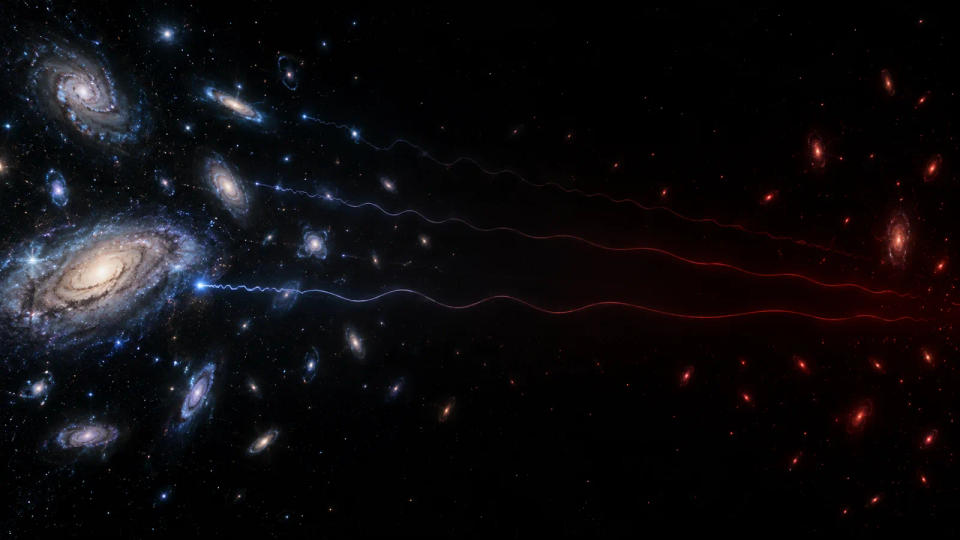
The image is an illustration of the idea, not a photograph of light physically traveling in colored ribbons. Real astronomers measure redshift from the light itself, often by examining recognizable features in a galaxy's spectrum.
Redshift reduces how much distant cosmic light arrives in the visible band and contributes to the dimness of the sky. But it is not the whole answer on its own. The more fundamental point is that stars and galaxies have only existed—and radiated—for a finite amount of time.
Is the Darkness Between Stars Really Empty?
Not at all. A patch of sky that looks blank to your eyes can reveal faint galaxies when a powerful telescope collects light for long enough. The Hubble Space Telescope's deep views helped show just how much distant structure lies in apparently empty directions.
Nor is the background of the night sky perfectly black to sensitive instruments. Across the universe, galaxies have released immense quantities of starlight. Some of that accumulated light forms a faint extragalactic background glow at optical and infrared wavelengths. NASA's Fermi observations have helped researchers study this collective starlight and the history of star formation.
There is also an even older light filling the sky: the cosmic microwave background, or CMB. It comes from a time about 380,000 years after the Big Bang, when the universe became transparent enough for light to travel freely over large distances.
As space expanded, that ancient radiation was stretched into microwaves. Today its temperature is about 2.7 kelvin, only a little above absolute zero. Our eyes cannot see microwaves, but instruments such as ESA's Planck satellite have mapped subtle variations in this background radiation.
So a dark-looking sky does not mean a lightless universe. It means that most of the radiation reaching us is too faint, too diffuse, or outside the narrow range of wavelengths visible to human eyes.
What a Black Sky Reveals About Cosmic History
It is tempting to say the sky is dark simply because the Sun has set. That explains why Earth's atmosphere stops scattering direct sunlight across our side of the planet. It does not explain why the universe behind our atmosphere fails to shine like an enormous wall of stars.
Olbers' paradox helps connect the familiar night sky to three discoveries: light travels at a finite speed, cosmic sources have a history, and the universe evolves as it expands. Scientists learn about that history not only from bright stars and galaxies, but also from the faint backgrounds between them.
The next time you notice a quiet patch of darkness between two stars, consider what is missing from your view. Some starlight has not arrived. Some has been stretched beyond visible colors. Some is far too faint for your eyes. The black backdrop is not an absence of information; it is evidence that the cosmos has a past.
Conclusion
The night sky is dark because the universe is not an eternally shining, static sea of stars. Its finite luminous history is the key to the puzzle, while cosmic expansion and the limits of human vision deepen the darkness we see.
Sources & Further Reading
- NASA Night Sky Network — Looking Beyond the Stars
- NASA Goddard — Ask an Astrophysicist: Cosmology (Olbers' Paradox)
- NASA HEASARC — Measuring the Darkness of Night
- ESA — Planck and the Cosmic Microwave Background
- NASA Hubble — The Abundance of Galaxies in the Observable Universe
Post a Comment