
Why would a newborn star throw powerful streams of gas into space while it is still trying to grow? The answer is that jets help a forming star manage the angular momentum of material falling toward it. The James Webb Space Telescope has now revealed how these flows carve through dusty nurseries—and, in one remarkable region, how several jets seem to point in nearly the same direction.
These are not explosions from finished stars. They are a normal, though dramatic, part of the earliest stages of stellar formation. Webb's infrared instruments are allowing astronomers to see their structure through clouds that hide the youngest objects from ordinary visible-light telescopes. Crucially, Webb's celebrated Serpens result was announced on June 20, 2024; it should not be mistaken for a brand-new 2026 observation.
How Does a Growing Star Produce Two Powerful Jets?
Stars begin inside cold molecular clouds. Gravity gathers gas and dust into a denser, hotter center called a protostar, but the collapsing material is rarely motionless. Even a little initial rotation becomes important as the cloud shrinks, much as a spinning skater speeds up by drawing in their arms. Much of the infalling material therefore settles into a rotating accretion disk rather than dropping straight onto the center.
Here lies a problem: gas with too much angular momentum cannot simply fall inward. Angular momentum must be redistributed or carried away before more material can reach the growing star. Magnetic fields threaded through the disk and its inner regions are central to prevailing jet-launching models. They can accelerate some gas outward and help focus it along paths roughly perpendicular to the disk. The flow removes some angular momentum, allowing other matter to continue moving inward.
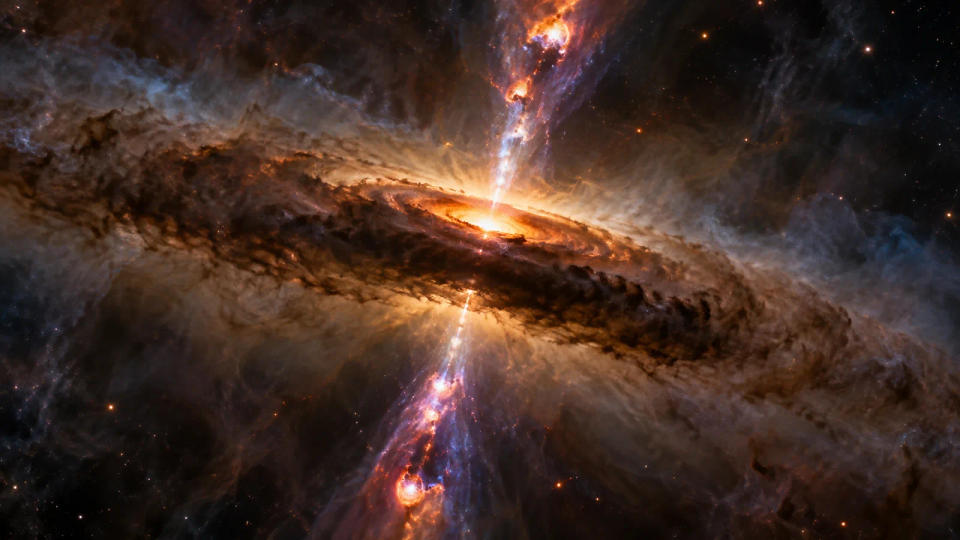
Think of the disk as a busy roundabout: material cannot all squeeze into the center while keeping the same orbital motion. Redirecting a fraction into outflows helps the system evolve. This comparison is only an analogy; real jets are not propelled by traffic-like pressure or by a star's surface firing like a rocket nozzle. The detailed balance between disk winds, tightly collimated jets, and magnetically driven outflows is still an active research area.
Because the rotating disk has two sides, the emerging flow commonly takes a bipolar form: one jet travels away on either side of the star. It may be much narrower than the broader gas swept up around it. Importantly, the star is gaining mass while only some material leaves; a jet is not evidence that the star has failed to form.
What Did Webb Discover in the Serpens Nebula?
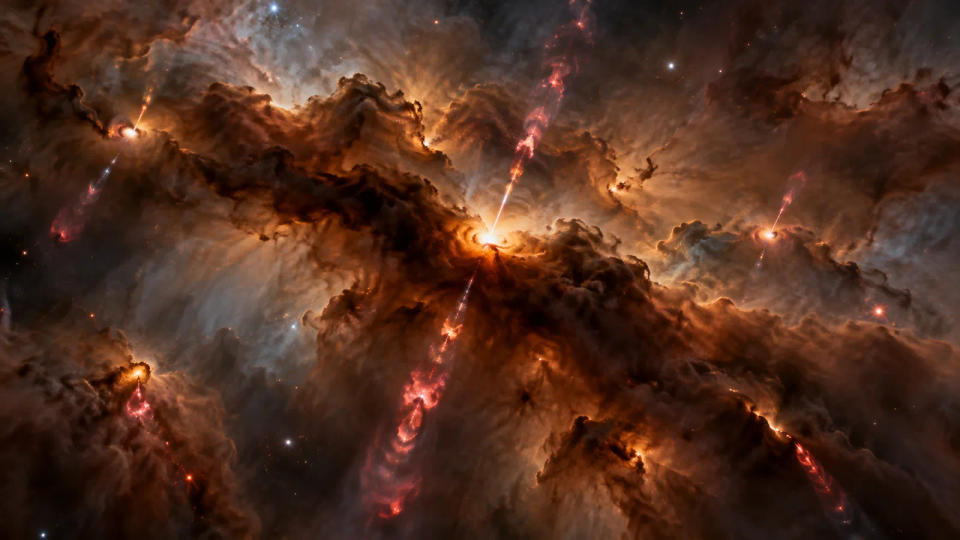
On June 20, 2024, NASA released Webb observations of Serpens, a star-forming nebula about 1,300 light-years away. Near the top-left area of the NIRCam image, astronomers identified a group of protostellar outflows with unexpectedly similar projected directions. Such streams often appear at varied angles in a stellar nursery. In this particular region, they line up roughly like streaks of rain slanting in the same direction.
That alignment matters because star formation begins in larger clouds, not in a collection of unrelated little factories. If stars inherit a common rotational tendency from the cloud or filament that formed them, their disks and young jets may initially share related orientations. Webb's sharp infrared view supplied observational support for this long-discussed possibility. It does not prove that every newborn star in Serpens has exactly the same three-dimensional rotation axis.
The image also captures bright, clumpy red features where jets run into surrounding gas and dust. These are shock-excited regions, not solid red beams visibly glowing to the naked eye. Webb's composite uses assigned colors for infrared observations; the red features trace emission associated with molecular hydrogen and carbon monoxide. Infrared wavelengths reveal structures previously lost in thick dust or reduced to vague blobs in shorter-wavelength images.
Researchers still need to compare jet orientations, the motions of the parent cloud, and the effects of stellar companions. Binary stars can cause disks or outflows to wobble, changing a jet's direction with time. The Serpens view is therefore a valuable snapshot of a young population, not a universal rule that all jets stay parallel forever.
What Do HH 211 and a Giant Jet Reveal?
Another Webb target, Herbig–Haro 211 (HH 211), offers a closer look at what happens when these fast flows encounter their surroundings. In a 2023 infrared image, the telescope traced a thin, knotty bipolar jet and spectacular curved bow shocks. A bow shock forms as moving material pushes into gas ahead of it, somewhat like the wave in front of a boat—although the astrophysical event involves supersonic gas, not water.
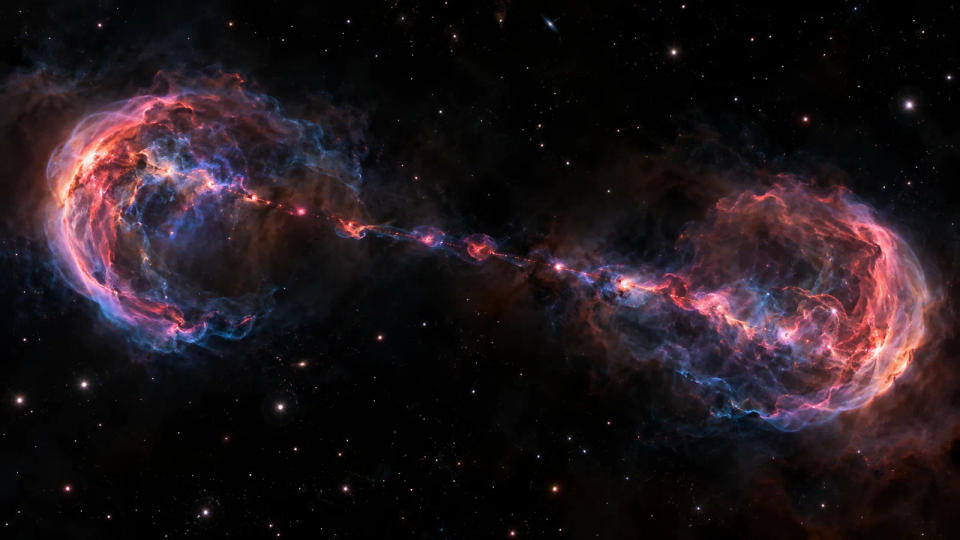
HH 211 is about 1,000 light-years away. Its driving object is a Class 0 protostar, an extremely early evolutionary stage. Webb revealed molecular emissions and a slight mirror-symmetric wiggle in the inner jet. An unseen stellar companion is one possible explanation for that pattern, not a confirmed identification. The picture helps astronomers investigate velocity, chemistry, and repeated episodes of ejection.
Then, in September 2025, NASA described a very different scale of outflow in Sharpless 2-284. Webb imaged a jet system spanning about eight light-years, powered by a massive forming star estimated at up to roughly ten solar masses. The system lies around 15,000 light-years away. Its size shows that impressive bipolar flows are not restricted to small future Sun-like stars; such detections help test how jet strength and geometry change with protostellar mass.
Webb has also exposed surprising systems hidden by dust. In 2024, observations of WL 20S revealed that an object previously treated as one young star is actually a pair, each associated with a jet. This is a reminder that identifying the number and geometry of young stars can change how astronomers interpret an apparent stream.
None of these cases means Webb has filmed gas moving in real time in a single photograph. Scientists combine morphology, emission at different wavelengths, spectroscopy where available, and comparisons with physical models to reconstruct the outflows. Equally, the colorful educational visuals accompanying this article are original scientific illustrations, not NASA telescope frames or direct measurements.
Conclusion
Newborn stars produce jets because growing through a rotating disk involves moving angular momentum outward as well as drawing mass inward. Magnetic fields provide a plausible and well-supported route for accelerating and collimating these flows. Webb's aligned jets in Serpens, intricate HH 211 shocks, and immense Sh2-284 outflow turn that physical process into detailed evidence about how stars are assembled. The extraordinary sight is not a star attacking space; it is a star forming.
Sources & Further Reading
- NASA — First-of-Its-Kind Detection Made in Striking New Webb Image
- ESA/Webb — Webb Snaps Supersonic Outflow of Young Star
- NASA — Webb Observes Immense Stellar Jet on Outskirts of Our Milky Way
- NASA — Webb Reveals Long-Studied Star Is Actually Twins
Post a Comment