
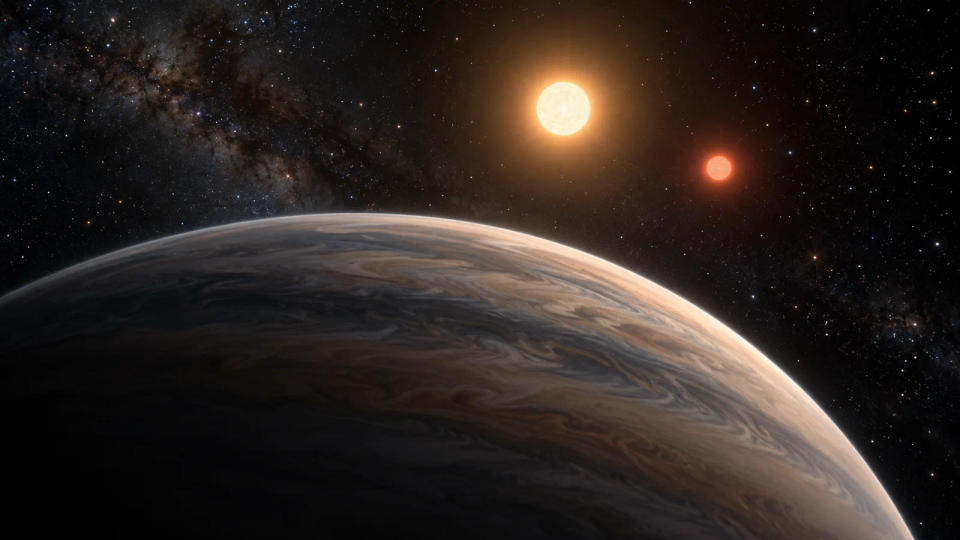
Could a real planet experience two sunrises like the fictional world of Tatooine in Star Wars? Yes: Kepler-16b orbits a pair of stars instead of a single sun. NASA confirmed it in 2011, although the planet itself is a cold, Saturn-sized gas giant rather than a habitable desert world.
The remarkable part is not simply that two stars appear in its sky. Both stars move around a shared center of mass, while the planet follows a larger orbit around the entire stellar pair. Kepler-16b helped astronomers establish that this arrangement is real and measurable, not just a clever idea from science fiction.
How Can One Planet Orbit Two Suns?
Most familiar planets, including Earth, orbit one star. Kepler-16b belongs to a different class called a circumbinary planet. “Binary” means that two stars are gravitationally bound, and “circumbinary” means that a planet travels around both of them. It does not jump back and forth between separate solar systems, nor does it trace a neat circle around each sun in turn.
Imagine two ice skaters holding hands and turning around one another, with a distant spectator walking around their shared dance floor. The skaters resemble the stellar pair; the spectator resembles the planet. Gravity is more complicated than that analogy, but the key idea is right: the combined mass of the two stars governs the planet’s wider orbit.
Kepler-16’s larger star is a cool K-type dwarf with about 69 percent of the Sun’s mass. Its smaller companion is a red dwarf with about 20 percent of the Sun’s mass. The stars complete one mutual orbit in roughly 41 days. Kepler-16b, much farther out, takes about 229 days to complete one trip around the pair.
Because the two stars are close together relative to the planet’s orbit, the system can support a long-lived circumbinary path. A planet passing too close to the moving pair could have its orbit strongly disrupted, but sufficiently distant orbits can remain stable. Kepler-16b’s orbit is a measured example of the latter, not evidence that every imaginable two-star arrangement is safe for planets.
Unlike our Sun, which is almost fixed at the center of the Solar System on everyday timescales, the two suns would continually change their apparent positions as viewed from Kepler-16b. Depending on their positions and the observer’s vantage point, the stars could appear separated, close together, or briefly aligned.
How Did NASA Prove Kepler-16b Was Real?
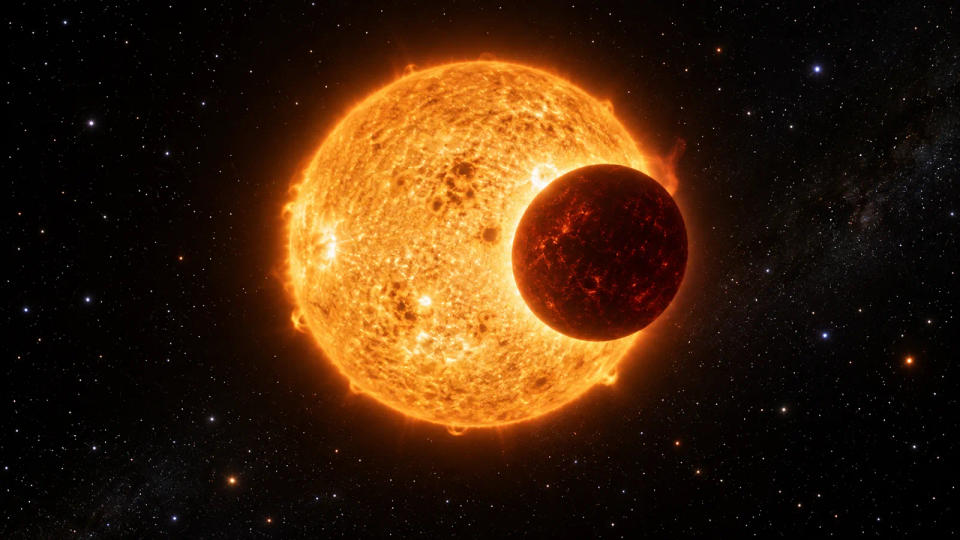
The discovery did not begin with a photograph of a planet beside two glowing suns. NASA’s Kepler space telescope monitored changes in starlight. When an object passes in front of a star from our line of sight, some of that light is blocked. Astronomers call this a transit, and a sensitive telescope can detect its tiny dip in brightness.
Kepler-16 offered a particularly informative puzzle. From Earth, its two stars regularly eclipse each other, producing familiar variations in brightness. Researchers then found additional dimming events that could not be explained by those stellar eclipses alone. A third object was crossing in front of the stars.
The extra events did not recur as a perfectly simple, single-star transit schedule. That irregularity was crucial: both stars were moving as the planet crossed, so each crossing happened against a changing background. Measurements of the stars’ eclipse timings also revealed subtle gravitational effects from the planet. Together, these observations showed that one planetary body circled the entire binary.
In the 2011 Science paper, Laurance Doyle and colleagues reported the first unambiguous detection of this kind of transiting circumbinary planet. They measured a nearly circular orbit and found that the motions of the planet and the stars lie within roughly half a degree of the same plane. That unusually well-aligned arrangement made the system especially valuable for testing how planets and stars form.
NASA’s catalog gives Kepler-16b an orbital distance of approximately 0.705 astronomical units from the binary’s center of mass, a radius about 0.754 times Jupiter’s, and a mass about 0.333 times Jupiter’s. Those figures describe a planet comparable to Saturn, not a small rocky body with a landscape that astronauts could walk across. Different published solutions give slightly different fitted values, as is normal in astronomical measurement.
Is Kepler-16b Really Like Tatooine?
The comparison works wonderfully for the two suns, but it breaks down once we ask what the planet would be like. Tatooine is depicted as a dry world with solid ground, towns, and people watching a double sunset. Kepler-16b is a giant planet dominated by gas, without a known solid surface where anyone could stand and watch the horizon. The images accompanying this article are scientific visualizations, not photographs taken near Kepler-16b.
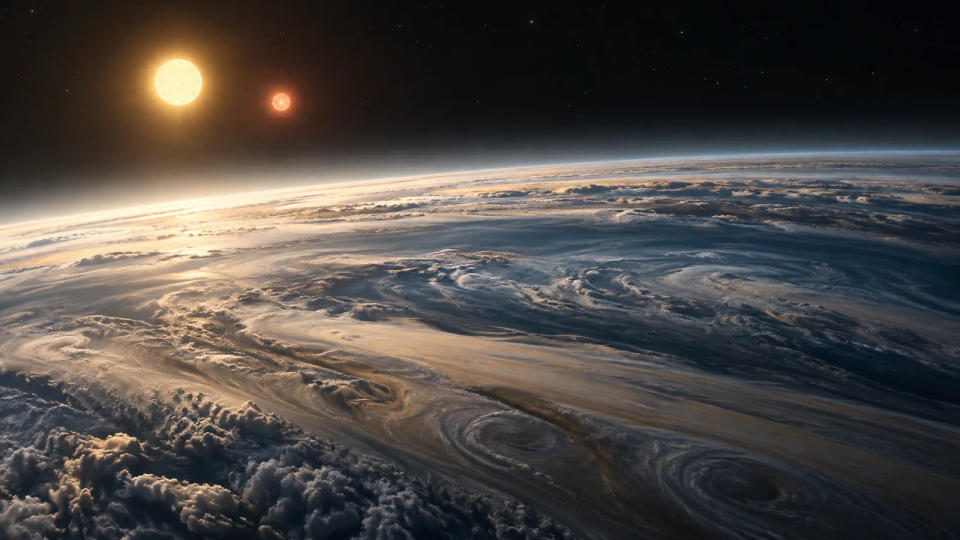
Two suns also do not automatically make a planet hotter or more hospitable. Each Kepler-16 star is smaller and less powerful than our Sun. Despite the planet’s orbit being somewhat closer to its stars than Earth is to the Sun, the combined stellar energy is relatively weak. NASA identifies Kepler-16b as a cold world outside the system’s conventional habitable zone.
What might its sky look like? A hypothetical observer floating above the clouds could see a brighter, warmer-colored primary star and a smaller, dimmer, redder companion. Their positions would change throughout the 41-day stellar cycle. Sometimes two distinct sources of illumination might create separate shadows on a suitable surface, though such a surface has not been found on this gaseous planet. A speculative moon is a possible setting for that thought experiment, not a moon astronomers have detected there.
Perhaps the deepest result is about planet formation. Young stars grow out of disks of gas and dust; in a close binary system, the moving stars gravitationally disturb surrounding material. Yet Kepler-16b exists on a well-defined orbit. Its orbital alignment suggests it likely formed within a disk surrounding both stars rather than arriving later by capture. Researchers still investigate how such planets assemble, migrate, and survive in different binary systems.
Kepler-16b also changed the search strategy for exoplanets. A transit around a moving pair may appear at uneven intervals, so looking only for perfectly repeated dips would miss some worlds. Later surveys have found other circumbinary planets, confirming that Kepler-16b was not simply a one-off curiosity. It represents a broader family of planetary architectures that our own single-Sun Solar System cannot show us.
Conclusion
Kepler-16b has two suns because it formed in a system where two gravitationally bound stars orbit each other, and the planet orbits around both. The 2011 transit measurements made that remarkable architecture undeniable. It may evoke the double sunset from Star Wars, but its true identity—a cold, Saturn-sized planet in a stable binary system—is a much more useful scientific discovery.
Sources & Further Reading
- NASA JPL — NASA’s Kepler Discovery Confirms First Planet Orbiting Two Stars
- NASA Science — Kepler-16 b: (Almost) a Real-life Tatooine
- NASA Exoplanet Catalog — Kepler-16 b
- Doyle et al. (2011) — Kepler-16: A Transiting Circumbinary Planet
- NASA Exoplanet Archive — Kepler-16 System
Post a Comment