
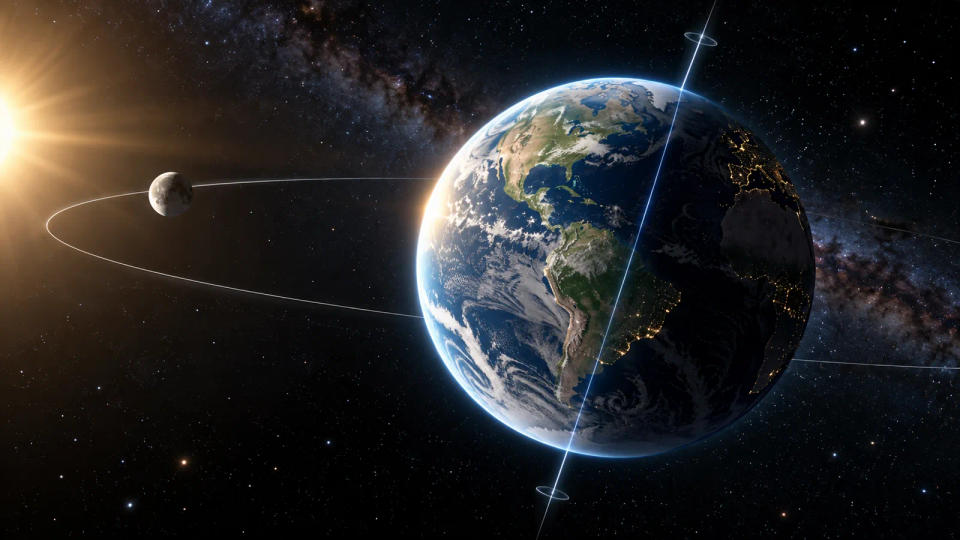
Why is the planet beneath our feet spinning at an angle instead of standing straight up? Earth's rotational axis leans about 23.5 degrees, and that small-looking slant gives us summer, winter, and almost everything in between.
The likely explanation begins with violent collisions in the young solar system. But the reason Earth's tilt has remained comparatively steady is just as interesting: the Moon changes how our spinning planet responds to gravity. It does not lock the axis in place, and the tilt is not perfectly constant.
How Did Earth Become Tilted in the First Place?
Imagine building a spinning top by throwing rocks together. Every impact can change how quickly it spins and which way its spin axis points. That is roughly the problem faced by the planets when the solar system formed about 4.5 billion years ago.
Young Earth grew through collisions with smaller bodies. Some were enormous. In the leading explanation for the Moon's origin, a large protoplanet commonly called Theia struck the young Earth, sending material into orbit that eventually became the Moon. Such an impact could also have substantially changed Earth's rotation and the direction of its axis.
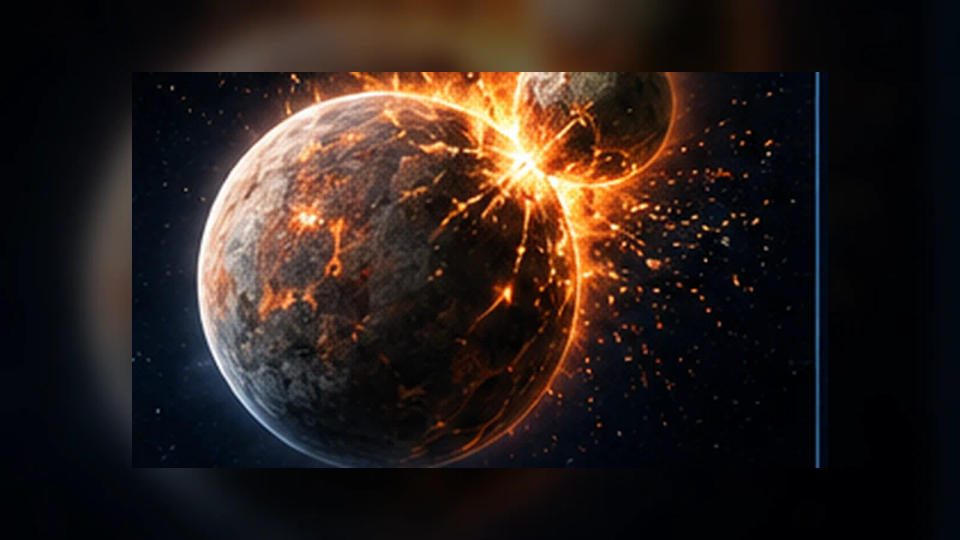
There is an important limit to this story. Scientists have not recovered a record showing that one particular blow set Earth's tilt to exactly 23.5 degrees. Giant-impact models explore possible histories, and the young Earth-Moon system evolved after the collision. The present angle is the result of that long dynamical history, not a number nature deliberately selected.
Also, what exactly is tilted? Picture Earth's orbit as a flat tabletop. Draw a line straight up from the table; that line is perpendicular to the orbital plane. Earth's north-south spin axis is tipped about 23.4 degrees away from that upright line. Measured from the orbital plane itself, the angle is about 66.6 degrees. Those are two ways of describing the same geometry.
What Does a 23.5-Degree Tilt Actually Change?
Follow Earth on its yearly trip around the Sun. Its axis keeps pointing in roughly the same direction in space over the course of a single year. In June, the Northern Hemisphere is tipped toward the Sun. In December, it points away. Meanwhile, the Southern Hemisphere experiences the opposite seasons.
The important change is sunlight, not a sudden change in how close we are to the Sun. When your hemisphere leans toward our star, the Sun climbs higher in the sky and daylight generally lasts longer. More solar energy arrives at the surface, producing warmer conditions. Lean away, and the sunlight arrives at a lower angle while days grow shorter.
Think of a flashlight shining on a table. Point it straight down and its light is concentrated into a small, bright patch. Tilt it and the same light spreads across a larger area. Sunlight behaves in a similar way as the Sun's height changes with the seasons.
If Earth's axis were almost upright, most places would have far weaker seasonal differences in daylight and solar heating. With a much larger tilt, summer and winter contrasts at many latitudes would become more dramatic. The real 23.5-degree value sits between those extremes, but it is not a universal sweet spot that guarantees a comfortable climate everywhere.
How Does the Moon Help Keep Earth's Axis Stable?
Here is the surprising part: Earth's spinning axis already wobbles, even with the Moon. To see why, imagine a spinning top whose handle slowly traces a circle instead of remaining aimed at one point. Astronomers call this motion axial precession.
Earth is not a perfect sphere. Its rotation gives it a slight bulge around the equator. Gravity from the Moon and Sun pulls on that bulge. Rather than simply pulling Earth's axis upright, these forces make its direction slowly sweep around. A complete cycle takes roughly 26,000 years.
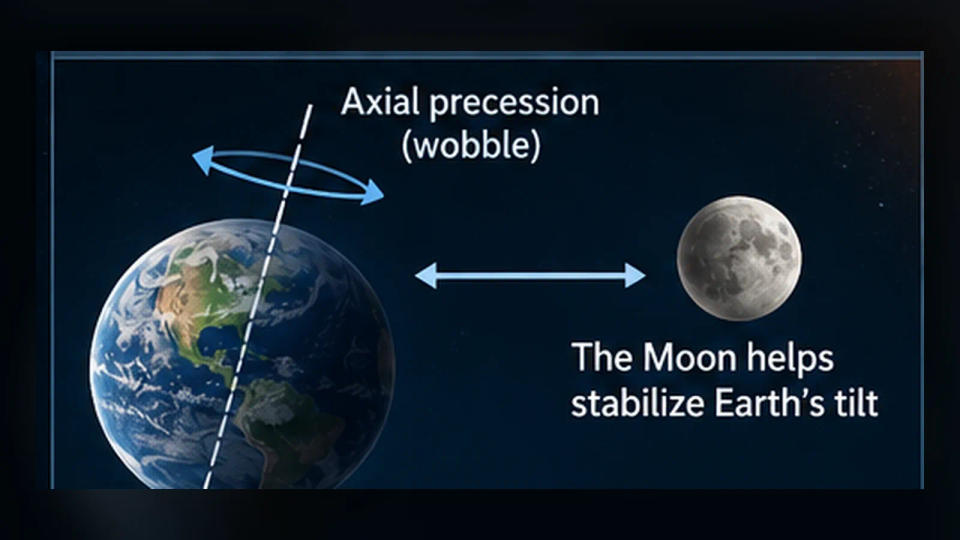
So why call the Moon a stabilizer if its gravity also produces wobble? Because the speed of that wobble matters. The Moon strengthens the gravitational torque on Earth's equatorial bulge and changes the rate at which the spin axis precesses. That helps keep Earth's spin motion away from certain resonances with the slowly changing orbital motions of other planets.
A resonance is like pushing a playground swing in time with its natural motion. Small pushes can then build into a much larger movement. Without the Moon, some gravitational rhythms could interact with Earth's spin axis more strongly, allowing its tilt to wander farther over very long periods.
The Moon is therefore not a hand holding Earth at precisely 23.5 degrees. It is part of a gravitational arrangement that makes large, erratic changes less likely under today's solar-system conditions.
Does Earth's Tilt Change—and What if the Moon Were Gone?
Yes. Over roughly 41,000 years, Earth's axial tilt varies between about 22.1 and 24.5 degrees. Astronomers call this changing angle obliquity. We are currently near 23.4 degrees, with the tilt gradually decreasing. This is different from precession: one changes the size of the tilt, while the other changes the direction the axis points.
These subtle variations affect the distribution of sunlight, particularly at high latitudes. Together with changes in Earth's orbit and the timing of seasons, they form part of the Milankovitch cycles associated with ice-age pacing. They are not an explanation for the rapid global warming measured in recent decades.
But would removing the Moon send Earth tumbling wildly between upright and sideways positions? That answer is less certain than many popular descriptions suggest. An influential 1993 study found that a Moon-free Earth could enter a broad region of chaotic axial-tilt behavior. It established why the Moon's stabilizing effect matters.
Later computer simulations added an important qualification. In some Moon-free Earth models, the tilt changed much more than it does today yet remained confined to a more limited range over hundreds of millions of years. Results depend on starting conditions, rotation rate, and planetary orbits. A moonless Earth would not necessarily flip over or become instantly uninhabitable.
Even in the real Earth-Moon system, the Moon is slowly moving away because of tidal interactions. That changes the system over geological time, but it does not mean our familiar seasons are about to disappear. The planetary clock runs vastly more slowly than a human lifetime.
Conclusion: Earth's tilt probably has roots in the collisions that built the planet, while the Moon helps keep its long-term changes relatively modest. Our axis is neither perfectly fixed nor randomly tumbling. It is a slowly moving part of a remarkably intricate gravitational system—and the reason seasons feel so familiar year after year.
Sources & Further Reading
- NASA Earth Observatory — An Epic View of the Seasons
- NASA Science — Facts About Earth
- NASA Science — Milankovitch (Orbital) Cycles
- NASA/JPL — Basics of Space Flight: Reference Systems
- Laskar, Joutel & Robutel (1993) — Stabilization of the Earth's Obliquity by the Moon, Nature
- Lissauer, Barnes & Chambers (2012) — Obliquity Variations of a Moonless Earth, Icarus / Carnegie Science
Post a Comment