
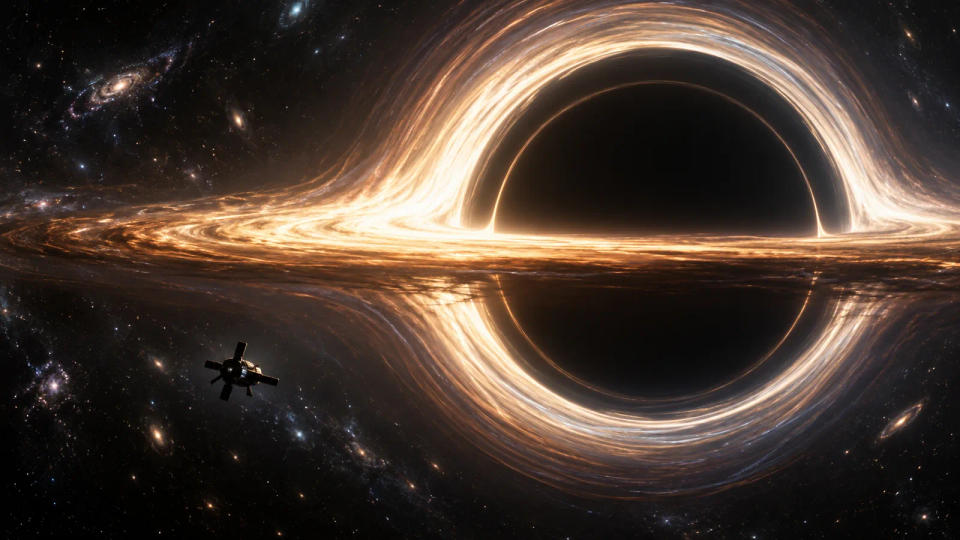
In Interstellar, Cooper makes a terrifying choice: he falls toward Gargantua, a black hole so powerful that even light cannot escape. You might expect him to be stretched into a long, thin strand before he gets anywhere near it. Yet he survives the fall long enough for the movie's strangest scene.
Surprisingly, the first part is not as impossible as it looks. Because Gargantua is an enormously massive black hole, Cooper could cross its event horizon without being torn apart right there. What happens farther inside is a very different question—and that is where the film begins to rely on science fiction.
Why Can a Black Hole Stretch Someone Like Spaghetti?
Imagine standing in a swimming pool with your feet on the bottom and your head near the surface. The water pressure is different at your feet and your head. Now imagine a much more extreme difference, but with gravity instead of water pressure.
If you fall feet-first toward a black hole, your feet are closer to its center than your head. They feel a stronger gravitational pull. Your body is pulled lengthwise, while the sides are squeezed inward. Scientists call this spaghettification, and the name is wonderfully descriptive.
The important point is that spaghettification is caused by a difference in gravity across your body, not simply by gravity being strong. This difference is known as a tidal force. The Moon raises tides on Earth through the same basic idea, although the effect on people here is tiny.
For a black hole with only a few times the Sun's mass, the change in gravity across a human body can become deadly even before reaching the event horizon. The person does not have to touch anything. Space itself provides the stretching force.
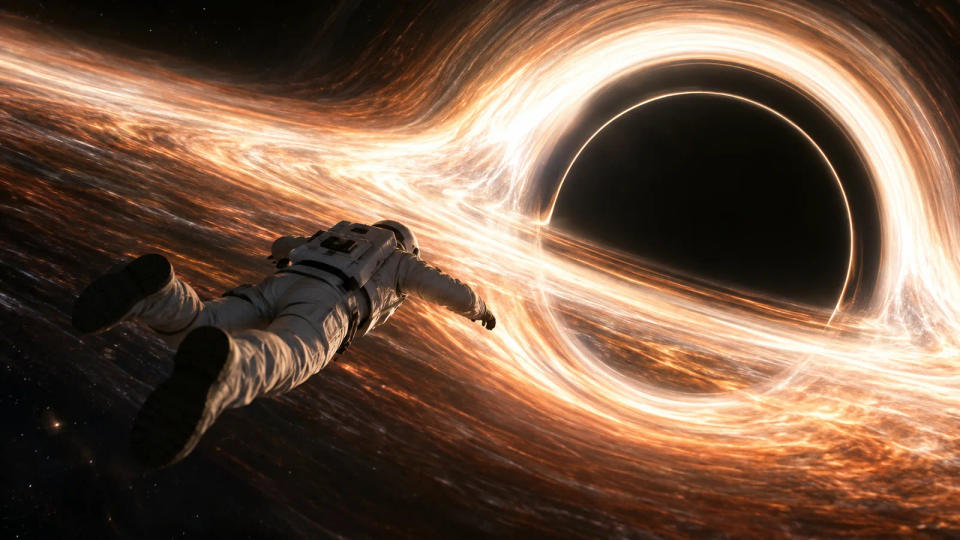
But not every black hole produces the same tidal force at its outer boundary. That difference is the secret to Cooper's survival.
Why Is Gargantua So Much Gentler at the Edge?
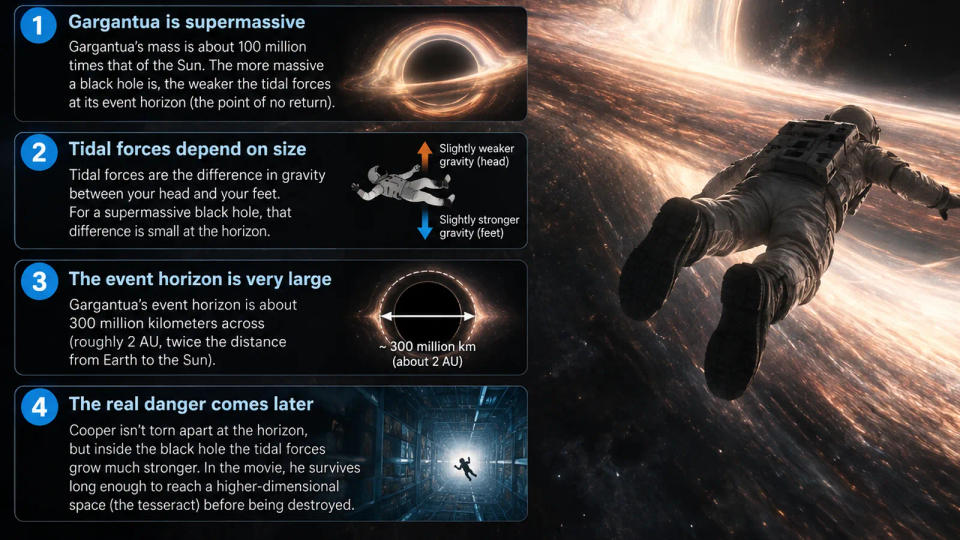
Gargantua is not an ordinary stellar-mass black hole. Physicist Kip Thorne, who advised the filmmakers, modeled it with a mass of roughly 100 million Suns. That number changes everything.
A small black hole has a relatively small event horizon. You have to get very close to its concentrated mass before crossing that boundary, so the gravitational pull can vary dramatically between your head and your feet.
A supermassive black hole has a much larger event horizon. You reach its point of no return while still spread across a region of space where the difference in gravity over your two-meter body can be comparatively small.
Think of two hills. One is a sharp, steep mound; the other is an enormous mountain with a broad, gradual slope. Two footsteps cover a big change in height on the mound but hardly any on the mountain. That is only an analogy—gravity around black holes is more complicated—but it captures why the size of the horizon matters.
For black holes of similar type, making the hole more massive actually reduces the tidal force at its event horizon. Gargantua's enormous scale therefore gives Cooper a chance to remain intact as he passes the boundary. It does not make the black hole harmless.
Thorne's fictional model also has Gargantua spinning extremely rapidly. Its spin affects the shape and behavior of the surrounding spacetime, but Cooper's immediate escape from spaghettification mainly depends on the black hole being supermassive.
Would Cooper Notice When He Crossed the Event Horizon?
Probably not in the way movies often suggest. The event horizon is not a wall, a glowing membrane, or a surface that a spacecraft slams into. It is an invisible boundary: once something has crossed it, no outward path can lead back to the rest of the universe.
Imagine floating down a river toward a waterfall. You may cross a point where the current becomes too fast for you to paddle back upstream. There is no painted line in the water announcing that moment. The situation at a black hole is far stranger, but the comparison helps explain the idea of a point of no return.
Cooper is also falling freely. That matters because someone in free fall can feel weightless, even in a powerful gravitational field. He would still experience tidal forces if they became strong enough, but the event horizon itself would not deliver a sudden physical blow.
From far away, a distant observer would receive increasingly delayed, redshifted light from his approach and would never watch him visibly cross the horizon in the usual way. From Cooper's own point of view, however, the crossing could happen in a finite amount of time. These are two different perspectives on the same journey.
And there is a catch: surviving the crossing does not mean he can turn around and fly home. Once inside, sending a signal or following an ordinary path back outside is impossible according to established general relativity.
So Why Doesn't Cooper Die Deeper Inside Gargantua?
This is the part where the answer changes from "plausible physics" to "movie speculation." Even around a supermassive black hole, tidal forces generally grow as an astronaut falls farther inward. Passing through the horizon safely only postpones the danger.
The detailed interior of a rapidly spinning black hole is an active area of theoretical study. Mathematical models suggest complicated structures and different kinds of singular behavior. But we have never observed a person, probe, or information-rich spacecraft surviving a journey inside a black hole. We cannot claim that Cooper's continued survival is established science.
In the movie, Cooper reaches a remarkable space called the tesseract. There he can see different moments in his daughter Murph's bedroom and communicate through carefully chosen gravitational effects. The story eventually suggests that advanced future humans made this arrangement possible.
A tesseract is a real idea in mathematics: it is the four-dimensional counterpart of a cube. But the movie's navigable room of time, the beings who construct it, and Cooper's return to the outside universe are fictional possibilities, not demonstrated technologies or discoveries.
There are other hazards the film keeps mostly offstage. Gas near an active black hole can become extremely hot and emit dangerous radiation. The details depend on the black hole's surroundings and Cooper's route. Gargantua's disk was deliberately imagined as relatively quiet, but a bright disk would not automatically be safe to approach.
That makes the scene interesting for a reason beyond its visuals. The movie uses real physics to explain how Cooper could survive the beginning of the fall, then uses a bold fictional idea to carry the story beyond what scientists can currently explain.
Conclusion
Cooper is not instantly torn apart because Gargantua is huge. Its vast event horizon means the gravitational difference between his head and feet can be small enough for a human to endure while crossing it. That part has a genuine basis in general relativity. Surviving indefinitely inside the black hole—or escaping through a tesseract—is where Interstellar leaves established science behind.
Sources & Further Reading
- NASA — What Happens When Something Gets Too Close to a Black Hole?
- NASA — New Black Hole Visualization Takes Viewers Beyond the Brink
- NASA — Frequently Asked Questions on Black Holes
- Kip Thorne — The Science of Interstellar (Book Excerpt)
- Science Friday — Kip Thorne on Truth, Educated Guesses, and Speculation in Interstellar
Post a Comment