
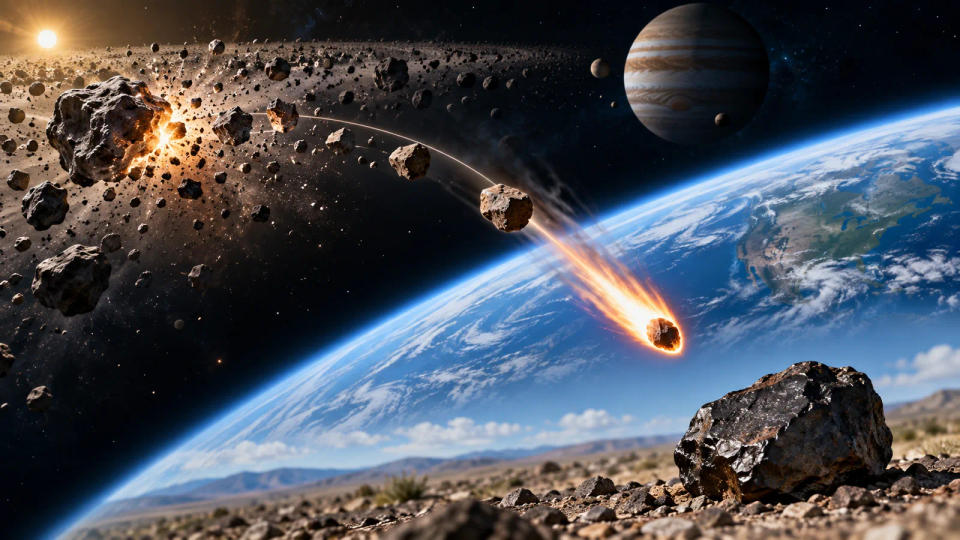
A meteorite may look like an ordinary dark rock, but its story usually began millions of kilometers away. Most meteorites that reach the ground are fragments of asteroids, especially bodies that formed in or near the main asteroid belt between Mars and Jupiter. A much smaller number were blasted off the Moon or Mars by powerful impacts.
The name changes during the journey. In space, the object is a meteoroid. When it races through Earth’s atmosphere and produces a bright streak, we see a meteor. If any solid piece survives all the way to the surface, that surviving piece is a meteorite.
Most Meteorites Start in the Asteroid Belt
The asteroid belt is not a crowded ring of boulders constantly smashing together. It is mostly empty space, spread across a huge region between Mars and Jupiter. But it contains countless rocky bodies left over from the early Solar System, and over very long timescales they do collide.
Those collisions can chip small fragments from a larger asteroid or break an asteroid apart entirely. The fragments inherit the chemistry and structure of their parent body, which is why meteorites can act like free samples of worlds that are otherwise difficult to visit. NASA’s meteorite collections show that stony meteorites are by far the most common kind seen to fall, while iron and stony-iron meteorites are much rarer.
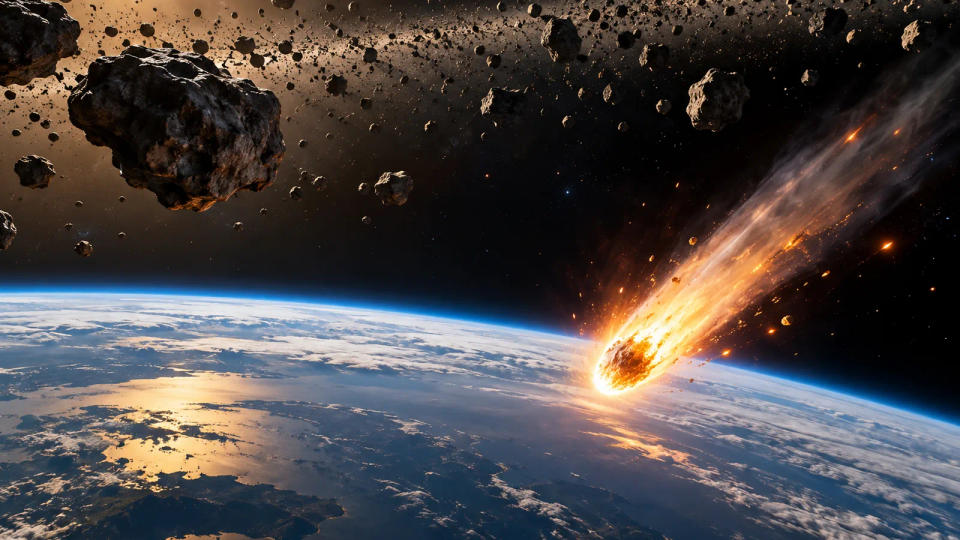
Some meteorites preserve material that formed about 4.56 billion years ago, near the beginning of the Solar System. Primitive chondrites can contain tiny round grains called chondrules, while other meteorites came from asteroids that once melted and separated into crust, mantle-like rock, and metallic cores. An iron meteorite can therefore be a piece of the interior of a small ancient world.
How a Rock Escapes the Belt and Reaches Earth
Being knocked loose is only the first step. A fragment in the main belt will normally keep orbiting the Sun there unless something changes its path. Repeated collisions can push debris into new orbits, and Jupiter’s gravity creates powerful orbital resonances in parts of the belt. In those regions, small gravitational tugs build up over time and can move fragments onto much more elongated paths.
Some of those new orbits cross the paths of the inner planets. Once a fragment becomes a near-Earth object, a close encounter with a planet can alter its orbit again. Eventually, a tiny fraction of these rocks meet Earth at exactly the wrong place and time.
A good example is asteroid Vesta. Scientists connect the howardite-eucrite-diogenite, or HED, family of meteorites with Vesta because their mineral signatures match observations of that asteroid. Research on Vesta also shows how debris can be delivered toward an “escape hatch” in the asteroid belt, where Jupiter’s gravitational influence can help shift fragments onto Earth-crossing trajectories.
The trip is usually not a straight shot from asteroid to Earth. A meteorite may spend a long time as a small independent body orbiting the Sun before chance orbital geometry finally sends it into our atmosphere.
Earth’s atmosphere is the final filter. Incoming meteoroids strike the air at tens of kilometers per second. The air in front of the object is compressed so rapidly that it becomes extremely hot, and the meteoroid’s outer surface melts and ablates away. Smaller bodies may disappear completely; larger ones can fragment into a shower of pieces. Only material that survives this violent deceleration becomes meteorite material on the ground.
That last stage also changes how the rock looks. A freshly fallen meteorite often carries a thin, dark fusion crust created as its exterior was briefly melted during entry. The inside can remain much less altered, preserving minerals and textures that formed long before Earth existed. That contrast is one reason a small blackened stone can hold an extraordinary record of early Solar System history.
A Few Meteorites Come From the Moon and Mars
Asteroids are the main source, but they are not the only one. Large impacts on the Moon and Mars can accelerate surface rocks fast enough to escape those worlds completely. Once in solar orbit, a small number of those fragments eventually reach Earth.
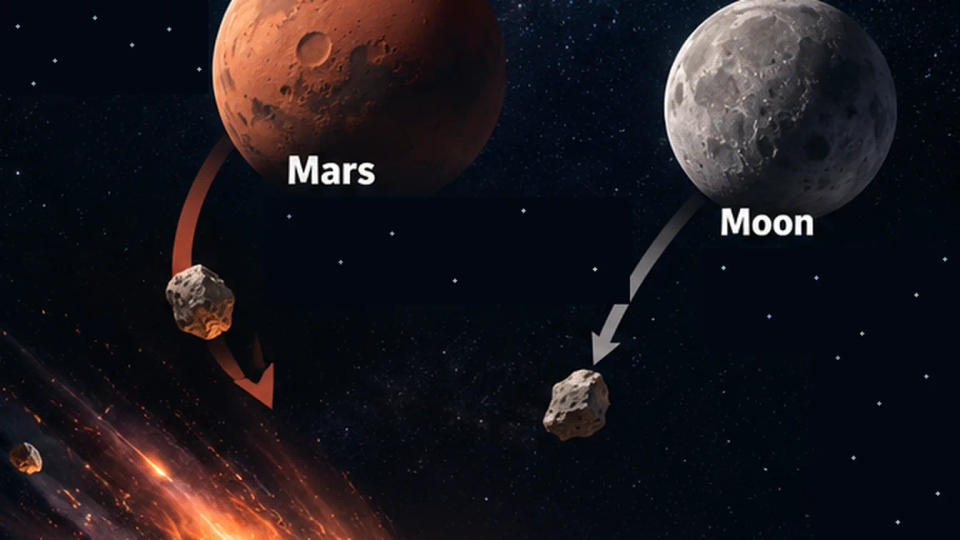
Lunar meteorites can be compared with Moon rocks returned by the Apollo missions. Martian meteorites offer an even stranger clue: some contain tiny pockets of trapped gas with a composition that matches the Martian atmosphere measured by spacecraft. That chemical fingerprint is one of the strongest reasons scientists know those rocks really came from Mars.
Comets also release dust and rocky particles, and they are major sources of the tiny meteoroids that create annual meteor showers. But that does not mean the meteorites collected from the ground are mostly comet fragments. Recovered hand-sample meteorites overwhelmingly trace back to asteroids, with the Moon and Mars supplying a small but scientifically valuable minority.
How Scientists Identify a Meteorite’s Birthplace
There is no tiny label on a meteorite saying where it came from, so researchers build the case from several kinds of evidence. If a bright fireball is photographed from multiple locations, its path can sometimes be reconstructed well enough to estimate the object’s orbit before it hit Earth. In favorable cases, that orbit points back toward the asteroid belt.
Laboratory chemistry is even more revealing. Scientists compare minerals, elemental abundances, and isotopes with measurements of asteroids, lunar samples, and planetary data. Meteorite ages also matter. Many asteroid-derived meteorites are extremely ancient, while some Martian meteorites formed much later because Mars remained geologically active long after small asteroids had cooled.
Spectroscopy provides another bridge between a rock in a laboratory and a body in space. Telescopes and spacecraft measure how an asteroid’s surface reflects different wavelengths of light. If that spectral pattern matches the minerals in a meteorite group, the connection becomes much stronger. Vesta and the HED meteorites are one of the clearest examples.
So where do meteorites actually come from? Usually from asteroids, occasionally from the Moon or Mars, and almost always after a complicated chain of collisions, orbital changes, and atmospheric survival. Every meteorite on the ground is the final piece of a journey that began somewhere else in the Solar System—and sometimes billions of years ago.
Sources & Further Reading
- NASA Science — Meteors and Meteorites: Facts
- NASA Johnson Space Center ARES — What Are Meteorites?
- NASA Science — Asteroid or Mini-Planet? Hubble Maps the Ancient Surface of Vesta
- NASA Science — Basics of Space Flight: The Solar System
- Smithsonian National Museum of Natural History — Meteorites: Messengers From Outer Space
Post a Comment