
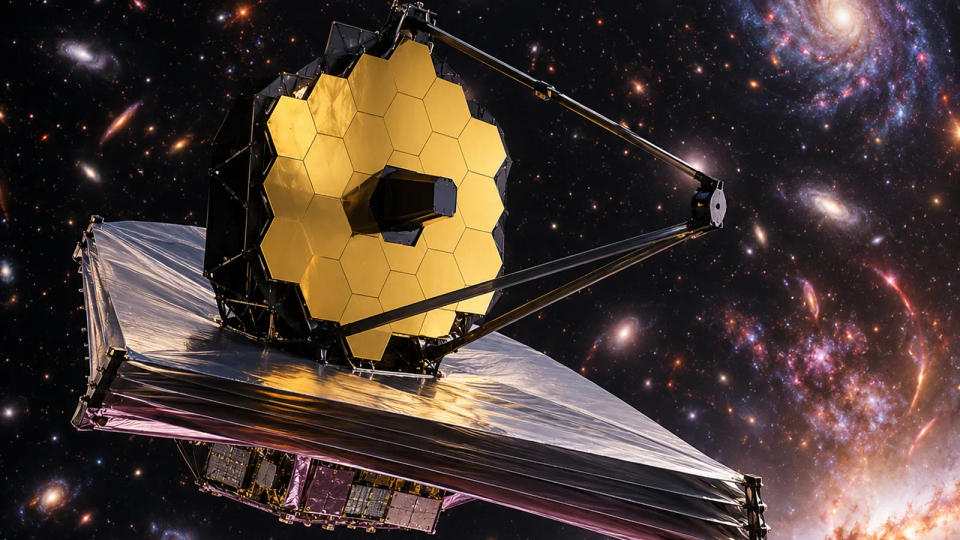
The James Webb Space Telescope is not simply floating in space taking beautiful pictures whenever something interesting appears. Its real job is much more disciplined: Webb follows carefully planned observing programs, points at selected targets, collects infrared light as images and spectra, stores those measurements onboard, and sends the data back to Earth for scientists to process and analyze.
That routine sounds almost ordinary until you remember where it happens. Webb works about 1.5 million kilometers from Earth, around the Sun–Earth L2 region, while studying everything from nearby planets to galaxies whose light has traveled for more than 13 billion years.
Webb Has a Job List, Not a Camera Roll
Webb does not roam the sky looking for discoveries on its own. Astronomers propose specific observations, those proposals are reviewed, and approved targets are folded into a tightly optimized schedule. The telescope then carries out those observations as a sequence of planned visits.
That schedule has to account for much more than scientific priority. A target must be visible from Webb’s allowed pointing zone, the observatory must keep its sunshield properly oriented, instrument settings have to be configured, and the spacecraft needs time to slew from one target to the next. Some observations are also time-sensitive, such as an exoplanet transit or a rapidly changing astronomical event.
In other words, a typical day in Webb’s life is closer to running a remote scientific laboratory than operating a giant space camera. Commands are prepared on Earth, uploaded to the observatory, and then executed autonomously.
Why Webb Works Around L2
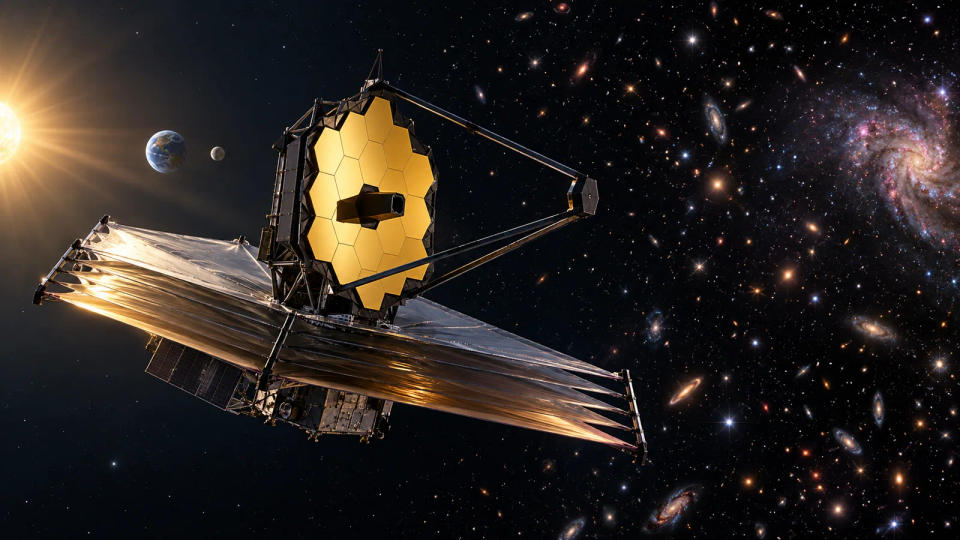
Unlike Hubble, Webb does not orbit Earth. It orbits the Sun while moving around a region called the second Lagrange point, or L2, roughly 1.5 million kilometers beyond Earth in the direction away from the Sun. Webb itself circles around L2 rather than sitting exactly at one fixed point.
This location is one of the keys to the mission. From Webb’s perspective, the Sun, Earth, and Moon stay in roughly the same direction. That allows the observatory to keep its five-layer sunshield between those warm, bright objects and the telescope’s cold mirrors and instruments.
Infrared astronomy depends on that cold environment. Warm hardware glows in infrared light, which can overwhelm the faint signals Webb is trying to measure. Keeping the telescope cold and thermally stable makes it possible to detect dim galaxies, dusty star-forming regions, cool planetary objects, and subtle fingerprints in exoplanet atmospheres.
The L2 orbit also avoids the frequent day-night interruptions that a telescope in low Earth orbit would experience. Webb can spend long stretches observing without Earth repeatedly blocking its view.
Four Instruments Turn Infrared Light Into Science
Webb’s famous gold mirror collects light, but the mirror is only the beginning. The actual measurements are made by four main science instruments: NIRCam, NIRSpec, MIRI, and NIRISS. Together they cover near- and mid-infrared wavelengths and can work in several observing modes.
Sometimes Webb produces an image, mapping where infrared light is coming from across a scene. At other times it performs spectroscopy, spreading light into a spectrum so astronomers can look for features linked to atoms, molecules, temperature, motion, and other physical properties.
That is why saying Webb “takes pictures” misses much of the mission. A spectrum may look less dramatic than a processed image, but it can reveal what a distant atmosphere contains, how quickly gas is moving, whether dust is hiding young stars, or how an early galaxy is forming and enriching itself with heavier elements.
What Is Webb Studying in 2026?
As of September 2026, Webb is in Cycle 5, the observing cycle that runs from July 1, 2026 through June 30, 2027. Scientists around the world are using its time for research on the Solar System, exoplanets, star formation, stellar populations, galaxies, black holes, and the distant universe.
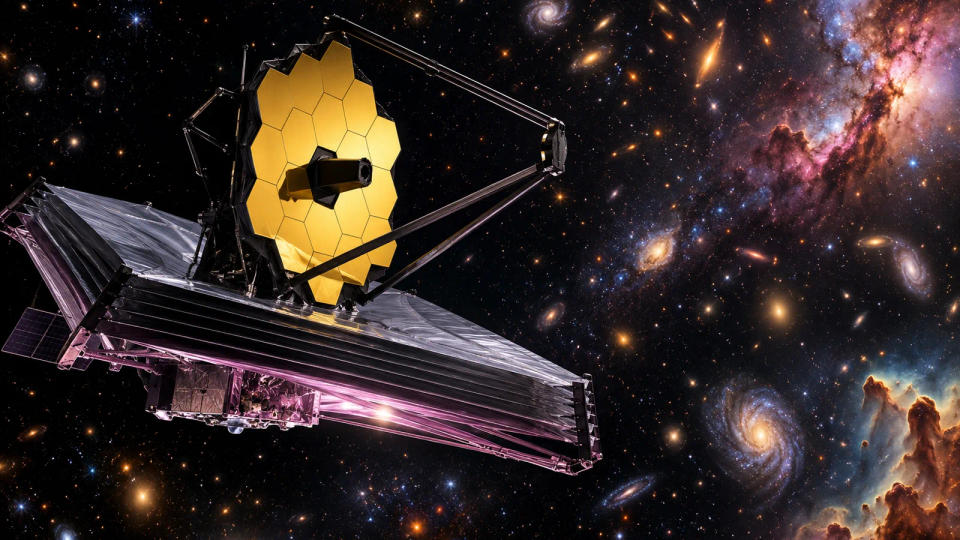
Recent 2026 science releases show how broad that work has become. Webb observations have been used to examine the dusty center of Centaurus A, resolve millions of stars in the starburst galaxy M82, study very young stars in the FS Tau system, and identify an additional giant planet in the well-known Beta Pictoris system through the chemical signature of its atmosphere.
Those examples should not be read as a live list of what the telescope is pointing at this minute. Webb’s observing schedule changes constantly, and many observations remain in scientific analysis long before they become public images or headlines. The important point is that the observatory is being used as a general-purpose infrared laboratory for many different branches of astronomy at once.
Webb can also respond to certain targets of opportunity, but even those observations have to be incorporated into a carefully managed schedule. It is powerful, yet its time is finite and heavily requested.
How Webb’s Measurements Become Discoveries on Earth
After an observation, the detector data are stored on Webb’s onboard solid-state recorder until they can be transmitted through NASA’s Deep Space Network. Routine communications include command uploads, engineering telemetry, and science-data downlinks, and these communications can take place while the observatory continues its work.
What arrives on Earth is not a finished poster image. The raw measurements pass through a calibration pipeline that corrects detector effects, applies reference information, and produces increasingly refined data products. Those products are archived in the Mikulski Archive for Space Telescopes, or MAST, where research teams can work with images, spectra, data cubes, and other calibrated files.
The colorful Webb images seen by the public are therefore only one visible end product of a much larger process. Behind each one may be multiple exposures, filters, calibration steps, data-quality checks, and scientific interpretation. In many cases, the most important result is not the picture itself but a number, a spectral feature, a measured distance, or a physical model supported by the data.
So what is the James Webb Space Telescope actually doing in space? It is carrying out a nonstop sequence of precision observations from a cold, stable location far beyond Earth, turning ancient and otherwise invisible infrared light into data that astronomers can test, compare, and learn from. The spectacular images are real, but they are only the most photogenic part of the job.
Sources & Further Reading
- NASA Science — James Webb Space Telescope
- NASA Science — Webb Orbit
- NASA Science — Webb Observatory
- STScI — Observing with JWST
- STScI — JWST Science Data Overview
- NASA Science — Webb Science Releases
Post a Comment