
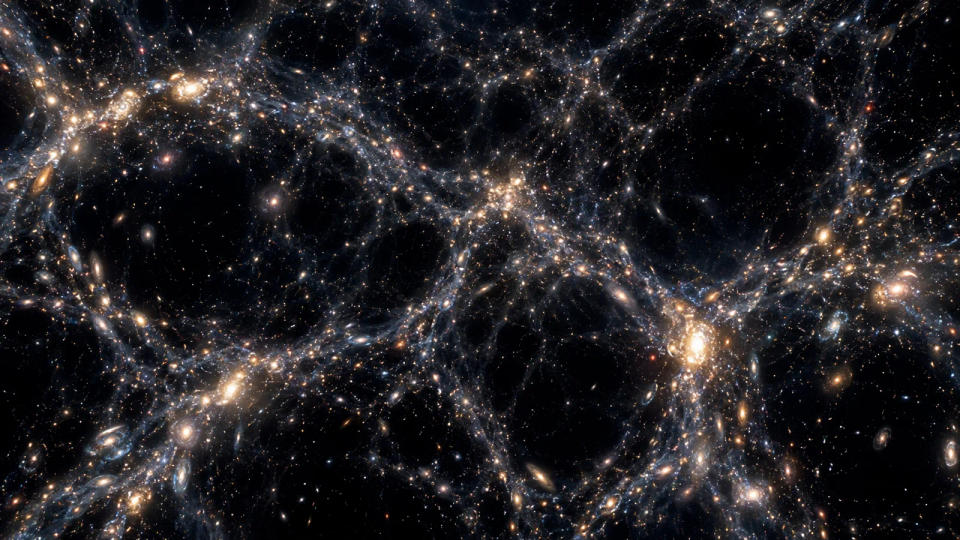
The cosmic web is the universe's enormous three-dimensional network of matter, shaped into long filaments, broad sheets, crowded galaxy clusters, and relatively empty voids. It is not a literal glowing net stretched across space: most of its underlying mass is invisible dark matter, while galaxies and thin intergalactic gas trace parts of its structure.
If we could zoom far beyond the Milky Way and look at a sufficiently large region, galaxies would stop resembling randomly scattered points. Instead, they would outline something like a sponge or a network of roads, with busy intersections separated by enormous quiet areas. Astronomers call that pattern the cosmic web.
What Is the Cosmic Web Made Of?
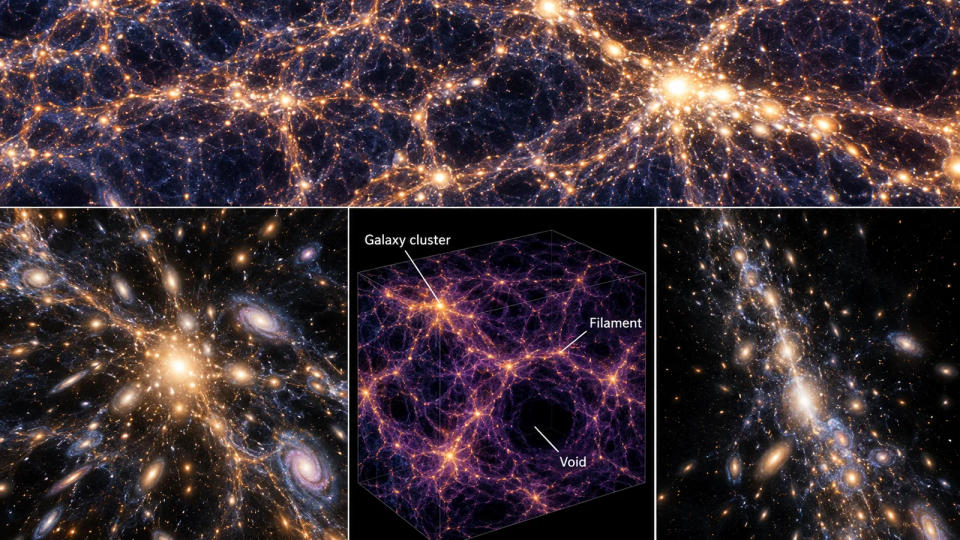
A filament is an elongated region where matter is more concentrated than in the surrounding space. Some filaments connect dense knots containing groups or clusters of galaxies. Other matter spreads into sheets or walls; between them are cosmic voids with substantially fewer galaxies than average. The geometry is irregular and three-dimensional, not a perfect spiderweb with uniform strands.
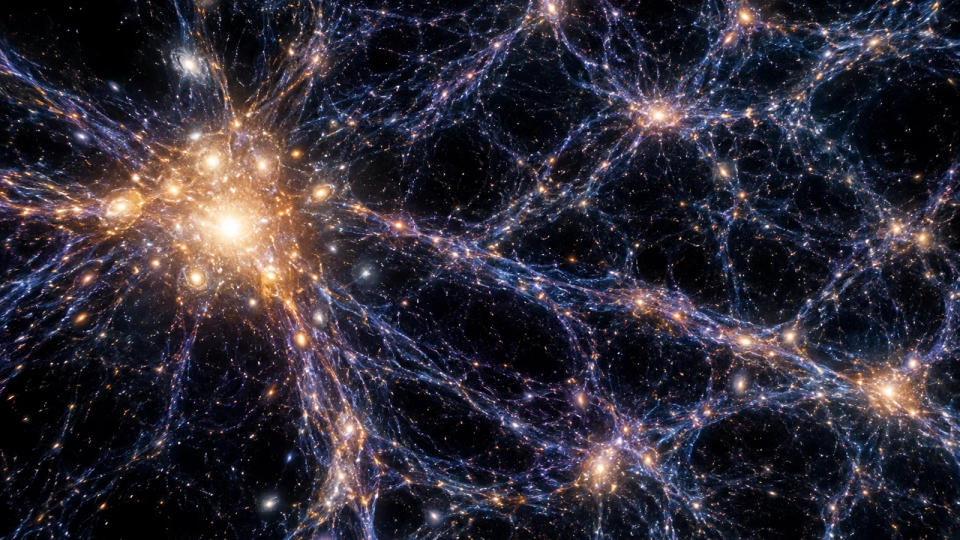
There are several ingredients. Dark matter contributes most of the matter's mass and shapes the gravitational framework. Ordinary matter, especially hydrogen and helium gas, responds to that gravity. Where gas becomes dense enough inside galaxies, it can eventually form new stars. Galaxy clusters are the busiest intersections, but countless faint galaxies also populate the connecting regions.
The filaments are not solid tubes, and their blue or purple colors in popular illustrations are assigned for visibility. Dark matter does not shine, and most gas between galaxies is far too diffuse to make an obvious glowing rope. This article's images are explanatory visualizations, not direct photographs of a luminous cosmic net.
Voids are not absolutely empty, either. They can contain sparse gas, dark matter, and isolated galaxies. A useful analogy is a city map: roads connect crowded centers, but the countryside between roads still contains things. Unlike real roads, though, the cosmic web was formed naturally by gravity rather than constructed for transport.
How Did Gravity Build the Cosmic Web?
The story begins with the early universe. After the Big Bang, matter was distributed quite smoothly on large scales, but tiny variations in density were already present. Regions with slightly more matter exerted slightly stronger gravitational attraction and gradually drew in more material. Over billions of years, this process amplified small differences into an interconnected landscape of dense and sparse regions.
In the standard cosmological picture, dark matter played a crucial early role because it could gather gravitationally without needing to cool and radiate energy the way ordinary gas does. Gas later accumulated in the dark matter's gravitational wells. Smaller structures grew, merged, and fed larger ones, helping produce galaxies, galaxy groups, and clusters.
This does not mean all galaxies simply slide down fixed cosmic highways. Space itself expands, gravity acts in three dimensions, and the motions of galaxies and gas depend on their local surroundings. Filaments guide how matter accumulates statistically, but they are changing structures rather than rigid pipes.
The web also has a history we can observe. In 2023, researchers using the James Webb Space Telescope reported a line of 10 galaxies extending about 3 million light-years when the universe was only about 830 million years old. They interpreted the alignment as an early filament that may later develop into a larger cluster. It is a glimpse of web-building, not a picture of today's fully developed network.
How Can Telescopes Map an Invisible Network?
The simplest clue is the distribution of galaxies. Telescopes measure where galaxies appear on the sky and estimate their distances, often using redshift. Combining direction with distance builds a three-dimensional map. Dense chains, crowded nodes, and wide underpopulated regions emerge as the survey grows; the pattern is not just an artist's invention.
Astronomers can also investigate the hard-to-see ingredients. Background galaxies sometimes appear subtly stretched because the gravity of foreground mass bends their light. This weak gravitational lensing allows researchers to reconstruct maps of mass, including dark matter, without claiming that a telescope has directly photographed dark matter particles.
A January 2026 NASA report described a Webb-based map covering a region containing nearly 800,000 identified galaxies. Researchers compared the inferred dark-matter distribution with ordinary matter and resolved finer features than in earlier maps of the same field. The colored mass layers shown in such scientific products represent measurements interpreted through lensing analyses, not natural-light images of invisible material.
Gas provides another line of evidence. Ultraviolet light from distant quasars passes through intervening material, leaving absorption patterns that reveal hydrogen and other elements along the line of sight. Hubble investigations have used these signatures to connect otherwise faint intergalactic gas with predicted filaments. Different methods together strengthen the picture while retaining their respective measurement uncertainties.
ESA's Euclid mission is building a complementary wide survey. Its March 2025 release previewed deep fields with millions of galaxies, offering a glimpse of how galaxies are arranged across the web. More extensive maps will help astronomers test how the structure changes over cosmic time. A striking image of galaxies alone is useful, but precise distance and lensing data are essential to map the real three-dimensional network.
Why the Cosmic Web Matters
Where a galaxy lives may influence its evolution. In a dense cluster, interactions with neighbors and hot surrounding gas can change a galaxy's supply of star-forming material. Filaments can supply gas to developing galaxies and help assemble groups over long periods. Scientists study these environmental effects statistically, because the fate of any single galaxy depends on many processes.
The web also helps explain why astronomers care about apparently empty space. A significant amount of ordinary matter is spread through the thin gas between galaxies rather than packed into visible stars. Finding and measuring this material helps reconcile observations with predictions about the universe's ordinary-matter content. Voids, meanwhile, offer a contrasting environment for testing how structure grows.
There is a broader mystery. By comparing observed clustering and gravitational lensing with models, scientists can test ideas about dark matter and the cosmic expansion driven by dark energy. The existence of a web-like pattern is well established, but the fundamental identity of dark matter remains unknown. No single beautifully colored image settles that question.
Our own Milky Way is part of this wider cosmic geography. The Local Group belongs to a hierarchy of nearby groups, clusters, and larger-scale concentrations, rather than floating in isolation. Yet the cosmic web is not an interconnected transportation system, and its filaments are not visible threads across our night sky. They are an emergent pattern apparent only when we study extraordinary distances.
In short, the cosmic web is the large-scale architecture produced as gravity magnified tiny differences in the early universe. Galaxies reveal many of its dense strands; lensing and absorption reveal less visible matter; and missions such as Webb and Euclid are sharpening the map. What looks like a glowing net in a visualization is actually a vast, mostly invisible gravitational story.
Sources & Further Reading
- NASA: Large Scale Structures
- NASA: Mapping the Cosmic Web
- NASA: Webb Identifies the Earliest Strands of the Cosmic Web
- NASA: New Details About Dark Matter’s Influence (2026)
- ESA: Euclid Opens Data Treasure Trove (2025)
Post a Comment