
Why does Venus spin backward? Explore retrograde rotation, solar and atmospheric tides, impact hypotheses, and what remains uncertain.
Venus turns in the opposite direction to its orbit and to Earth's spin. The direction is well established, but its complete origin story is not. Long-term interactions involving solar gravitational tides, atmospheric thermal tides, and the planet's interior offer ways to reach slow retrograde rotation. A giant collision is a possible historical hypothesis, rather than a demonstrated event required by every explanation.
What does “backward” actually mean?
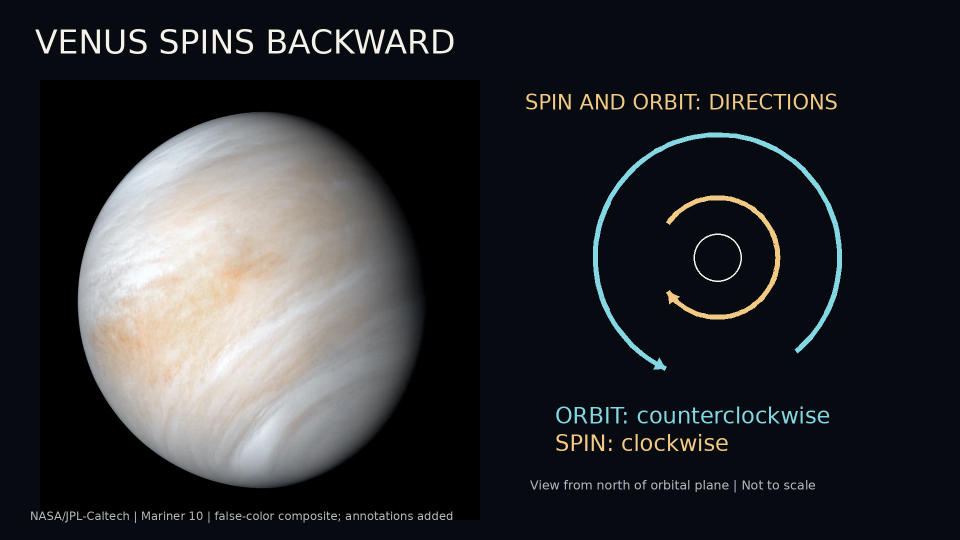
First separate two motions: rotation around the planet's own axis and revolution around the Sun. Venus follows the same general orbital direction as the other planets. Its unusual behavior concerns its spin. From the north side of its orbital plane, its orbit is counterclockwise while its rotation is clockwise. Reversing the observer's viewpoint reverses both apparent directions, so the reference viewpoint belongs in any useful diagram.
In this sense, Venus rotates from east to west. The Sun would consequently appear to rise in the west and set in the east, although the thick cloud cover prevents an Earth-like view from the surface. “Retrograde rotation” describes this axial motion. It should not be confused with a planet temporarily appearing to move backward among the stars in Earth's sky.
Nor should the title be read as claiming that Venus is the only unusual spinner. Uranus has an extreme axial orientation and is also conventionally classified as retrograde. The relevant comparison is with Earth and most planets, rather than a rule with exactly one exception.
Cloud motion is another potential trap. Clouds can travel around Venus much faster than the solid planet turns. Following a cloud feature therefore measures atmospheric circulation, not automatically the rotation of the crust. Radar observations supply a way to investigate the solid planet through its visually opaque atmosphere.
Why 243 days of rotation does not mean a 243-day solar day
A sidereal rotation is one turn relative to distant stars. For Venus, that takes about 243 Earth days. A year, meaning one orbit, lasts about 224.7 Earth days. The familiar statement that a Venusian day exceeds its year is correct when “day” means this sidereal rotation period.
A solar day asks a different question: how long until the Sun returns to the same position in the local sky? On Venus the answer is approximately 116.75 Earth days. Because rotation and revolution proceed in opposite senses, their angular rates add when calculating how quickly the surface turns relative to the Sun. Using positive period magnitudes, the approximation is 1/solar day = 1/rotation period + 1/orbital period.
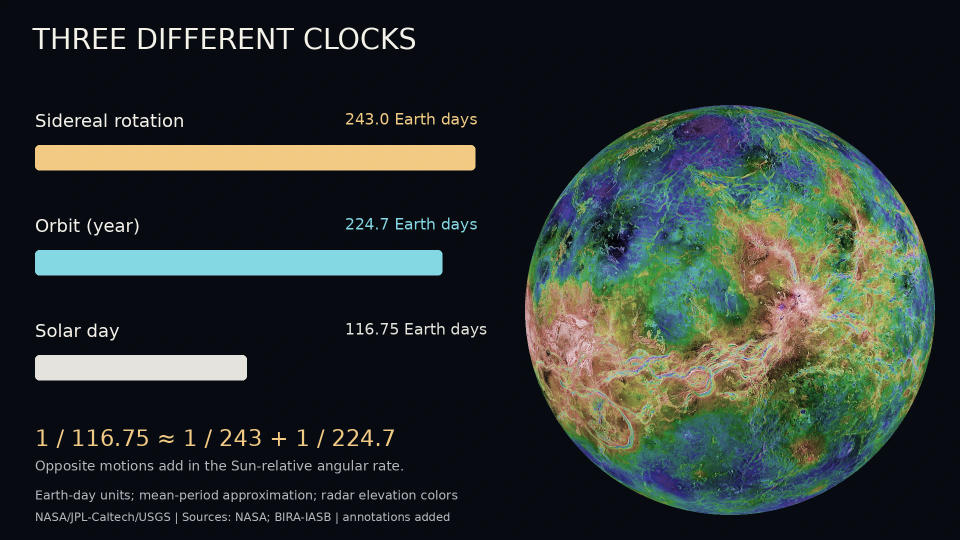
The bars compare time intervals, not sizes or orbital distances. The colored globe is processed radar topography, not a photograph of the surface's natural colors. Keeping these conventions explicit prevents two independent kinds of misleading comparison.
More precise measurements also show that the rotation period is not perfectly constant. Margot and colleagues used radar observations collected during 2006–2020 and reported an average sidereal period of 243.0226 ± 0.0013 Earth days. Their measurements revealed variations corresponding to roughly 20 minutes. Such changes constrain interactions between the atmosphere and solid planet; they do not record the ancient moment when retrograde rotation began.
Which mechanisms could produce retrograde rotation?
Gravity does more than pull a planet along its orbit. A star also raises tides in the planet's body. Dissipation associated with the tidal deformation can change rotation over long intervals. In a simple nearly circular case, solid-body tides tend to move rotation toward synchronism, where the spin period matches the orbital period.
A dense atmosphere adds another influence. Uneven solar heating changes atmospheric pressure and redistributes mass. The Sun's gravity acts on that displaced atmospheric mass, producing a torque. When transferred to the solid planet, an atmospheric thermal-tide torque can oppose the solid-body tidal torque. “Torque” means a turning influence, not simply wind blowing against a surface like a hand pushing a ball.
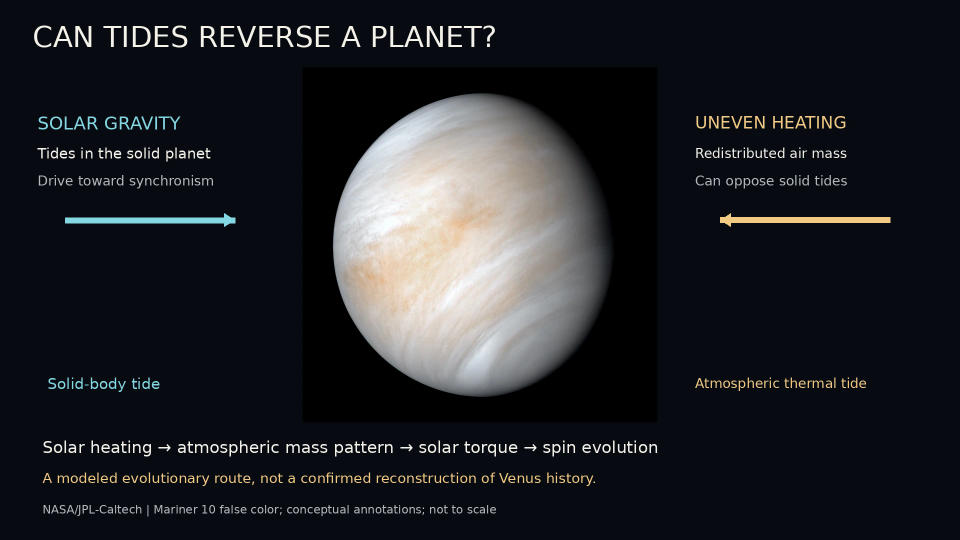
This balance has a long research history. Dobrovolskis and Ingersoll discussed atmospheric and solid-body torques in 1980. Correia and Laskar's 2001 study then showed alternative evolutionary routes to the observed kind of slow retrograde state. One involved a change in axis orientation; another could reverse the spin without requiring that axis-flip route. An “upside-down planet” illustration therefore cannot by itself identify what actually happened.
A 2026 paper by Sylvio Ferraz-Mello revisits a gradual route in which the growth of atmospheric influence changes the possible rotational equilibria. Under the model's conditions, a slowly evolving planet can enter a branch that ultimately becomes retrograde without a collision. This demonstrates a physical possibility. It does not establish a measured chronology of Venus's early atmosphere or prove that the modeled path was its unique history.
An impact could also alter a young planet's angular momentum, so collisions belong in a discussion of hypotheses. However, “something hit Venus and knocked it backward” leaves unanswered questions about subsequent tidal evolution and the persistence of the present spin. Different mechanisms may have acted at different stages. A persuasive account must explain the current slow rotation as well as a possible initial disturbance.
Testing these ideas means comparing more than a final rotation direction. Researchers must ask how sensitive a result is to initial spin, atmospheric properties, and internal dissipation. If different histories converge on a similar present state, observing that state alone cannot select one history. Measurements become especially valuable when they narrow the allowed physical conditions.
Conclusion
Venus's backward spin is an observed property; its origin remains a reconstruction problem. The most useful explanation distinguishes that observation from competing histories, and distinguishes the solid planet's rotation from atmospheric motion. Tidal and atmospheric models show that a dramatic impact is not compulsory. Understanding which path Venus followed requires tighter constraints on its interior, atmospheric evolution, and rotation over time.
Sources & Further Reading
- NASA: Venus Facts
- Royal Belgian Institute for Space Aeronomy: Venus, backwards rotation and orbital period
- Margot et al. (2021): Spin state and moment of inertia of Venus
- Dobrovolskis and Ingersoll (1980): Atmospheric tides and the rotation of Venus. I — Tidal theory and the balance of torques
- Correia and Laskar (2001): The four final rotation states of Venus
- Ferraz-Mello (2026): Exoplanets synchronization in the habitable zone: Learning from Venus' retrograde rotation
Image credits: cover and section2 — NASA/JPL-Caltech, Mariner 10, false-color composite, explanatory graphics added. Section1 — NASA/JPL-Caltech/USGS, radar elevation composite with explanatory time comparison added. Source imagery is observational; arrows and explanatory relationships are schematic.
Post a Comment