
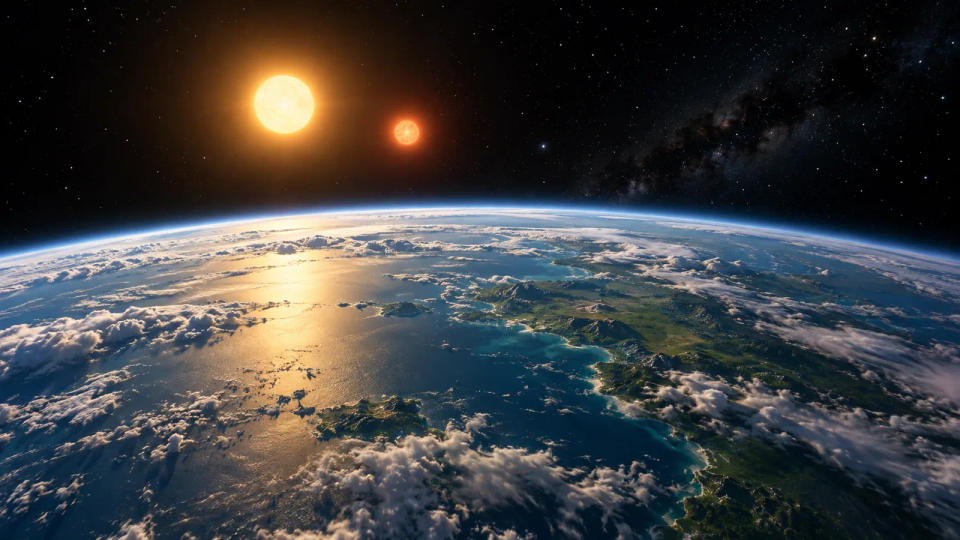
Imagine planting a garden beneath two suns. Would spring return on schedule, or would the changing stars turn every year into a guessing game?
Yes, a planet orbiting two stars could have stable, repeating seasons. It would need a long-lived orbit, a reasonably steady axial tilt, and a climate capable of handling changes in the combined starlight. Its weather might be more complicated than Earth's, but two suns do not automatically mean climate chaos.
Astronomers call a world that travels around both members of a close stellar pair a circumbinary planet. We have found such planets. What we have not yet established is that any known circumbinary planet has Earth-like seasons on a habitable surface.
First, the Planet Must Orbit the Two Stars Safely
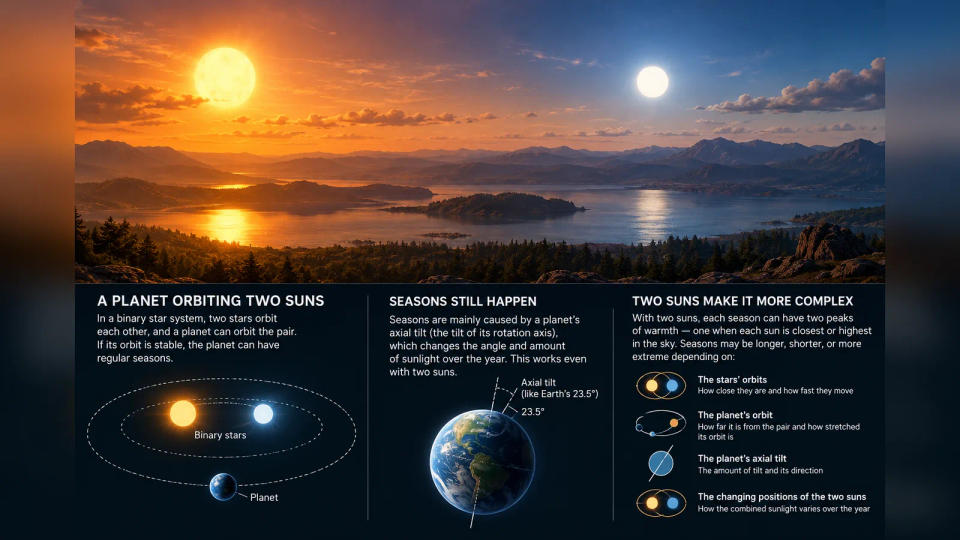
Picture two dancers circling each other while a third person walks around the outside of their dance floor. That is a useful starting image for a circumbinary system. The stars orbit their shared center of mass, while the planet follows a larger path around both of them.
The crucial word is larger. A planet that passes too close to the stars can be tugged in competing directions, making its orbit unstable. Farther out, however, the pair's combined gravity can guide the planet along a predictable path for very long periods. How far out is safe depends on the stars' masses, their separation, and the shapes of their orbits.
This is more than a mathematical possibility. NASA's Kepler mission identified Kepler-16 b, a gas giant that circles a stellar pair once every roughly 229 days. Its stars orbit one another much faster, about every 41 days. The planet's existence shows that an orbit around two suns can genuinely work.
But orbital stability answers only whether a planet can stay there. It does not tell us whether the surface, if it has one, will experience a recognizable summer or winter.
Seasons Come Mainly From Tilt, Not the Number of Suns
On Earth, summer arrives because our planet's rotation axis leans about 23.5 degrees relative to its orbital plane. As Earth travels around the Sun, each hemisphere alternately tilts toward and away from the incoming light. That changes both how directly sunlight strikes the ground and how long daylight lasts.
A two-sun world can follow the same basic rule. If its axis remains tilted by a fairly consistent amount, one hemisphere can still enjoy a season of longer, brighter days while the other receives shorter, weaker daylight. Half an orbit later, the pattern can reverse.
Think of an angled desk lamp shining on a globe. Tilting the globe changes which hemisphere receives the strongest light. Adding a second moving lamp makes the brightness pattern more complicated, but it does not remove the effect of the tilt.
There is a catch: the stars do not sit at one fixed point in the sky. They move around each other while the planet makes its larger journey. At times their apparent positions may be close together; at other times, farther apart. The two sources of daylight can change in brightness and direction at different rates.
That means a circumbinary world could have an underlying annual rhythm set by its tilt, with extra shorter cycles laid over it. The length and strength of those added cycles would depend on the actual star-and-planet system—not on a universal two-sun calendar.
Could the Moving Suns Cause Surprise Heat Waves?
Potentially. Even if a planet follows a stable orbit, the distance from each star changes as the binary revolves. The total energy reaching the top of the atmosphere can rise and fall. In some alignments, one star can even briefly pass in front of the other, causing an eclipse.
Yet more incoming light does not instantly translate into the same jump in ground temperature. Think about a beach on a bright afternoon: dry sand heats quickly, while nearby seawater warms more slowly. Water can store and redistribute heat, softening sudden changes.
A 2020 climate-modeling study explored hypothetical Earth-like planets around pairs of stars. In its most extreme modeled cases, the combined starlight changed substantially over relatively short periods. Some land regions showed noticeable temperature swings, while oceans were much more resistant to change. The results were simulations, not temperatures measured on an actual two-sun Earth.

The study found that in extreme scenarios, global-average land surface temperature could vary by up to about 5°C from the binary-driven cycle, with local daytime highs varying by up to about 12°C. These are model-dependent possibilities, not a forecast for every circumbinary planet. Ocean temperatures varied much less in the same experiments.
Earlier three-dimensional simulations of an entirely ocean-covered hypothetical planet in the Kepler-35 system also found that the varying light affected temperature and rainfall patterns without necessarily pushing the modeled climate outside its habitable range. A world with deep oceans and a substantial atmosphere might therefore have fairly familiar long-term seasons alongside unusual short-term weather.
Would Two Stars Make the Planet's Axis Wobble?
This may be the most surprising part. You might expect two stars to make a planet's spin axis wildly unstable. But in some configurations, the opposite could happen.
Axial tilt is not necessarily fixed forever. Gravitational forces can slowly change the orientation of a planet's orbit and its rotation axis. Over enough time, those changes can alter the intensity of the seasons. Earth has relatively modest long-term tilt variations, while Mars is known for much larger ones.
A 2022 theoretical study investigated planets orbiting binary stars and found that the gravitational influence of the two-star pair can, in certain low-inclination systems, help reduce variations in planetary axial tilt. The rapidly shifting orbital orientation can prevent the spin and orbital motions from falling into certain destabilizing resonances.
In plain English, the two stars can sometimes keep a planet from developing the very large tilt swings that would make its seasons hard to predict. This is an intriguing result from calculations and simulations, not proof that every circumbinary planet has a steady axis.
Planets with strongly tilted or eccentric orbits, unfavorable resonances, or additional gravitational disturbances could behave quite differently. A stable orbit and a stable axial tilt are separate requirements—and neither guarantees a comfortable climate.
What Do Real Two-Sun Planets Tell Us?
The best-known example remains Kepler-16 b, but it is not a second Earth. It is a cold gas giant, roughly Saturn-sized. Nobody could stand on a grassy hillside there and watch two sunsets.
Kepler-47 offers another useful clue. NASA described a planet in that two-star system traveling within the system's habitable zone—the distance range where liquid surface water could be possible under suitable conditions. But that planet, Kepler-47 c, is a giant world, not a confirmed temperate rocky planet with oceans, forests, or seasons like ours.
The habitable zone is only a starting point. To assess genuine seasonal stability, astronomers would also need to understand a world's mass, atmosphere, rotation, tilt, water inventory, and the changing light from both stars. Some of those properties are extremely difficult to measure for distant planets today.
That is why climate researchers model hypothetical rocky worlds rather than claim to know the weather on Kepler-16 b or Kepler-47 c. These models help identify which combinations of orbit, atmosphere, ocean, and tilt might allow a planet to remain livable through many repeated years.
Conclusion. Two suns can make a planet's sky spectacular and its weather unusually complex. But if the orbit and axial tilt are well behaved—and its climate buffers changes in starlight—spring could still follow winter year after year. A reliable calendar under two suns is scientifically plausible, even if we have yet to find a world where anyone could use one.
Sources & Further Reading
- NASA Earth Observatory — An Epic View of the Seasons (2026)
- NASA Science — Kepler-16 b: (Almost) a Real-life Tatooine
- NASA Science — Orbiting in the Habitable Zone of Two Suns
- Popp & Eggl (2017) — Climate Variations on Earth-like Circumbinary Planets, Nature Communications
- Wolf et al. (2020) — The Resilience of Habitable Climates Around Circumbinary Stars
- Low Spin-Axis Variations of Circumbinary Planets (2022), Monthly Notices of the Royal Astronomical Society
Post a Comment