

Imagine standing on the Moon beside a perfectly vertical shaft that does not stop at a mine, a cavern, or even the mantle. It continues all the way through the lunar center and opens on the opposite side.
If the tunnel were somehow kept open, perfectly straight, and evacuated of gas, jumping in would not make you fall forever. You would accelerate toward the Moon’s center, race through that midpoint at your highest speed, then slow down as you climbed toward the far side. In a simple uniform-density model, the trip from one surface to the other would take about 54 minutes.
What would happen when you jumped into the tunnel?
At the lunar surface, gravity is only about 1.62 meters per second squared, roughly one-sixth of Earth’s surface gravity. The moment you stepped into the shaft, that gravity would pull you inward.
But something strange happens as you descend. The Moon is a sphere, so the material above you begins to surround you in every direction. In the idealized physics of a spherical world, the gravitational pulls from the layers outside your current depth cancel one another. Only the mass closer to the center than you are continues to produce a net inward pull.
That means gravity gradually weakens on the way down. In a Moon treated as having uniform density, the decrease is smooth and nearly linear: strongest at the surface, weaker halfway down, and exactly zero at the center.
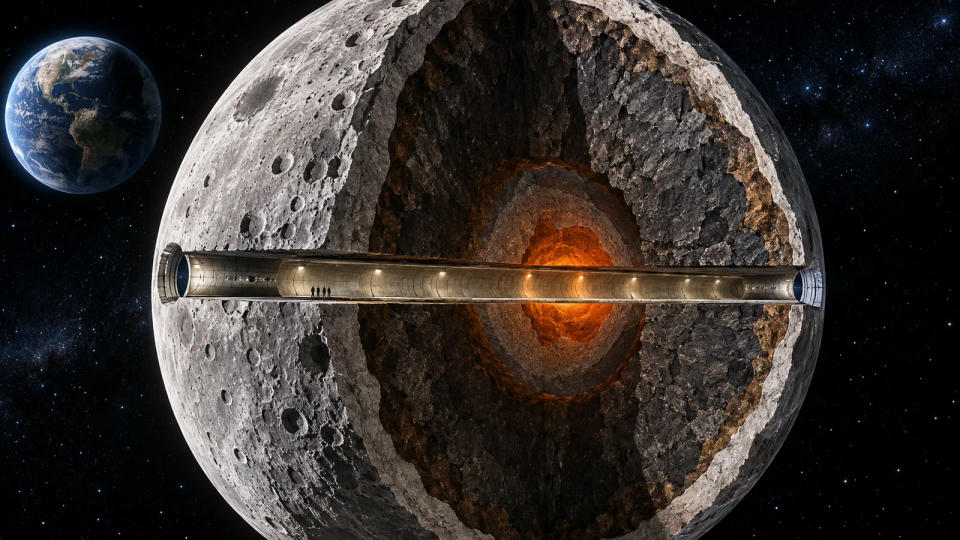
Zero gravity at the center does not mean you would stop there. By then you would already be moving fastest. The gravity you experienced on the way in would have converted gravitational potential energy into speed, so you would shoot through the center and continue toward the opposite surface.
In the same simplified model, your speed at the center would be about 1.7 kilometers per second. After passing the midpoint, gravity would point back toward the center, so it would act like a brake. In the ideal case, you would reach the opposite surface with zero speed, turn around, and fall back again. With no friction or air resistance, the motion would repeat like a giant gravitational pendulum.
How long would a trip through the Moon take?
The classic result is surprisingly short. Using the Moon’s radius and surface gravity, a straight trip through a uniform-density Moon comes out to roughly 54 minutes from one side to the other.
There is a beautiful reason for that number. Inside a uniform sphere, gravity changes in proportion to distance from the center. That produces the same type of motion as a mass on an ideal spring, called simple harmonic motion. A full back-and-forth oscillation through the Moon would take about twice the one-way crossing time.
The real Moon is not uniform, however. Its density changes from crust to mantle to core, so the exact travel time would differ from the textbook value. A realistic calculation would have to follow how the Moon’s gravitational pull changes through its actual layered interior rather than using one average density.
So “54 minutes” is best understood as the clean thought-experiment answer, not a stopwatch prediction for a real lunar tunnel.
What would you actually have to drill through?
The Moon may look like a single gray ball, but it is a differentiated world with a crust, mantle, and core. NASA estimates the crust at roughly 40 kilometers thick on the near side and around 60 kilometers on the far side. Beneath it lies a vast rocky mantle made largely of minerals such as olivine and pyroxene.
Far deeper down, the tunnel would enter a partially molten region near the core. NASA describes the Moon as having a small iron-rich solid inner core surrounded by a liquid iron shell, while modern geophysical studies continue to refine the exact dimensions. A 2023 study in Nature found strong evidence for a solid inner core with a radius of about 258 kilometers, within its stated uncertainty.
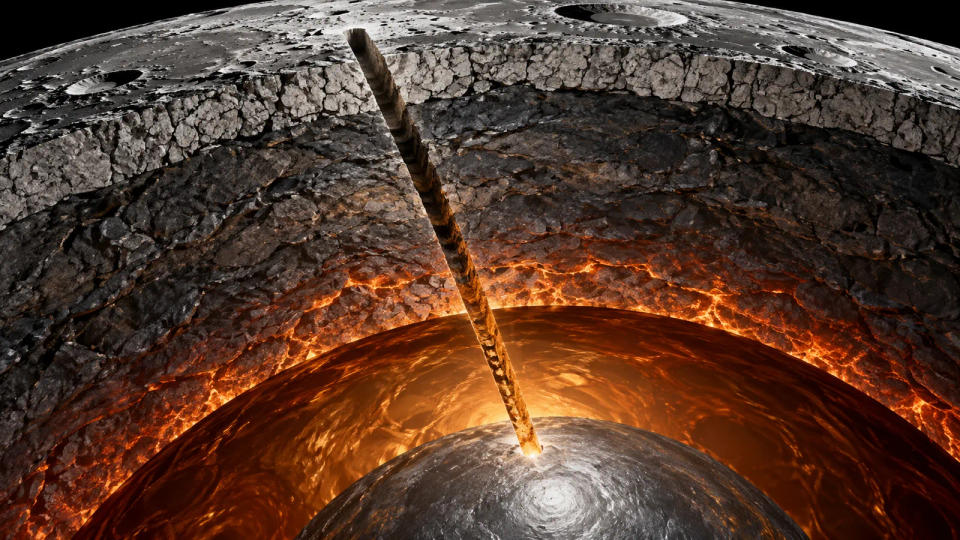
That is where the fantasy of ordinary drilling ends. Rock deep inside the Moon is under enormous pressure and is much hotter than the surface. Near the center, the tunnel would have to pass through material that is not simply cold, rigid stone. It would encounter hot mantle rock, partially molten zones, and liquid metal around the solid core.
Even if a drill could somehow survive those conditions, the tunnel walls would need to remain perfectly supported across a path about 3,475 kilometers long—the Moon’s full diameter.
Why the tunnel would collapse long before you finished
The biggest obstacle is not finding a drill bit hard enough. It is keeping the hole open.
Near the surface, lunar rock can behave like brittle stone. Deeper down, higher temperature and pressure allow rock to deform slowly over time. A deep unsupported shaft would tend to squeeze, fracture, or flow shut. Any partially molten material encountered along the route could also invade the tunnel.
The Moon is not completely geologically silent either. Apollo seismometers detected moonquakes, including deep events linked to tidal stresses and shallower quakes in the crust. A structure extending through the entire Moon would have to tolerate repeated stress changes while maintaining alignment through thousands of kilometers of rock.
Then there is the vacuum problem. The fun version of the tunnel assumes no atmosphere inside, because gas drag would remove energy from the falling traveler. In reality, hot rock and volatile-bearing material could release gases, and any injected atmosphere would create resistance. With enough drag, instead of oscillating from side to side, you would eventually lose energy and settle near the center.
Engineering a pressure-resistant, heat-resistant, quake-resistant tube across the Moon is so far beyond current technology that the thought experiment is more useful as a lesson in gravity than as a construction proposal.
Conclusion. A tunnel through the Moon gives us one of the clearest ways to picture how gravity behaves inside a spherical world. You would not be pulled harder and harder as you approached the center. The opposite happens: the net gravitational force fades to zero, even while your speed reaches its maximum.
In the ideal version, you could cross the Moon in roughly an hour, emerge on the far side, and—if nothing stopped you—fall all the way back again. In the real Moon, heat, pressure, layered geology, liquid metal, moonquakes, and rock deformation make such a tunnel effectively impossible. The journey works beautifully in physics because the impossible engineering has been removed.
Sources & Further Reading
- NASA Science — Moon Facts
- NASA Science — Moon Composition & Structure
- NASA Science — Moonquakes
- NASA NSSDC — Moon Fact Sheet
- Nature — The lunar solid inner core and the mantle overturn
Post a Comment