

What would happen if a river on Earth were filled with the stuff we usually burn as natural gas? On Saturn's largest moon, Titan, this is not science fiction: rivers have carved valleys and lakes and seas hold liquid methane and ethane. The reason is surprisingly simple. Titan is so cold that water behaves like rock, while methane can behave like water.
Yet that answer raises another question. A cold pool of methane might be imaginable, but how does an entire landscape acquire shorelines, winding channels, clouds and rain? To understand it, we need to visit a world that has Earth's weather machinery but runs it with different ingredients.
Why Methane Can Be Liquid When Water Is Frozen Solid
Titan's surface temperature is about 94 kelvin, or minus 179 degrees Celsius (minus 290 degrees Fahrenheit). Earth would be an unrecognizable icebound place at that temperature. On Titan, exposed water ice is exceptionally hard and forms much of the surface's bedrock. The rounded 'stones' photographed by the Huygens probe are consistent with water ice, not the familiar silicate rocks in an earthly stream.
But the freezing and boiling temperatures of a substance are not universal. They depend on the material and the surrounding pressure. Methane is a simple molecule, CH4, containing one carbon atom and four hydrogen atoms. At Titan's extreme cold and roughly 1.5 times Earth's surface atmospheric pressure, methane can remain liquid in exposed lakes and seas. Ethane, another hydrocarbon with two carbon atoms, can also be liquid there.
Think of two bottles on the same cold shelf. One contains water, which has become solid; the other contains a substance whose liquid-temperature range is much lower. There is no mystery in their different states. The unusual part is that Titan is both cold enough and equipped with a thick enough atmosphere to let a volatile liquid persist outside a container.
That atmosphere is mostly nitrogen with methane as a smaller but crucial component. It creates an orange photochemical haze that hides the surface from ordinary visible-light cameras. The rivers are not molten ice, the lakes are not oceans of liquid water, and Titan is not warm underneath a golden sky. Its familiar-looking scenery is built from unfamiliar materials.
How Methane Rain Carves Rivers and Refills Lakes
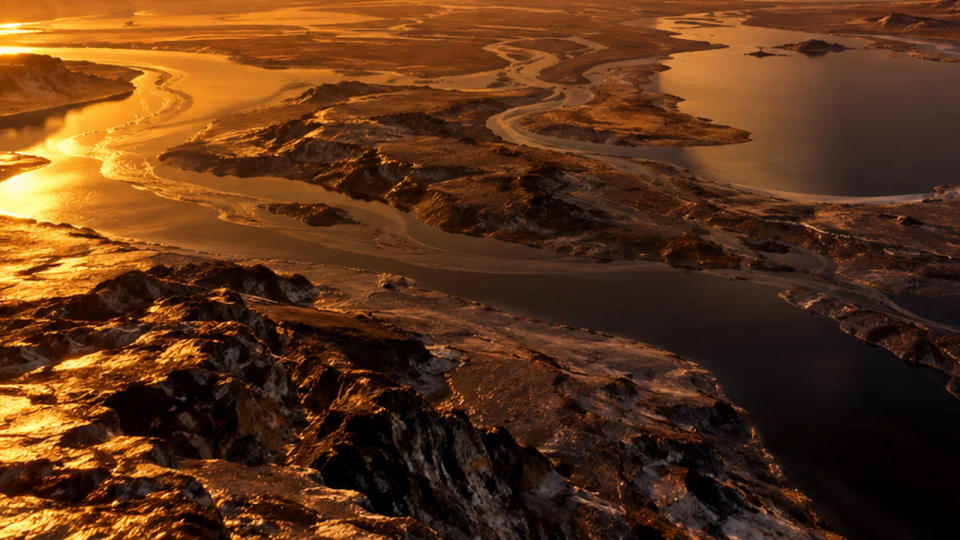
Earth has a water cycle: sunlight warms oceans, water evaporates, rising vapor condenses into clouds, and rain returns it to the ground. Titan has a methane cycle. Methane evaporates from surface reservoirs, collects in clouds as the air cools, and can fall as rain. That rainfall can flow downhill, erode channels and carry material into low basins.
It is a familiar process with an alien liquid. Imagine a rainstorm crossing a frozen landscape where the 'rocks' are water ice. Instead of a brook running over gravel, methane runoff can cut through icy ground, transport organic particles, and leave riverbed-like shapes. Some channels may also be fed by liquid emerging from the subsurface, much as a spring feeds a stream on Earth.
Importantly, a channel does not have to contain flowing liquid all the time. Rivers on Earth also leave dry beds after intermittent rain. In 2005, the European Space Agency's Huygens probe descended through Titan's haze and imaged branching drainage networks, dark lowlands and rounded ice-like pebbles. The local landing area appeared to be a dry bed, not an actively flowing river photographed in motion. Its terrain supplied strong evidence for previous liquid flow.
Weather is not merely an old geological story, either. NASA's James Webb Space Telescope, working with ground-based Keck observations, reported evidence in 2025 of convective methane clouds over Titan's northern lake and sea region. Convection is rising air: the same basic movement that helps build storm clouds over Earth. Webb did not film a methane river rushing toward the sea; it strengthened our view of the atmospheric side of an active methane cycle.
And Titan has seasons. It orbits the Sun with Saturn, taking almost 30 Earth years for one revolution. A Titan season therefore lasts roughly 7.5 Earth years. The distribution of clouds, rain and exposed liquid can change over that long rhythm. A dried river channel and a filled lake can belong to the same climate system without being wet at the same moment.
What Cassini Actually Found at Titan's Poles
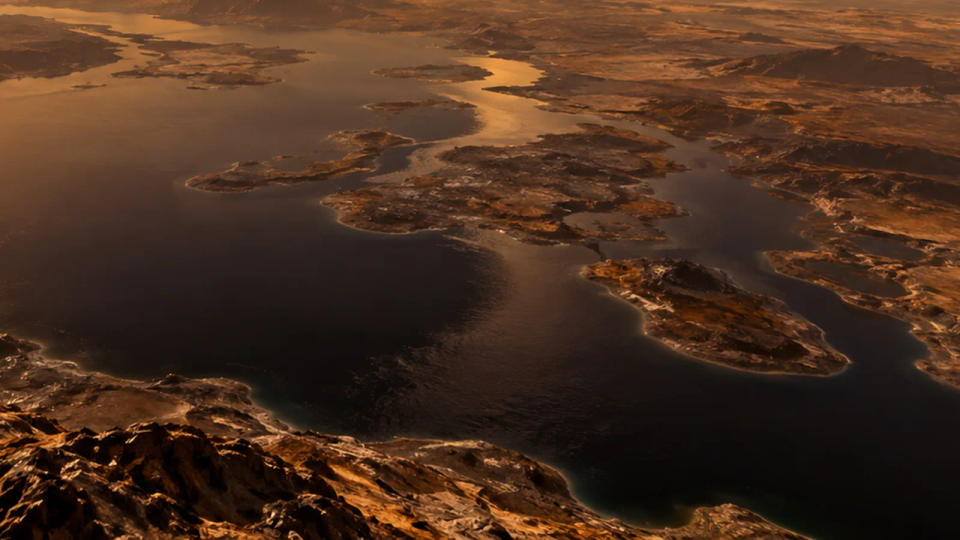
Titan's thick orange atmosphere once kept its surface largely concealed. NASA's Cassini spacecraft changed that picture. Its radar instrument used reflected radio waves to examine terrain beneath the haze. Dark, exceptionally smooth radar patches at high northern latitudes showed the shapes of lakes and seas, including channels connecting some of them. Other instruments and measurements confirmed that real liquid hydrocarbons occupy these basins.
The most famous named seas include Kraken Mare, Titan's largest, and Ligeia Mare, its second largest. These are not little puddles. Kraken Mare stretches roughly 1,100 kilometers (680 miles) along its length. Cassini's radar also helped measure portions of Ligeia Mare's depth; a NASA mission retrospective described depths around 170 meters (560 feet) in the examined area.
Measurements sharpened the chemical picture. Cassini analysis reported in 2019 indicated that small northern lakes were dominated by methane, while earlier work on southern Ontario Lacus found a substantial mixture of methane and ethane. 'Methane lakes' is therefore useful shorthand, not a claim that every body of liquid has exactly the same composition. Different reservoirs can have different ingredients and histories.
Most confirmed large liquid bodies lie near Titan's north pole. Near the equator, the landscape is often dominated by vast dunes made of organic particles rather than open seas. The location matters: Titan is not a global methane ocean, nor is every river valley permanently flooded. Even at the poles, some lake-shaped depressions are empty or have changed over time.
One more surprise is that scientists are still debating how certain basins formed. Some depressions may have developed as surface material dissolved or eroded, vaguely resembling sinkholes on Earth. Other steep-rimmed features have inspired alternative formation models. Cassini directly observed the shapes; their entire geological history remains a scientific reconstruction. That distinction is what makes Titan such an exciting place to investigate.
High above these lakes, sunlight and charged particles break apart atmospheric methane, producing a complicated chemistry of carbon-rich molecules. Some of that material settles onto the surface. Titan may also hide an internal ocean of water beneath its icy shell, entirely different from its surface methane seas. Neither complex chemistry nor a possible subsurface ocean proves that life exists there. NASA's Dragonfly mission is intended to investigate prebiotic chemistry, not to announce that Titan's lakes are inhabited.
Conclusion
Titan has rivers and lakes of liquid methane because its surface sits in a remarkable temperature-and-pressure range where methane and ethane can remain liquid while water freezes hard. A nitrogen-rich atmosphere then allows methane to evaporate, form clouds, fall as rain and reshape icy ground. Huygens photographed evidence of drainage and past flow; Cassini mapped actual northern seas; Webb has added evidence about methane cloud activity.
The lesson is bigger than one strange moon. Rivers, shorelines and weather do not require liquid water in every possible world. They require a substance able to flow, an environment that keeps it liquid, and a way to move it around. Titan supplies all three—with methane taking the role that water plays on Earth.
Sources & Further Reading
- NASA Science — Titan Facts
- ESA — Seeing, Touching and Smelling the Extraordinarily Earth-like World of Titan
- NASA — Cassini Reveals Surprises with Titan's Lakes
- NASA — Webb's Titan Forecast: Partly Cloudy With Occasional Methane Showers
- NASA JPL — The Mysterious 'Lakes' on Saturn's Moon Titan
Post a Comment