
TESS discoveries passed 1,000 confirmed planets in October 2026, revealing worlds we can study beyond a simple count.

What have we actually learned from a thousand planets beyond our solar system? NASA’s TESS discoveries show that planetary systems offer an extraordinary range of worlds, while providing targets for measuring what those worlds are made of. The milestone belongs to a worldwide observing effort: TESS finds promising signals, and researchers test them with additional observations and analysis.
NASA’s October 8, 2026 announcement counted 1,008 confirmed TESS discoveries. That is a dated snapshot, rather than a claim that the running total will remain fixed. The most interesting question is what turns a faint signal into a planet we can understand.
How does a dip in starlight become a confirmed planet?
TESS, short for Transiting Exoplanet Survey Satellite, launched on April 18, 2018. It monitors stars in visible light, looking for changes in brightness. Its extended observations also capture other changing objects, including pulsating stars and distant stellar explosions. This broader activity is a useful reminder that a changing light signal does not automatically mean a planet has appeared.
During a transit, a planet passes between its host star and the observer. The star becomes slightly fainter because the planet blocks part of its disk. Astronomers plot that change as a light curve. A repeating pattern can reveal an orbital period, while the amount of blocked light helps estimate the planet’s size relative to the star.
The geometry matters. TESS can detect a transit only when the orbit carries the planet across the star along our line of sight. A planet whose orbit misses the stellar disk from our viewpoint can still exist without producing that familiar dip. The survey therefore reveals an observable sample, rather than a complete inventory of every planetary system.
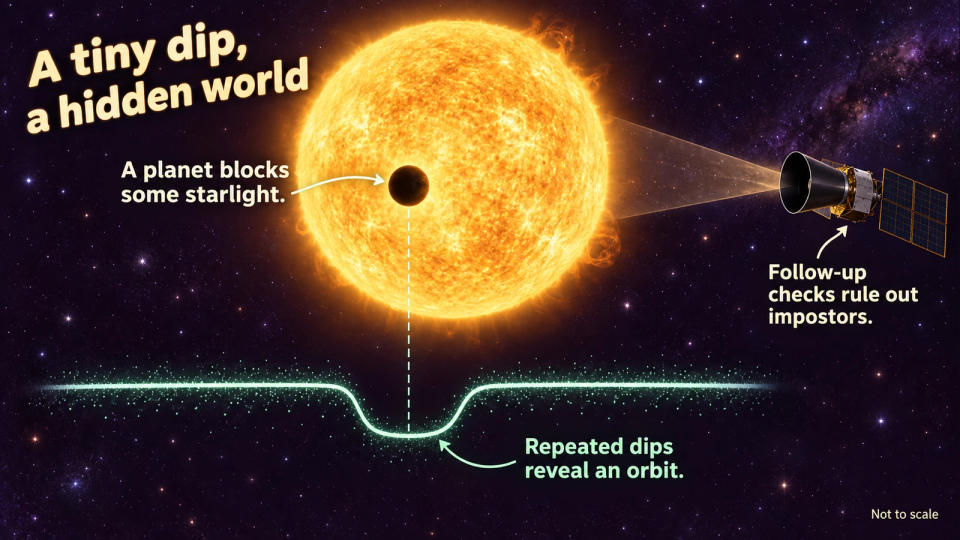
Researchers must rule out alternatives, such as an eclipsing stellar companion, a neighboring source blended into the observations, or instrumental effects. Follow-up telescopes can test whether the signal occurs where and when expected. Radial-velocity observations offer another route: a planet’s gravity makes its host star move, producing measurable changes in its spectrum.
Confirmation and statistical validation are related but distinct approaches. Independent dynamical evidence can establish a planet, while careful statistical work can demonstrate that plausible false-positive explanations are extremely unlikely. A catalog entry does not imply that every planet has received exactly the same suite of measurements. Published methods and uncertainties remain essential.
What have more than 1,000 TESS planets revealed?
The October milestone covered planets around 853 host stars. Their sizes and orbital periods varied enormously, showing why an exoplanet catalog cannot be reduced to a collection of Earth twins. TESS is building a comparative sample: researchers can ask how different planetary sizes, orbits and stellar environments fit together.
One especially valuable result concerns planets with both mass and radius measured reliably. NASA reported that 541 confirmed TESS discoveries had both quantities measured to better than three sigma. It also credited TESS with 241 of the 400 planets smaller than four Earth radii meeting that measurement standard in the archive snapshot. These are specific subsets, not measurements available for every discovery.
Why pair mass with radius? Size describes how much space a world occupies; mass describes how much matter it contains. Together they constrain average density and help researchers distinguish possible rocky interiors from substantial envelopes of gas. They do not deliver a unique geological cross-section. Different interiors can sometimes explain similar bulk properties, so conclusions must retain their uncertainties.
TESS was designed to identify promising planets around bright, relatively nearby stars. Those targets make follow-up observations more practical. A faint dip can therefore become the beginning of a longer investigation involving ground observatories and space telescopes. For suitable targets, atmospheric studies can add information that a transit detection alone cannot provide.
Do Earth-size discoveries bring us closer to another Earth?
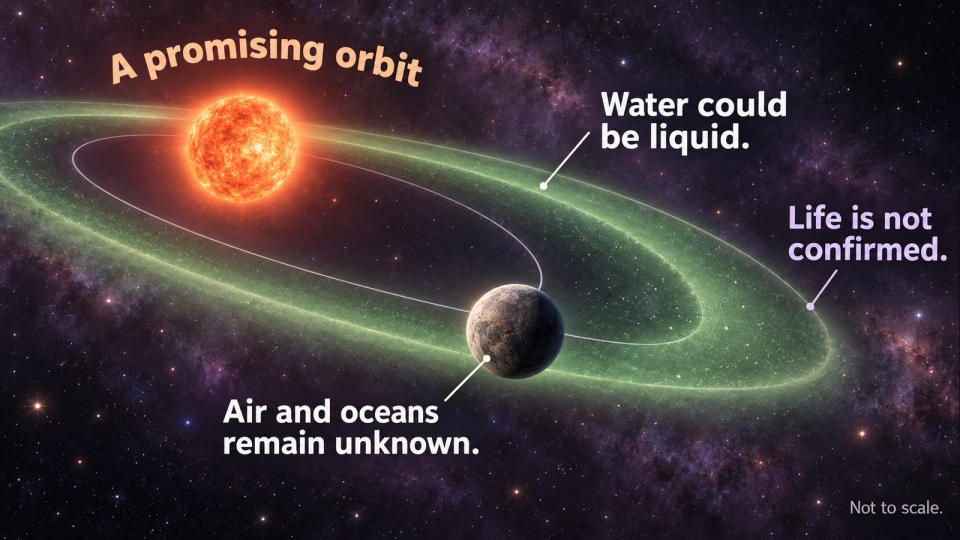
The TOI 700 system illustrates both the excitement and the limits. In January 2023, NASA announced TOI 700 e, an approximately Earth-size world orbiting a cool star roughly 100 light-years away. Its approximately 28-day orbit placed it in the system’s optimistic habitable zone. Another planet, TOI 700 d, lies in the more conservative habitable zone.
A habitable zone is a range of stellar distances where liquid surface water could be possible under suitable conditions. It is not a water detection. Nor does an Earth-size radius establish an Earth-like atmosphere, a temperate climate, or biology. Those are separate questions requiring separate evidence.
Finding TOI 700 e required an additional year of TESS observations beyond the initial discovery work in that system. Its faint signal shows why continued monitoring matters: an existing data set can gain explanatory power when repeated observations make a subtle pattern easier to recognize. A discovery announced later need not represent a planet that formed recently.
TOI 700 d also demonstrates the value of independent follow-up. NASA’s Spitzer telescope observed its predicted transit, strengthening the planetary interpretation and improving measurements. Researchers then modeled a range of possible environments, including hypothetical ocean-covered and land-dominated versions. Those contrasting models explored possibilities; they did not photograph or verify the planet’s surface.
Atmospheric spectroscopy follows a different trail of evidence. When suitable observations can measure how starlight changes with wavelength while interacting with a planet’s atmosphere, researchers can investigate possible molecules. Models help interpret such signals, but a simulated spectrum remains a prediction until observations can test it. Discovery, characterization and habitability assessment are successive scientific questions.
Conclusion
TESS’s thousand-planet milestone is a starting point for comparison and deeper investigation. The mission supplies discoveries that other observatories can examine, while repeated measurements improve our understanding of individual systems. The real achievement is the growing ability to connect evidence across instruments and ask better questions about worlds beyond the Sun.
For readers following the next announcement, three details deserve attention: what was actually measured, how the planetary interpretation was tested, and which conclusions remain models or possibilities. A confirmed planet is already remarkable. Understanding its environment is the next challenge.
Sources & Further Reading
- TESS reaches 1,000 confirmed exoplanets!
- TESS (Transiting Exoplanet Survey Satellite)
- The Transiting Exoplanet Survey Satellite
- 10 Steps to Confirm a Planet Around Another Star
- NASA’s TESS Discovers Planetary System’s Second Earth-Size World
- NASA Planet Hunter Finds Earth-Size Habitable-Zone World
Post a Comment