
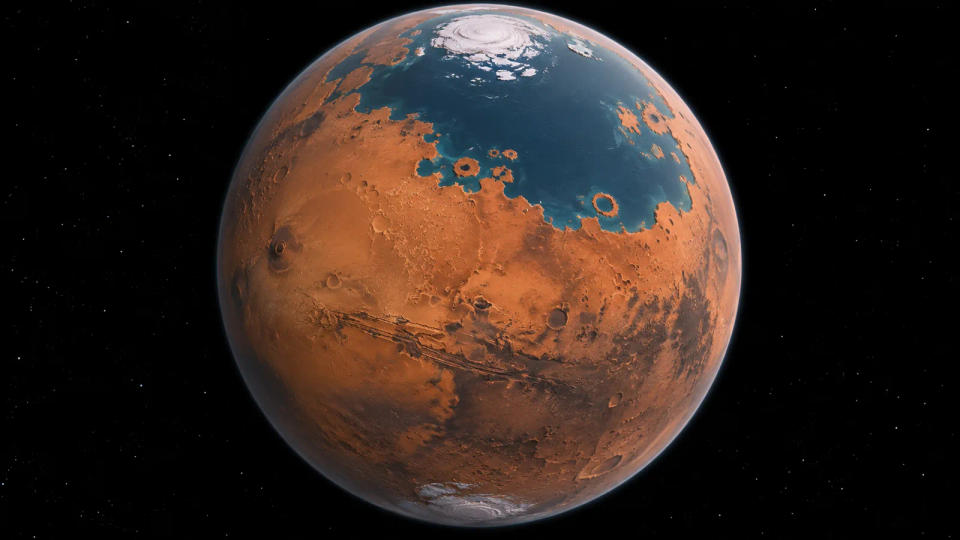
Mars looks dry enough to make the idea of Martian oceans sound almost absurd. Yet the planet is not truly waterless. It still holds enormous amounts of water as ice, and some of its ancient water may also be locked inside minerals in the crust.
So a future civilization would not necessarily have to bring every drop from Earth. The more interesting question is whether Mars has enough usable water to fill rivers and seas—and whether we could release it without spending impossible amounts of energy. The short answer is that Mars probably contains a great deal of water, but most of it is in the wrong form, in the wrong place, or too difficult to extract.
Where Mars’s Water Is Hiding Today
The easiest Martian water to imagine using is ice. Both polar regions contain thick deposits, and spacecraft have also found widespread ground ice far from the poles. NASA’s Subsurface Water Ice Mapping project has identified northern mid-latitude regions where ice may lie only tens of centimeters beneath the surface, which is one reason those areas are attractive for future human missions.
Some individual reservoirs are surprisingly large. Radar observations of Utopia Planitia revealed an underground deposit estimated to contain roughly as much water as Lake Superior. In 2024, ESA reported that radar measurements of the Medusae Fossae Formation near the equator were consistent with ice-rich layers several kilometers thick. If all of that suspected ice melted, ESA estimated it could cover the entire planet in a layer about 1.5 to 2.7 meters deep.
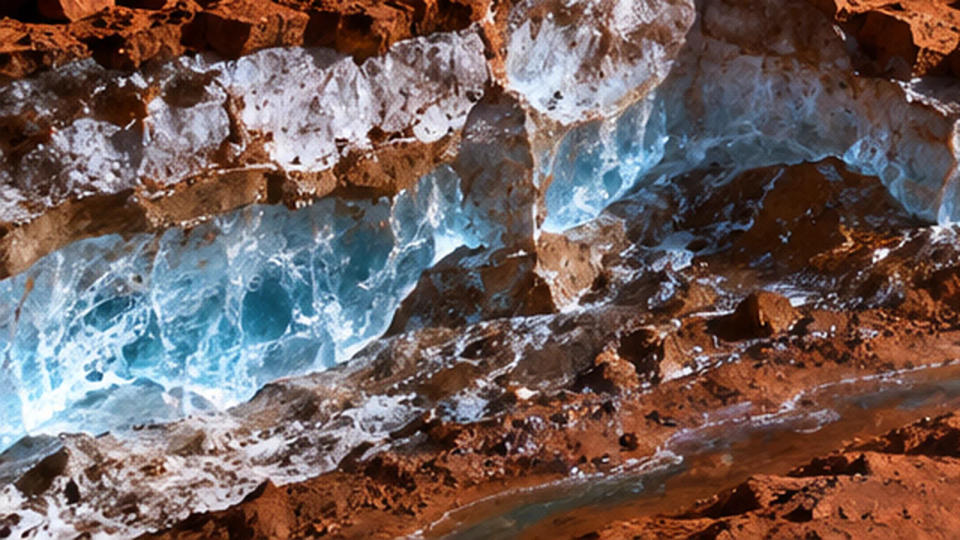
That sounds enormous, but a planet-wide ocean is a much bigger target. These discoveries are excellent news for local settlements, fuel production, and agriculture. They do not automatically mean there is an easily accessible global ocean waiting under the soil.
Some of Mars’s missing water may not be ice at all. A NASA-funded study published in 2021 concluded that roughly 30% to 99% of the water from early Mars could have become trapped in hydrated minerals in the crust. When water reacts chemically with rock, it can become incorporated into clays and other minerals instead of remaining as free liquid or ice.
This helps explain why ancient Mars could once have supported lakes, rivers, and perhaps oceans while the modern surface is so dry. The same study estimated that early Mars may have held enough water to make a global layer roughly 100 to 1,500 meters deep if spread evenly over the planet.
But mineral-bound water is not the same thing as a buried lake. Releasing it could require mining, crushing, and heating staggering quantities of rock. Even if the total inventory is ocean-scale, the energy bill could make it far less useful than shallow ice. In other words, “Mars still has the water” does not mean “Mars has a convenient reservoir we can pump.”
Could We Melt Mars’s Ice Into Seas and Rivers?
In principle, yes—but melting is only the first step. A terraforming project could target polar ice, shallow ground ice, and buried glaciers, then use heat to turn that ice into liquid water or vapor. On a warmer, higher-pressure Mars, some of that water could eventually circulate through rainfall, rivers, lakes, and groundwater.
The engineering scale would be extraordinary. Heating a small reservoir for a settlement is one problem; changing the phase of enough ice to reshape a planet is another. Any practical plan would have to warm the climate at the same time, because today’s Martian surface cannot keep large bodies of liquid water stable for long.
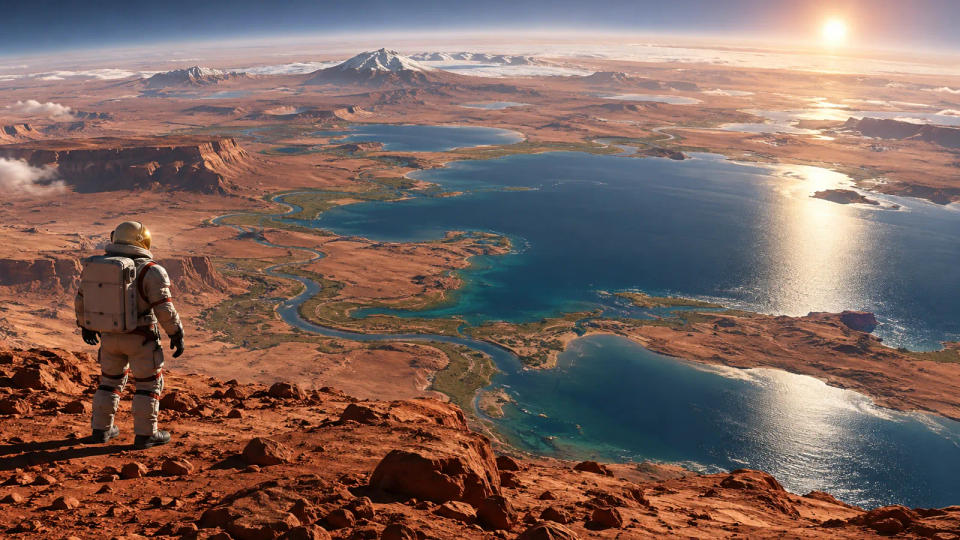
This is why a terraformed Mars with open seas should be treated as a far-future climate concept, not as something that follows automatically from discovering ice. The water supply and the planetary climate would have to be engineered together.
Could Comets or Asteroids Deliver the Missing Water?
If local water proved insufficient or inaccessible, the Solar System offers another source: water-rich asteroids and comets. In theory, changing the orbits of icy bodies could deliver additional water to Mars. The attraction is obvious—space already contains natural packages of ice, so why not move them to the planet?
The problem is scale and control. Redirecting even one large object would demand extraordinary propulsion, navigation, and planetary-defense precision. Delivering an ocean would require a long sequence of such operations, and impacts energetic enough to release water could also vaporize material, excavate the surface, and create serious hazards.
NASA’s 2018 assessment of Mars terraforming reached a similar conclusion about importing volatiles: many thousands of comets or asteroids could be required, making the approach impractical with present-day technology. Future engineering might reduce that difficulty, but importing water is not a convenient backup plan. It is another planetary-scale megaproject.
Could Mars Ever Have Oceans Again?
Mars may already contain enough total water for impressive seas, especially if large amounts remain locked in crustal minerals. But “enough water exists” is only one part of the problem. The more immediate obstacle is the environment that water would enter.
Mars has an atmosphere with less than 1% of Earth’s sea-level pressure. Under present conditions, exposed liquid water tends to freeze or vaporize rather than remain as stable rivers and oceans. A successful terraforming program would therefore need to raise surface pressure and temperature before vast quantities of water could behave the way they do on Earth.
That makes the most realistic sequence surprisingly clear: first learn to use shallow Martian ice locally, then understand how much deeper water is truly accessible, and only much later ask whether a warmer, thicker atmosphere could support permanent seas. Mars is not a dry planet because every molecule of water disappeared. It is dry because much of its water is frozen, chemically trapped, buried, or lost—and the planet no longer provides the conditions needed for open water to last.
Sources & Further Reading
- NASA/JPL: New Study Challenges Long-Held Theory of Fate of Mars’ Water
- NASA Science: SWIM Map Shows Subsurface Water Ice on Mars
- NASA/JPL: Mars Ice Deposit Holds as Much Water as Lake Superior
- ESA: Buried Water Ice at Mars’s Equator?
- NASA: Mars Terraforming Not Possible Using Present-Day Technology
- NASA Science: Hubble and MAVEN Help Solve the Mystery of Mars’ Escaping Water
Post a Comment