
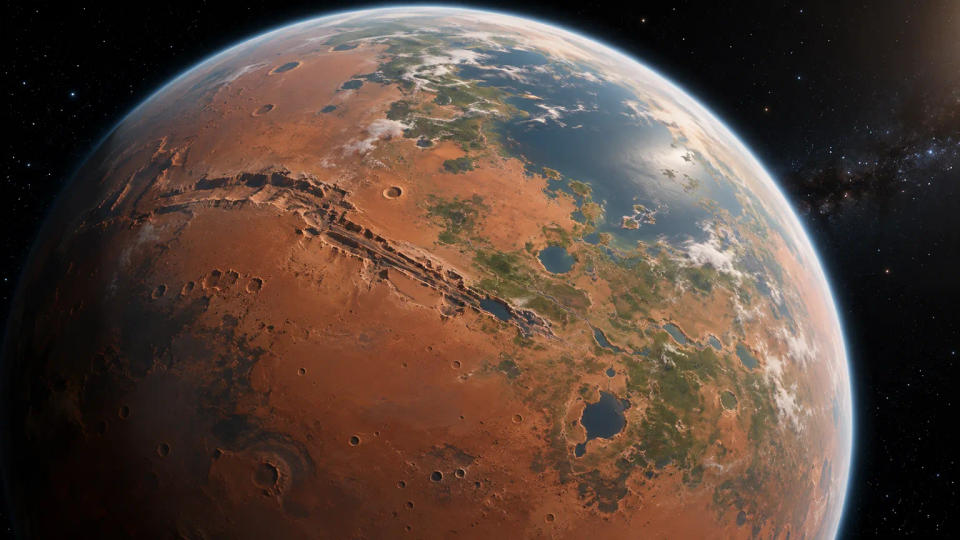
Mars looks like the obvious place to build a second Earth. It has a day almost as long as ours, seasons, polar ice, ancient river valleys, and a surface humans could eventually walk on.
But turning Mars into an open-air world where people could breathe, grow forests, and watch rain fall is far beyond anything humanity can do today. Warming the planet may be physically possible in principle, and newer climate studies have made that part of the idea more interesting. Creating a dense, oxygen-rich, stable biosphere is a much bigger challenge.
What Mars Is Like Today
The first problem is that modern Mars is barely wrapped in air. Its average surface pressure is only about 0.6% of Earth's sea-level pressure, and the atmosphere is mostly carbon dioxide. Under those conditions, exposed liquid water is not stable for long: it tends to freeze, boil away, or sublimate depending on temperature and location.
Mars is also cold. Its global average temperature is around -60°C, even though afternoons near the equator can occasionally become much warmer. The thin atmosphere cannot hold heat efficiently through the night or transport it around the planet the way Earth's atmosphere does.
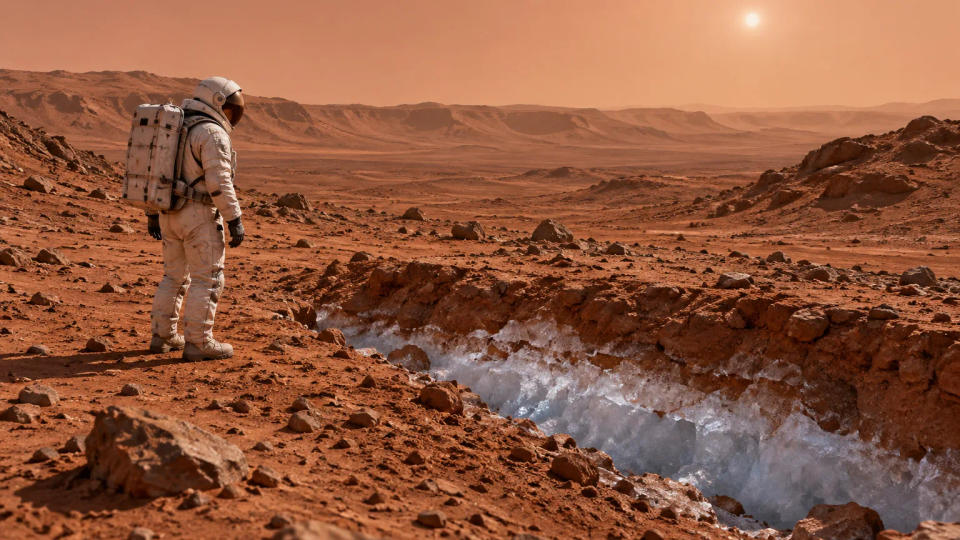
Water is not absent, however. Orbital missions have mapped large deposits of water ice, including shallow subsurface ice in some mid-latitude regions. That matters enormously for future explorers because local ice could supply drinking water, oxygen, and rocket propellant. It does not mean Mars is one warming spell away from becoming an ocean world.
The First Terraforming Problem: Heat and Air Pressure
The classic terraforming plan is simple on paper: release carbon dioxide trapped in the polar caps, soil, and minerals, thicken the atmosphere, strengthen the greenhouse effect, and let the warming release even more gas and water.
Spacecraft measurements made that scenario much less encouraging. A NASA-sponsored analysis published in 2018 concluded that Mars does not appear to have enough easily accessible carbon dioxide to build anything close to an Earth-like atmosphere with present-day technology. Even processing all known accessible carbon dioxide sources would still leave the planet far below Earth's atmospheric pressure.
That finding did not prove that every possible terraforming method is impossible. It showed that the popular idea of simply releasing Mars's own buried CO2 is not enough. Any serious planetary-scale plan would need another warming agent, imported material, enormous industrial production on Mars, or technology that does not yet exist.
Could Engineered Dust Change the Equation?
One newer proposal focuses not on making more gas, but on making Mars's existing atmosphere better at trapping heat. In a 2024 Science Advances study, researchers modeled tiny engineered rods made from materials that could potentially be manufactured from Martian minerals. These particles were designed to interact strongly with thermal infrared radiation while still allowing useful sunlight to reach the surface.
In the models, sustained release of the particles could warm Mars by more than 30 kelvins under favorable assumptions. That is a striking result because it suggests global warming might require far less material than earlier schemes based on specialized greenhouse gases.
But this is a climate-model result, not a demonstrated engineering system. Scientists still need to understand how long such particles would remain aloft, how Mars's clouds and water cycle would respond, how the particles would be manufactured and distributed, and whether unexpected climate feedbacks would appear. The researchers themselves emphasized that warming is only an early step toward habitability.
Warming Mars Is Not the Same as Making It Breathable
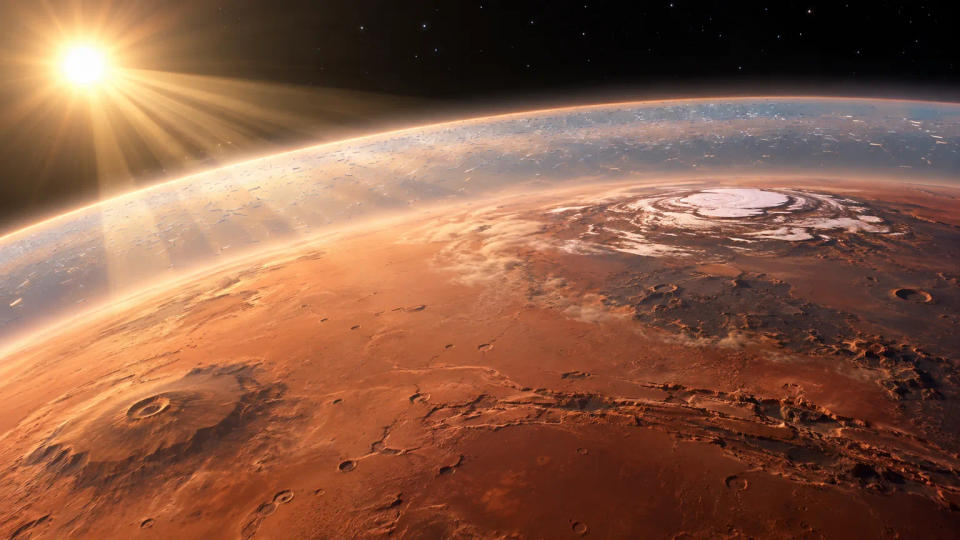
Suppose future engineers really could warm large parts of Mars enough for seasonal or even persistent liquid water. Humans still could not simply remove their helmets.
A breathable atmosphere requires far more than warmth. It needs enough total pressure, enough oxygen, and a composition that living organisms can tolerate. Producing oxygen is technically possible: NASA's MOXIE experiment aboard Perseverance proved that oxygen can be extracted from Martian carbon dioxide. Over its mission, MOXIE produced 122 grams of oxygen and demonstrated the basic chemistry under real Martian conditions.
That achievement is important for local exploration, especially because future crews could use locally produced oxygen for breathing and rocket fuel. Terraforming is a different scale entirely. A planet-sized atmosphere contains an immense mass of gas, and oxygen would also react with surface rocks rather than simply accumulating forever.
A 2025 Nature Astronomy perspective argued that recent advances justify renewed scientific study of Mars terraforming, but it also treats atmospheric oxygenation as a slow, separate stage. Warming a world in decades, if that ever proves feasible, is not the same as building an Earth-like biosphere in decades.
A Second Earth—or a World of Habitats?
The most realistic path to living on Mars may not require changing the entire planet. Sealed settlements could create small Earth-like environments while leaving the broader Martian climate mostly untouched. Habitats could recycle air and water, use buried ice, manufacture oxygen, and shield crews from radiation without waiting for centuries of planetary engineering.
That approach also gives future explorers more control. A habitat can be repaired, expanded, or abandoned. Altering an entire planet would be far harder to reverse, and any serious terraforming plan would raise scientific and ethical questions about preserving Mars, especially if evidence of past or present native life were ever found.
So could Mars become a second Earth? Not with present-day technology, and probably not in the familiar science-fiction sense for a very long time. Yet the question is no longer only about fantasy. Mars climate research, resource mapping, oxygen production, and new warming concepts are gradually separating the parts that may be physically possible from the parts that remain enormous unsolved problems.
Sources & Further Reading
- NASA: Mars Terraforming Not Possible Using Present-Day Technology
- NASA/JPL: MOXIE Completes Its Mars Mission
- NASA Science: SWIM Map Shows Subsurface Water Ice on Mars
- Science Advances: Feasibility of Keeping Mars Warm With Nanoparticles
- Nature Astronomy: The Case for Mars Terraforming Research
Post a Comment