
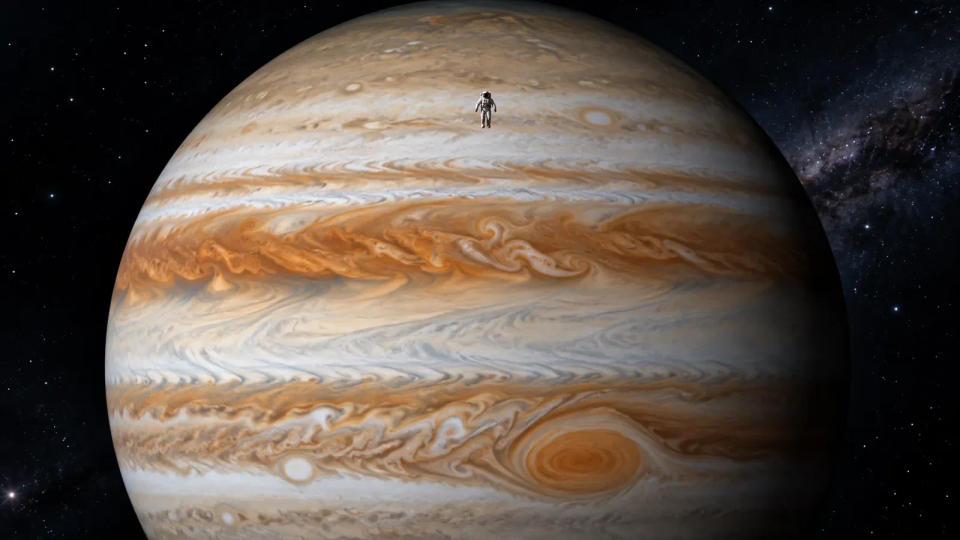
Jupiter looks like a planet you could somehow land on, but that familiar round shape is misleading. If you tried to stand on Jupiter, there would be no ground waiting for your boots. You would enter a deep atmosphere of hydrogen and helium and keep descending into regions where the gas becomes hotter, denser, and eventually fluid-like.
So the short answer is simple: you cannot stand on Jupiter because Jupiter has no true solid surface. The more interesting question is what would happen instead.
Why Jupiter Has No Surface to Stand On
On Earth, the atmosphere ends at rock, soil, ocean, or ice. Jupiter is different. NASA classifies it as a gas giant, and its visible “surface” is really the tops of clouds suspended in an enormous atmosphere. Scientists often use the level where the pressure is 1 bar—roughly Earth’s sea-level atmospheric pressure—as a convenient reference radius, but that level is not solid ground.
At that reference level, Jupiter’s gravity is about 2.36 times stronger than Earth’s at the equator. If a rigid platform could magically float there, a person who weighs 70 kilograms on Earth would experience a downward force comparable to weighing roughly 165 kilograms under Earth gravity. But Jupiter provides no natural platform. Step out of a spacecraft, and you fall.
What Happens as You Fall Through Jupiter’s Atmosphere
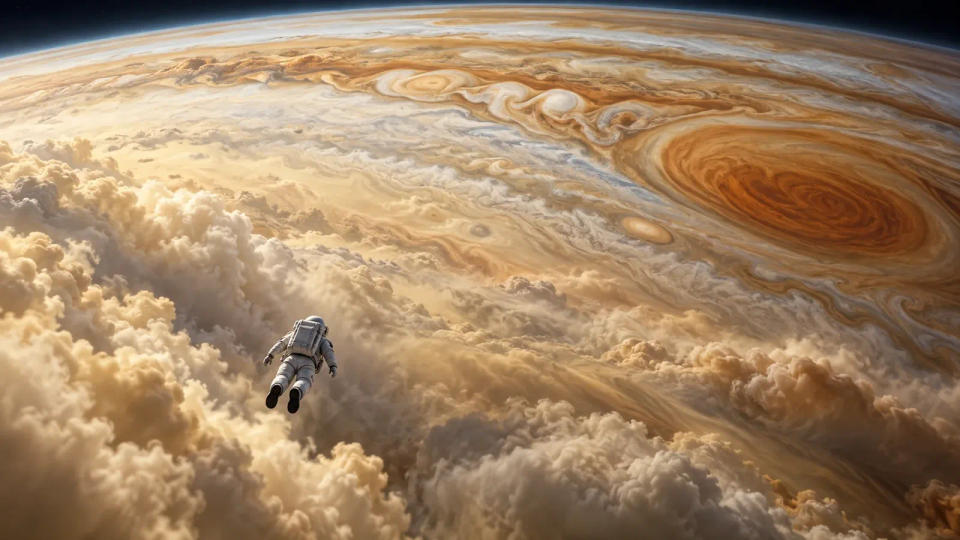
The first part of the descent would be through a world of clouds and powerful winds. Jupiter’s atmosphere is mostly molecular hydrogen and helium, with smaller amounts of gases such as methane and ammonia. Its visible cloud systems include ammonia ice and deeper water-bearing clouds.
Near the 1-bar level, the temperature is about 165 kelvin, or roughly −108°C (−162°F). Winds in some low-latitude regions can reach around 150 meters per second—about 540 kilometers per hour. You would not be dropping through a calm fog. You would be entering a fast-moving, turbulent atmosphere on a planet that rotates once in about ten hours.
Without a sealed life-support system, the lack of breathable oxygen would make survival impossible almost immediately. Even with a spacesuit, Jupiter is far beyond what ordinary human equipment is designed to handle. A thought experiment therefore needs an imaginary suit or capsule that can resist the cold, wind, pressure, and heat long enough for us to ask what comes next.
Pressure and Heat Would Become the Real Problem
As you descend, the atmosphere above you becomes heavier. Pressure rises continuously, and so does temperature. There is no sharp boundary where “atmosphere” suddenly turns into “interior.” Jupiter simply becomes denser as you go down.
NASA’s Galileo atmospheric probe showed how quickly conditions become extreme. In 1995, it entered Jupiter’s atmosphere at tremendous speed, deployed a parachute, and transmitted data for about an hour. By the end of its useful transmission, the probe had reached pressures of roughly 22 bars, and NASA’s mission history records a temperature near 153°C (307°F). That was still only a tiny fraction of the way into the planet.
A human body could not tolerate the continuing increase in pressure. A conventional spacecraft would eventually be crushed or destroyed by heat. Even a fictional indestructible capsule would not encounter a solid floor after surviving those layers; it would continue into denser hydrogen.
Deep Inside Jupiter, Hydrogen Changes Completely
Far below the visible clouds, pressure compresses hydrogen so strongly that it no longer behaves like the thin gas we know on Earth. NASA describes Jupiter’s deep interior as containing liquid hydrogen, and deeper still, a region of liquid metallic hydrogen. Under those extreme conditions, electrons become mobile enough for the hydrogen to conduct electricity like a metal.
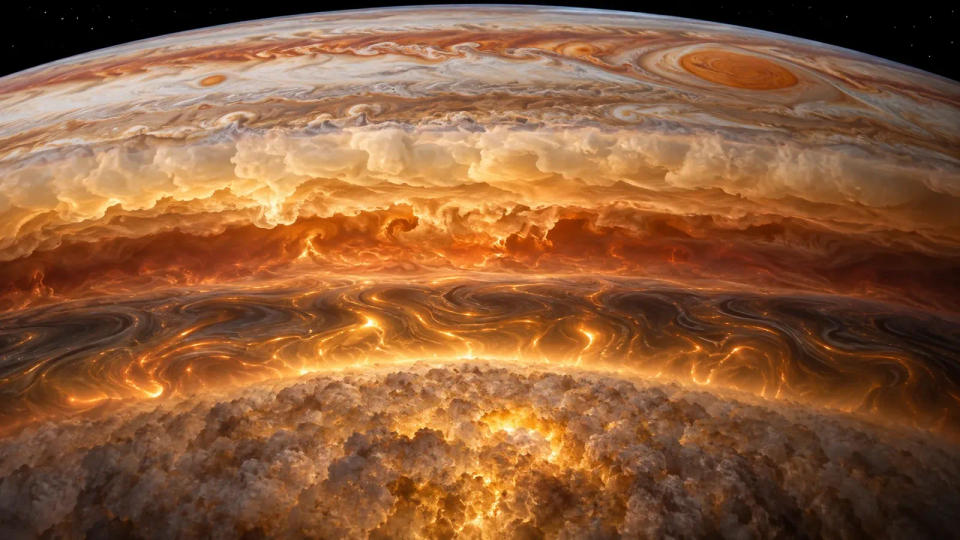
This electrically conducting layer is important because it helps generate Jupiter’s enormous magnetic field. It also shows why the phrase “gas giant” can be confusing. Jupiter is mostly made of elements that are gases under ordinary conditions, but much of its interior is not a fluffy gas. Pressure transforms the material into dense fluids.
NASA’s Juno measurements have also changed the old picture of a small, neatly separated solid core. The data favor a large, dilute or “fuzzy” central region in which heavier elements are mixed into the surrounding hydrogen rather than forming a clean, crust-like boundary. In other words, even deep inside Jupiter there is no known rocky surface comparable to the ground beneath your feet on Earth.
Would you ever stop falling? Not in the ordinary sense of landing. As the surrounding material becomes denser, drag and buoyancy would become increasingly important. A hypothetical object that somehow remained intact could slow dramatically and might settle at a depth where its average density matched the surrounding fluid. The exact level would depend on the object’s density, how it compressed, and how it interacted with Jupiter’s hot interior.
Gravity also changes as you move inward. It does not simply keep getting stronger all the way to the center. The amount of Jupiter pulling from below changes with depth, while material above you also contributes gravitationally in different directions. Near the center, the net gravitational pull would approach zero. But reaching that region as a recognizable human, suit, or spacecraft is physically unrealistic because pressure and temperature would have destroyed ordinary matter structures long before.
So if you “tried to stand on Jupiter,” the strange result is that standing never happens. There is no first step onto solid ground, no hidden surface beneath the clouds, and no rocky crust waiting farther down. You would begin a descent through weather, then through increasingly compressed hydrogen, into a planet whose interior gradually changes state rather than presenting a place to land.
Conclusion
Jupiter’s appearance makes it easy to imagine a giant version of Earth with a surface hidden under clouds. In reality, its clouds are only the visible top of a deep planetary fluid. The farther down you go, the less the idea of “standing” makes sense. Jupiter is not a world with a surface covered by atmosphere; it is a world whose atmosphere merges into its interior.
Sources & Further Reading
- NASA Science — Jupiter Facts
- NASA NSSDC — Jupiter Fact Sheet
- NASA JPL — Findings From NASA's Juno Update Jupiter Water Mystery
- NASA Science — Juno Mission
- NASA History — Mission to Jupiter: A History of the Galileo Project
Post a Comment