
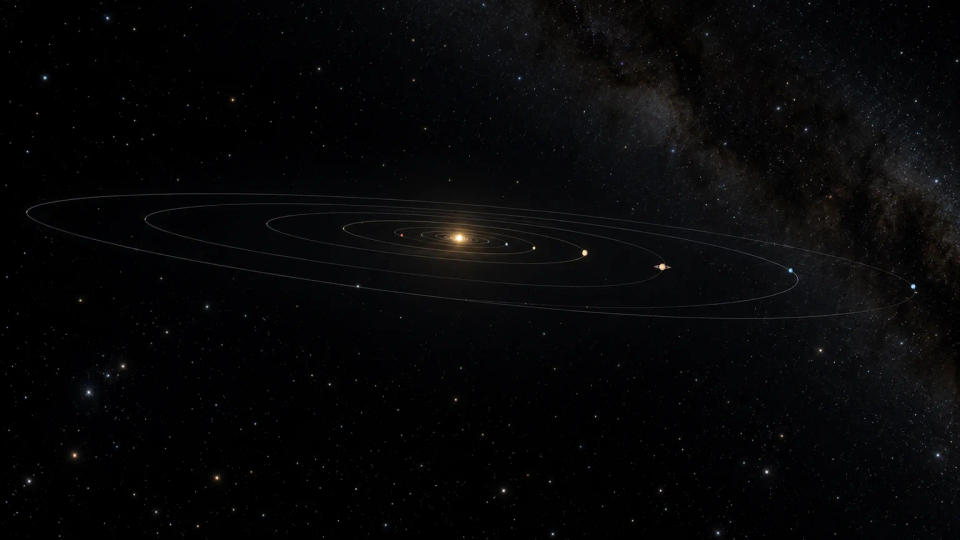
Most diagrams make the Solar System look like a neat target: the Sun in the middle, eight planets circling around it, and an imaginary camera floating far above. So why do we not have a real photograph from that angle?
The surprising answer is that we have come partway. Voyager 1 photographed the Solar System from 32 degrees above the ecliptic in 1990, and Ulysses later traveled almost over the Sun’s poles. But no spacecraft has ever taken the clean, directly overhead “map-like” picture most people imagine. Getting to that viewpoint is difficult, and the Solar System is far too large for the result to look like the familiar textbook illustration anyway.
What Does “Above the Solar System” Actually Mean?
The planets do not orbit the Sun in random directions. They formed from a rotating disk of gas and dust, so the major planets still travel in nearly the same broad plane. Astronomers use Earth’s orbital plane, called the ecliptic, as a convenient reference.
When we say “above the Solar System,” we usually mean moving well north or south of that plane and looking back toward it. There is no universal up or down in space. A spacecraft could approach from either side and still provide what we would casually call a top-down view.
The catch is that Earth also lives inside this flattened system. Most spacecraft launched from Earth begin with much of Earth’s sideways motion around the Sun. That naturally sends them along trajectories that stay relatively close to the ecliptic instead of climbing steeply away from it.
Voyager and Ulysses Show How Close We Have Come
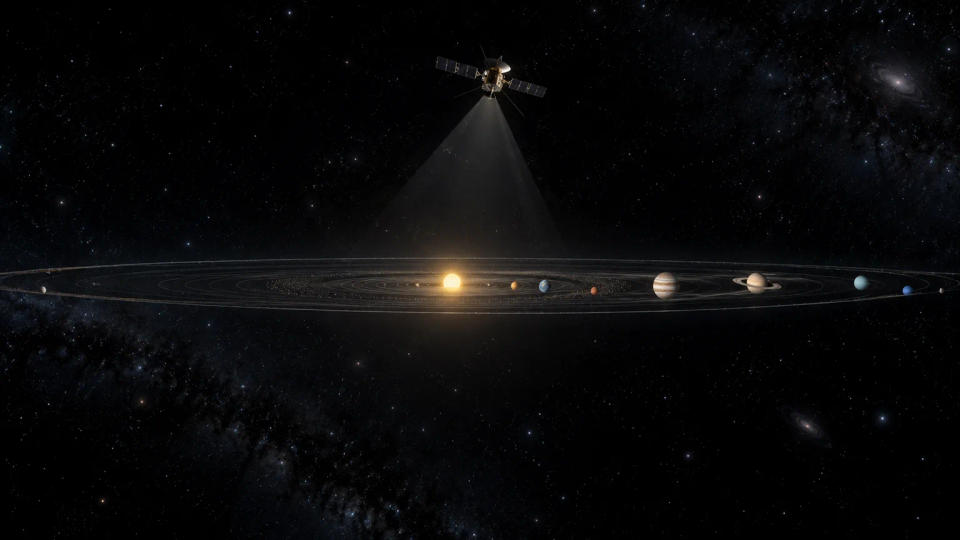
On February 14, 1990, Voyager 1 turned its cameras back toward home from beyond Neptune. The spacecraft was about 6 billion kilometers from the Sun and roughly 32 degrees above the ecliptic. It captured 60 frames that became the famous Solar System “family portrait.”
Six planets appeared in the sequence: Venus, Earth, Jupiter, Saturn, Uranus, and Neptune. Mercury was too close to the Sun to be detected, Mars was lost in scattered sunlight inside the camera system, and Pluto was too small and faint for the planned mosaic.
This was an extraordinary outside-looking-in view, but it was not the overhead photograph people often picture. The planets were mostly tiny points of light, not miniature worlds lined up around the Sun. Earth itself occupied only a fraction of a camera pixel. The “portrait” was also a mosaic assembled from many frames rather than one wide photograph containing a clearly visible planetary disk.
Ulysses went much higher. The joint ESA-NASA spacecraft launched later in 1990 to study the space environment above and below the Sun’s poles. It first flew to Jupiter, whose gravity bent it onto a steep solar orbit. Ulysses eventually reached a maximum solar latitude of 80.2 degrees — far closer to a polar, top-down geometry than Voyager 1.
But Ulysses was not built as a planetary photographer. Its instruments measured the solar wind, magnetic fields, charged particles, dust, radio waves, X-rays, and gamma rays. It did not carry the kind of imaging camera needed to make a visible-light family portrait.
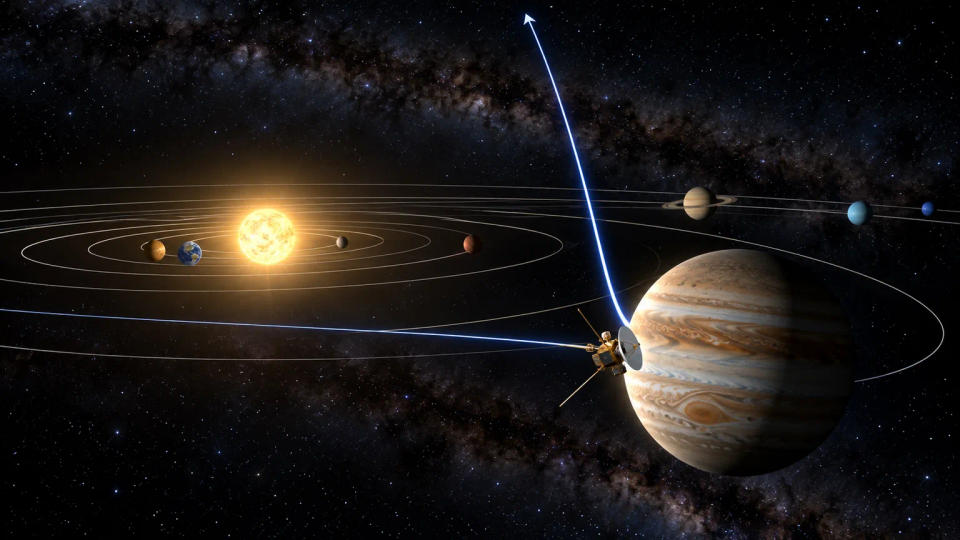
Even with a camera, Ulysses would not have produced the classic poster-like view. Its orbit extended only to about Jupiter’s distance from the Sun. From there, the outer planets would still cover an enormous area of sky, while the inner planets would crowd close to the Sun’s glare.
Why a True Overhead Solar System Photo Is So Difficult
The first problem is orbital energy. Changing the tilt of a spacecraft’s orbit can require a large change in velocity. Missions therefore avoid dramatic plane changes unless the geometry is essential to their science. Ulysses solved the problem with a Jupiter gravity assist; Solar Orbiter is using repeated Venus flybys to gradually tilt its orbit.
The second problem is distance. To see Neptune’s orbit as a compact structure rather than something stretching across a huge portion of the sky, a camera would need to travel not only far above the ecliptic but also very far from the Sun. That means years of travel and a mission designed specifically for a viewpoint that is visually impressive but not necessarily the most scientifically productive place to work.
The third problem is scale. Textbook diagrams cheat, helpfully. They enlarge the planets thousands or millions of times relative to their orbital distances. In a true photograph wide enough to show the planetary system, even Jupiter would be a tiny point. The Sun would dominate the brightness, while the planets would be faint dots separated by enormous black gaps.
So a real overhead image would probably look less like a colorful classroom diagram and more like a bright star surrounded by a few barely detectable specks.
Could a Future Mission Finally Take the Picture?
Yes, in principle. A spacecraft could use planetary gravity assists or powerful propulsion to enter a high-inclination trajectory, travel far above the ecliptic, and carry cameras designed for the extreme brightness range between the Sun and the planets.
We are already moving toward better high-latitude views of our star. As of September 2026, ESA’s Solar Orbiter is flying at about 17 degrees to the Sun’s equator. A Venus flyby scheduled for December 24, 2026, is planned to raise that inclination to about 24 degrees, with later flybys expected to take it to 33 degrees from June 2029. Its purpose, however, is to image and study the Sun’s polar regions, not to photograph the entire planetary system.
A dedicated Solar System portrait mission would therefore be technically possible, but it would compete with missions that can visit planets, sample particles, study the Sun, or investigate the distant heliosphere. Scientists can also create accurate top-down visualizations from measured orbital data without sending a camera to the required location.
Conclusion: We have not seen the Solar System from directly overhead in the way illustrations suggest, but we have come surprisingly close. Voyager 1 looked back from 32 degrees above the ecliptic, while Ulysses reached roughly 80 degrees of solar latitude without an imaging camera. The missing picture is not forbidden by physics. It is mainly a consequence of difficult orbital geometry, huge distances, extreme scale, and mission priorities.
Ironically, the first true overhead photograph may be less spectacular than the diagrams that inspired the question. The real Solar System is not a tight collection of colorful balls. It is a vast, almost empty structure in which the planets are tiny islands separated by darkness.
Sources & Further Reading
- NASA Science — Solar System Family Portrait
- NASA Science — Basics of Space Flight: The Solar System
- NASA Science — Ulysses Mission
- ESA — Solar Orbiter Gets World-First Views of the Sun’s Poles
- ESA — How to Get the Best View of the Sun
Post a Comment