
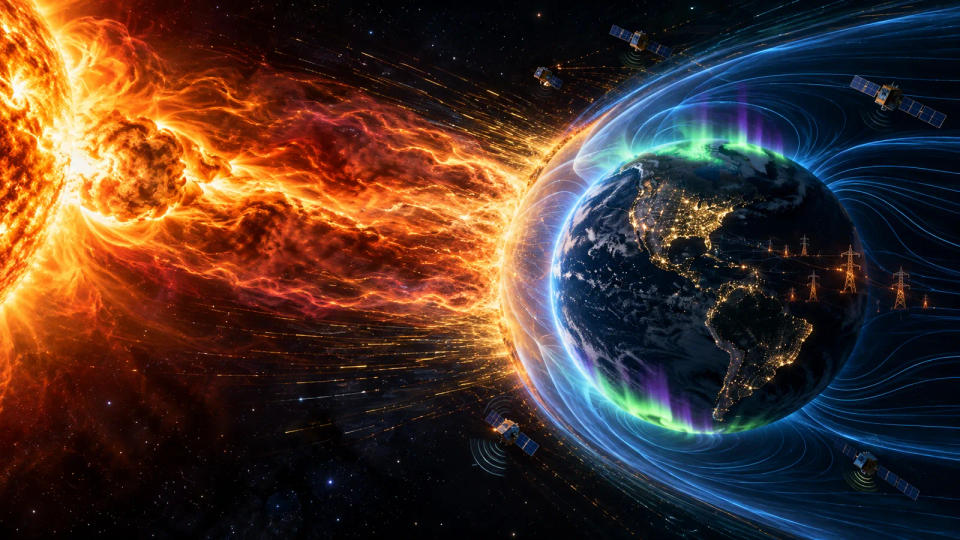
A truly massive solar storm would not “fry the whole planet,” but it could hit the technological systems that depend on long conductors, stable electrical power, satellites, radio links, and precise timing. The power grid is one of the biggest concerns. The internet is more complicated: the glass fibers carrying most data are not directly vulnerable to geomagnetic currents, yet the power systems, network equipment, satellites, and some long-distance cable infrastructure around them can be.
That distinction matters. A severe storm could produce regional blackouts, GPS errors, satellite trouble, radio outages, and disrupted connectivity without creating a single global off-switch for the internet. The exact damage would depend on the storm’s magnetic orientation, how quickly Earth’s magnetic field changes, local geology, grid design, and how operators respond.
How a Solar Storm Turns Into an Earth Problem
The most dangerous ingredient for the power grid is usually a fast, Earth-directed coronal mass ejection, or CME: a huge cloud of magnetized plasma thrown from the Sun. Solar flares can disturb radio communication almost immediately because their X-rays reach Earth at the speed of light. A CME is slower, typically taking many hours to several days to arrive.
When the CME’s magnetic field couples efficiently with Earth’s magnetic field, it can drive a geomagnetic storm. Rapid changes in the magnetic field above Earth induce electric fields in the ground. Those fields, in turn, push geomagnetically induced currents through long conductive systems such as high-voltage transmission lines, pipelines, and other grounded infrastructure.
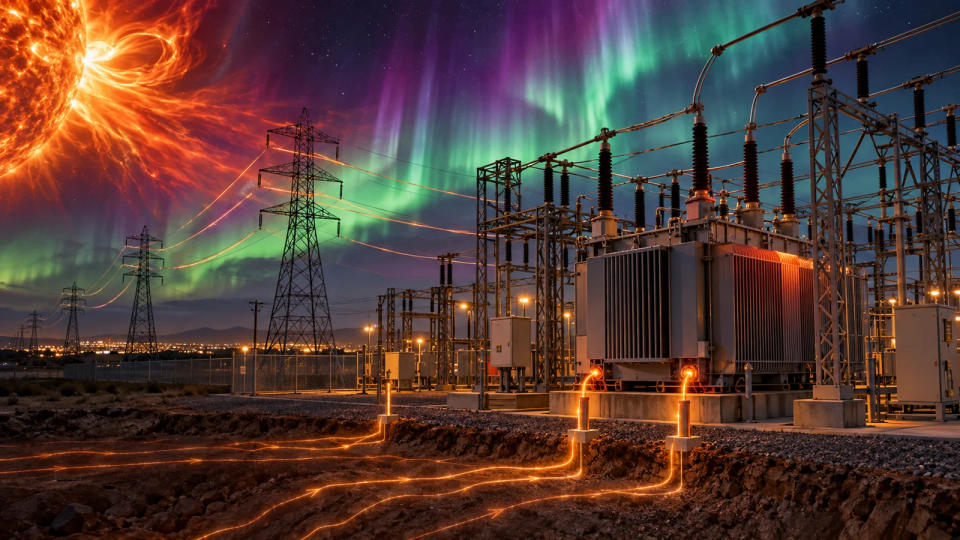
This is why dramatic auroras and grid risk are related. Both are signs that energy from the solar wind is strongly disturbing Earth’s magnetic environment. But an impressive aurora does not automatically mean a blackout is coming; the ground-level electrical effects vary greatly from place to place.
Why Power Grids Are the Most Exposed
Modern transmission grids contain exactly the kind of equipment geomagnetic storms can exploit: very long wires connected to the ground through substations and transformers. The induced current behaves differently from the alternating current the grid is designed to carry. In transformers it can push the magnetic core toward saturation, increase heating, distort voltages, raise reactive-power demand, and cause protective systems to operate.
The result might be nothing more than a manageable grid irregularity. In a worse case, utilities could see voltage instability, transformer damage, cascading line trips, or large blackouts. NOAA’s G5 “Extreme” geomagnetic-storm scale explicitly warns that some grid systems may experience collapse or blackouts and that transformers may be damaged.
History shows the threat is real. In March 1989, a geomagnetic storm contributed to the collapse of Hydro-Québec’s power grid, cutting electricity to more than six million people for about nine hours. Yet storm strength alone does not determine the outcome. The May 2024 event also reached G5, the highest NOAA category, but caused comparatively limited public disruption. That is a useful reminder that “G5” describes the space-weather environment, not a guaranteed level of damage on the ground.
Location also matters. Geoelectric fields can be stronger where the underlying rock is electrically resistive, because the grid may become a more attractive path for current. Long transmission lines at higher geomagnetic latitudes are often watched particularly closely, but severe disturbances can extend much farther toward the equator.
Would the Internet Actually Go Down?
The viral phrase “internet apocalypse” makes the situation sound simpler than it is. Most internet data travels through optical fiber, and the fiber itself is glass. A geomagnetic storm cannot drive a damaging electrical current through the optical strand the way it can through a power line.
But the internet is not just fiber. Routers, data centers, cellular towers, cable landing stations, local access networks, cooling systems, and cloud services all need electricity. A widespread power outage would therefore become an internet outage for many users even if the fiber remained perfectly intact. Backup batteries and generators can bridge short interruptions, but they are not unlimited.
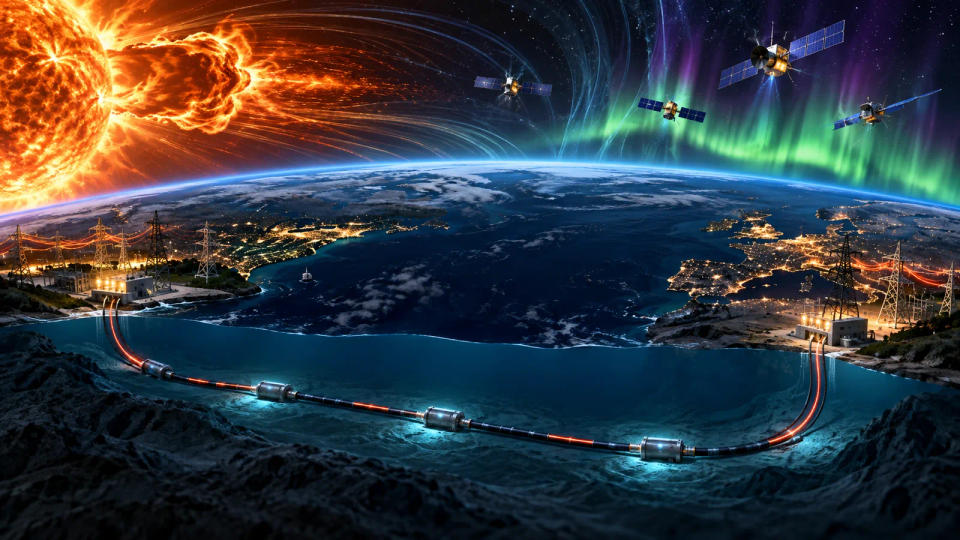
Long submarine cables deserve special attention because their optical repeaters are powered through conductive components that can experience storm-induced voltages. Early research raised concern that a superstorm could disable multiple transoceanic routes. More recent measurements are somewhat reassuring: a 2022 study monitoring four transoceanic cables found clear storm-related voltage changes but concluded that even a Carrington-scale event would not be expected to damage the long-haul cables it studied.
So a severe solar storm could certainly disrupt internet service, especially through power failures and dependent infrastructure. But current evidence does not support treating worldwide destruction of the fiber-optic backbone as an inevitable outcome.
Satellites, GPS, Radio, and Timing Could Fail at the Same Time
The most disruptive scenario is not one broken system; it is several stressed systems at once. Geomagnetic storms can disturb the ionosphere and degrade GPS and other GNSS signals. Solar flares can cause high-frequency radio blackouts on the sunlit side of Earth. Energetic particles can interfere with spacecraft electronics, while heating of the upper atmosphere increases drag on low-Earth-orbit satellites.
That combination matters because modern infrastructure is interconnected. Grid operators use communications and timing. Financial networks depend on data centers and precise clocks. Aviation and shipping use satellite navigation. Emergency services need both power and communications. A solar storm can therefore create cascading operational problems even when no single technology is completely destroyed.
Forecasting and preparation reduce the risk. Space-weather agencies can often see an Earth-directed CME leaving the Sun and provide broad advance warning, while spacecraft near the Sun-Earth L1 point give more precise information about the incoming solar wind shortly before it reaches Earth. Utilities can monitor geomagnetically induced currents, adjust system configuration, reduce stress on vulnerable equipment, and coordinate protective actions. Satellite operators can alter procedures when radiation and charging risks rise.
Scientists are still refining the worst-case limits. In 2026, a NASA-led study reported evidence that the electrical-current response in Earth’s upper atmosphere may not “saturate” as earlier interpretations suggested. The finding does not prove that any particular future storm will cause catastrophic damage, but it reinforces why extreme space weather remains an active engineering and forecasting problem rather than a solved one.
Conclusion: A massive solar storm would be less like a single electromagnetic doomsday pulse and more like a stress test for a highly connected technological civilization. Power grids are the clearest terrestrial vulnerability. Internet service could fail in many places because its supporting infrastructure loses power or communications, while satellites, GPS, and radio systems may degrade at the same time. The good news is that these hazards are monitored, modeled, and planned for—and the internet’s fiber core is more resilient than the most dramatic headlines suggest.
Sources & Further Reading
- NASA Science — Solar Storms and Flares
- NOAA Space Weather Prediction Center — NOAA Space Weather Scales
- NOAA — Strong Geomagnetic Storm Reaches Earth, May 2024
- U.S. Geological Survey — Magnetic Storms and Geoelectric Hazards
- Castellanos et al. — Solar Storms and Submarine Internet Cables
- NASA Science — New Study on Extreme Solar Storm Effects
Post a Comment